
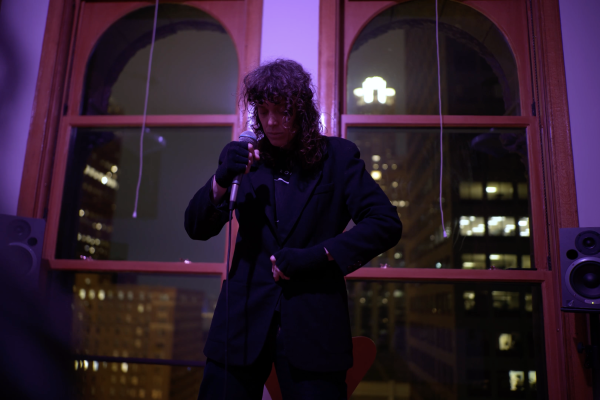

Ka Baird stalks the stage like a phantom: hungry, unsettled, irrepressible. Wielding a microphone and sometimes a flute, they sway and swing at the air, moving with the zeal of a mind possessed. Each gesture accompanies a wave of noise—rattles and thuds that skitter like marbles. They spit, expire, and hiss into the mic, scrape it on the floor, or strike it with their palm. Sometimes they smack the mic down as though spiking noise into the audience, enacting sound’s invisible, unstoppable transmission.
One of the most striking features of Baird’s performances is the expressive potential of breath. They employ a variety of extended vocal techniques—constricted, guttural breaths, sibilant puffs, and wide-mouthed exhales—that adopt different shapes and moods, turning breath’s normally imperceptible presence into something immediate and textured. These shifts of air are picked up by Baird’s processed mic and electronically manipulated, emerging from the speakers amplified, echoed, and augmented with synthesized noises. In some performances the processing is minimal, leaving Baird’s breath exposed as the source of their sounds. In other instances, the electronic noise triggered by their breath and vocals displaces them, casting the mic as a wind instrument that channels air into otherworldly sound. Yet even this noise registers as a continuation of Baird’s breath, magnifying its contours, duration, and force. Over the course of the performance, the audience becomes attuned to breath’s many forms: air sucked in or spit; the sensations of chokes and pants; or the way that voice disturbs air as it emerges from Baird’s mouth.
Breath dances around the outskirts of meaning. It expresses one’s incarnate state and might allude to mood, but refuses to be signified as language. Rather, its presence implies animacy, as the bare outward sign distinguishing a live body from a dead one. In music, breath conventionally operates as substrate rather than substance, marking a vocal pause or respiratory need rather than meaningful sound in its own right. But Baird unsettles this notion through their breath-sounds, which float between noise and its bodily source. They push air through their lungs and shape it as it passes through their mouth, using pure friction to turn breath into something tangible. Here, sound becomes inseparable from its respiratory production, so that when Baird employs vocals and flute melodies, it feels like an extension of rather than a diversion from breath.
David Abram has described air as a “sensuous medium” thick with “invisible but nonetheless tactile, olfactory, and audible influences,” an element that engulfs and thereby links all living beings. Baird’s performances convert the air around us into such a sensory terrain—a conductive substance through which one body can affect and be affected by another. The audience’s physical receptivity sharpens in response to the force of Baird’s gestures and onslaught of noise, our senses reeling at the sight and sounds of an unpredictable body. Their movements move us; their breaths recycle and amplify our own. As the performance progresses, increasing in wildness–spit flying, sweat glinting–it is hard not to notice that the audience shares in the same vivifying substance as Baird. We breathe in what they do, our bodies all permeable to the same invisible, enveloping air.
Throughout a performance, Baird will often change their style of movement. Occasionally, they shift to a more humorous tone. Gesturing in the manner of a clown, their vocalizations turn reedy and playful, gliding up and down the scale like a slide whistle. At other times, they take up the flute as a conduit for breath rather than song, expelling pitched air as they click the metal keys. The effect is an instrument deconstructed into its noise-making parts, the production of breath-sounds collapsing midair into something stranger than music. At one performance I saw, Baird deployed the flute as a prop, gripping it at both ends as though to break it and wielding it like a bat. Another time, their breath work melted into a glowing melody, the notes darting off sideways like deer spooked into the forest.
Like the liminal breath-sound, or the flute reborn as a bludgeon, Baird deploys ordinary activities and objects in ways that transgress their typical use, defamiliarizing what is often taken for granted. In their performances, conventional forms are not really rejected so much as put into flux. In Inarticulation Exercises (2020), a quarantine-era live streamed performance commissioned by The Kitchen, Baird utilizes electronic noise and an assortment of tools–their own scrambled vocals, an electric toothbrush, a recorder, breath, and a mic–to create sound that, as suggested by the title, fails to make meaning. In a series of five-minute segments, seemingly random sounds are paired with curiously insistent gestures: uttering gibberish into the mic, they spread their eyes wide with urgency and wave their hand as though singing or playing an invisible instrument. Some movements, such as when Baird raises two microphones slowly over their head, are carried out with a seriousness that turns silly. But rather than feel alienated by the performance’s absurdity, the viewer is inclined to accept Baird’s invitation to reimagine the relationships between things. Opening ourselves to the performance’s inarticulacy, its rambling and unmooring from meaning, we might also start to become unfixed, to loosen the ways we order and have been ordered by the world.
Why are only certain pairings of movement and sound permitted to make sense, to articulate? Why do some arrangements of noise register as music or speech, but not others? If there is “sense” to be made out of Baird’s performances, then it belongs to the senses—our bodily ways of perceiving and knowing, of coming into contact directly with that which the mind must abstract in understanding. In Baird’s work, I find myself lingering within a state of charmed bewilderment that turns my focus outward to the strangeness of what I hear and see around me. Their erratic use of sound and movement encourages the senses to fuse in a surreal manner, situating the audience in the discordant gaps between one’s mental expectations of things and embodied experience. These disorienting effects might have an affinity with what Jack Halberstam calls the “wild,” a plane for all things that evade classification and remain epistemologically unfixed, existing “outside of an orderly and inevitable scheme of life.”
Baird’s return to a breathing, animal body may be wild in both its physical unrestraint and its estrangement from convention. It is also, perhaps, wild in its invocation of a power that sits beyond the horizon of perception. There are many such forces at play in Baird’s performance: air, the invisible substance which supports our animacy and sound’s dispersion; and breath, a movement so quiet and pervasive that it often escapes attention. At times, there is also some third, undivine, and unnamed thing that seems to yoke together all living beings, holding open the possibility of feeling and communing with others. Sometimes, in the churning ecstasy of Baird’s movements and breaths, a binding presence stirs, made immediate and alive, pulsing like a mystery–then it dissolves, slipping back into the world unseen.
Leave a Reply