
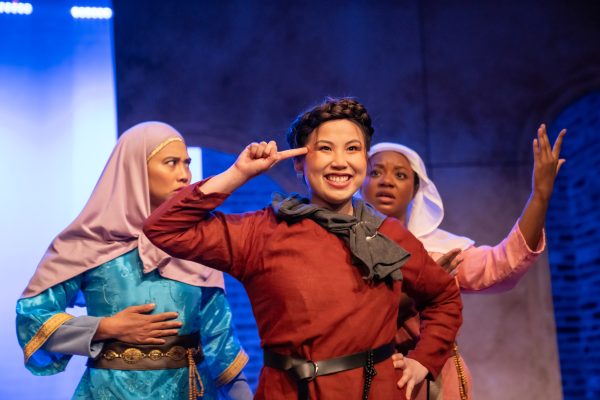
Recently, the playwright Diana Ly and I spoke about her philosophical, funny, tender, deeply felt, “medieval miniature” (Helen Shaw, The New Yorker) play Sex and the Abbey, which runs at The Brick through September 7th. Directed by Emily Lyon and produced by The Brick, The Omnivores, and The Sống Collective in association with Wiley Water Productions, Sex and the Abbey is believed to be the first New York City production of a play by a female Việt playwright.
Ly is a Vietnamese-American playwright and screenwriter who grew up in the Philippines. She studied computer science at Stanford and received her MFA in Playwriting at Hunter College.
Sex and the Abbey is inspired by (and directly includes) the work of Hrotsvit, a 10th century canoness who is the earliest known woman playwright. Taking place over the course of one day, several young canonesses living in Gandersheim Abbey prepare for a performance of Hrotsvit’s play Callimachus that they will do in front of Emperor Otto the Great–who will then settle a dispute over whether Gandersheim will remain run by women, or be taken over by the nearby monastery.
On a cozy Saturday morning Zoom, Ly and I discussed the origins and process of Sex and the Abbey and the struggles and rewards of producing work New York City in 2024. Ly’s intelligence and warmth are immediately visible, both in her writing and in her personality. “I feel a very deep obligation to an audience’s attention and entertainment,” she told me. I felt this care in Sex and the Abbey’s propulsion, its compassion, its humor, its elegance. I left our conversation inspired to revisit some plays from my college theater history class, to see what they could teach me about transgression and creativity within restrained containers.
This interview has been edited and condensed for clarity.

Kallan Dana: Tell me about the origin of Sex and the Abbey.
Diana Ly: I started writing this in my first year at Hunter, in theater history class. We could write a play instead of a research paper, but we still had to do the research. I did a lot of research. I was responding to Hrotsvit’s preface to her plays and letter to her patrons, which are relatively famous, and it’s basically Hrotsvit being relatively cheeky. I found out that there were no records of her work being performed in her time. But when I learned about the abbeys, I thought: there’s no way these women didn’t put on these plays. At the time, [the abbeys] were these havens for women; it was this network of places for women to be, and to be educated, and to have community. I felt like the women would have done something [with these plays]. I decided that the abbey was where the cool women of that time were hanging out. That’s why there’s that playful nod to Sex and the City [in the title]: this is four cool women, hanging out.
KD: I love what you said about finding a cheekiness in Hrotsvit’s voice in her writing about her work. I wonder if she was trying to write something somewhat transgressive inside of the religious container that she existed in.
DL: I think that women from different time periods are always more modern than we think they are. We often cast them in a more conservative light (which is often defined and documented by the patriarchy), so I think it’s interesting to imagine that this woman from 968 is actually modern in her way of talking and thinking. I really tried to infuse all my characters with that.
KD: How did the direct address element of the piece come into being? Was that at all inspired by Carrie’s voiceover in Sex and the City?
DL: The direct address is absolutely connected to Sex and the City! Early on in the writing process, the characters’ direct address monologues were a way in for me. I didn’t know exactly how the characters were going to talk, but I knew that there were going to be Latin prayers inside of the play. The direct address felt like a way to give us a break from the prayer. I always wanted the monologues to help make the world of the play more playful and accessible, and allow the characters to say things to us that they would never say to each other.
KD: How did you decide how similar or dissimilar the language in the play would be to how we speak today?
DL: I’ve given all the women modern cadence and used words that they wouldn’t have had access to (obviously they were using a different language anyway), but there aren’t any anachronisms that are calling attention to themselves in the play. The characters speak in a modern way that we can understand but they aren’t, like, mentioning Beyoncé. I was very inspired by Branden Jacobs-Jenkins’s stage direction in An Octoroon where he says: “I don’t know what a real slave sounded like. And neither do you.” And there is very little record-keeping about the women who lived in these abbeys. There is very little known about their lives.
KD: This is making me think about Saidiya Hartman’s “critical fabulation” work—the combined use of research, storytelling, and theory to fill in omissions of marginalized peoples from the historical record.
DL: Yes, I remember reading something Saidiya Hartman wrote and feeling like it connected to what I’m trying to do in my own writing projects—imagining the lives of real people where we know very little of their actual inner lives. I believe that [the women in my play] would have been frustrated about just being married off to somebody, but I also understand that they did not have the same view of society that we do now. An example of something real in the play that I believe Hrotsvit was a proponent of is this idea of chastity within marriage.
KD: The concept of observing chastity within marriage operates as this potentially radical act inside of Sex and the Abbey. We’re invited to read it as a way women can maintain their autonomy inside of a marriage they otherwise have no say in.
DL: In some ways it’s like using religious trappings to preserve some part of yourself, even if you’ve been sold into this marriage.
KD: Can you talk to me about the metatheatrical elements of the play? It’s very endearing to watch the characters be excited to put on a performance.
DL: I love plays within plays. I’ve written three plays about people putting on plays. I really enjoy playmaking as escapism and I really enjoy playmaking as art reflecting our lives back to us. Another inspiration for my writing is Jackie Sibblies Drury’s We Are Proud to Present…She does an incredible job of showing characters trying to make a play, talking about what it means, and being frustrated by it. I really tried to show the play-within-a-play of Sex and the Abbey as being in progress. This is a play that Hrotsvit is still writing. She hasn’t decided the ending of it yet; they could still change it. A big element of my play ended up being about teachers and students. How does one’s early access to theater and imagination affect how you view your whole life?
KD: I love the stylistic change of the representation of the play-within-the-play. We see their performance in what you describe as “freeze frames” in your stage directions.
DL: At that point in the play, we’ve heard language from Hrotsvit’s play [Callimachus, which was posthumously named after its male character by male scholars] so I didn’t feel like we needed to hear any more of the language. Charlotte Bydwell, our movement director, added a little bit of movement to each “freeze” to turn it more active. It’s exciting because the play changes modes; it’s an infusion of a different energy.
KD: How did you and Emily Lyon, the director, begin working together?
DL: Emily and I met through mutual friends and discovered that we were both very into dead female playwrights. Emily runs Expand the Canon, so she was obviously very aware of Hrotsvit. It was exciting for us to collaborate. The first development opportunity we had was a two-day reading that Laguardia Performing Arts Center [LPAC] and The Brick had curated for Rough Draft Festival in March 2023. At the time it felt very exploratory, and [our collaboration] grew from there because we were given other opportunities.
KD: And how did your other collaborators come on board?
DL: It’s been an incredible process with an incredible group of artists putting their efforts into cohering this production. It was a deep focus of mine to hire femme or nonbinary collaborators for this project.
KD: That makes so much sense, especially with this project.
DL: It involved this network of recommendations. Someone would recommend a designer to me and I would ask that designer “if you can’t do this, who else can you recommend to me?” As you well know, it takes a village to make a production. The Brick programed it from that first reading and LPAC gave us a longer workshop to develop it in October 2023, knowing that we were going to be doing it at The Brick. Handan Ozbilgin [Artistic Director of LPAC] and Theresa Bucheister [former Artistic Director of The Brick] were really thoughtful about how to support us if we really believe in a project, we want to help it find a route to get a future production. Having the Sống Collective come on to co-produce with me was really important. I had been in their Việt Writer’s Lab and they came on board because they believed in my vision.
You do need lots of different producing partners to produce a play in New York City. It is a connection of communities ultimately. A lot of New York theater is theater people going to each other’s work and supporting one another. Theresa believed in this play very early on and they stuck around in New York long enough to see the production they programmed and to help get my career off the ground before they move on to the next chapter of their life. Theater is really a network of communities of people who support each other and believe in each other.
Sex and the Abbey runs now through September 7th at The Brick.
Production information is below.
The Brick presents
Sex and the Abbey
Written By: Diana Ly
Directed By: Emily Lyon
August 22 through September 7, 2024
at The Brick Theater — 579 Metropolitan Ave
Tickets $25-50
The Abbey is in trouble – and only Hrotsvit’s play can save them! The canonesses need to impress Emperor Otto (who is visiting tonight!) with a performance… by Hrotsvit, the first western woman who ever dared to write a play. Embroiled in lustful conflicts, the stress of daily prayers, and impassioned moral arguments, can these women save Gandersheim Abbey from male takeover? Find out in this hot goss from 10th Century Saxony!
Production Manager: Madelyn Wiley
Stage Manager: Laia Comas
Assistant Stage Manager: Sam Kersnick
Costume Designer: Saawan Tiwari
Projections Designer: Cinthia Chen
Scenic Designer: Kim Zhou
Lighting Designer: Yang Yu
Sound Designer: Chiara Pizzirusso
Movement Director: Charlotte Bydwell
Dramaturg: Christine Scarfuto
Actors
Hrotsvit: Jen Anaya
Adelheid: Francesca Fernandez
Hadwig: Belle Le
Mathilda: Tia Cassmira
Special thanks:
Produced by The Omnivores @omnivoresnyc and The Sống Collective @thesongcollective in association with Wiley Water Productions @wileywaterproductions
Sex and the Abbey is powered by the Producer Hub
Running time: 65 minutes
Leave a Reply