

In the dark, anticipatory hush after the house lights go down, five male performers enter the stage at New York Live Arts and sit in a circle – an ancient configuration for ritual and the primary form for choreographer Ismaël Mouaraki’s Le sacre de Lila.
The performance, presented in partnership with L’Alliance New York’s Crossing The Line Festival, refers to a sacred rite of lila (which means “night” in Arabic), a North African trance ceremony involving singing and dancing. The mystical healing ritual typically starts at sunset and ends at sunrise, a cycle of time repeatedly reflected on stage as the lighting shifts several times, from dim to bright and back again.
Through fog cut with green light, another male dancer enters, orbits the group and then stops. He passes through to the center holding what seems like a long commanding stick, and with it starts to draw an enormous white chalk spiral across the entire stage floor. One by one, the other performers rise and hypnotically pour royal blue sand along the spiral as the sounds of a billowy wind build, creating a sense of reverence.
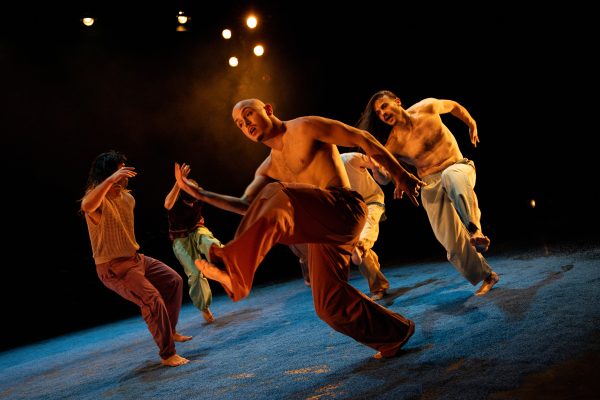
Then, suddenly, the dancers break the spell, diving and somersaulting into the sand to destroy the blue swirl they just created. The pace quickens and the soundscape changes to Gnawa music, a genre inspired by Sufism and African folk traditions. (The music can be traced back to the Gnawa people’s history of enslavement and liberation.)
Some sort of liberation does feel palpable as over the next hour, the dancers produce a series of energetic waves in which music and movement alternately accelerate and wind down: through this action, the performance opens a portal to pure rapture and ecstasy as each individual reaches an astonishing intensity.
“I was born into a culture where dance is spiritual,” said Mouraki in a recent interview with NYLA artistic director Bill T. Jones. “I don’t believe in God. I believe in the spirituality of the body.”
Indeed, it looks like the dancers are reaching an altered state of consciousness as each takes a turn rotating into a spotlight and executing moves associated with ballet, hip hop, and contemporary dance. Only their common costumes – loose pants, sleeveless tops, bare feet – bind them together. Otherwise, each appears to be transfixed within his own world.
Then, through quickened breathing, chanting, and repeating rhythmic music of increasing magnitude, everyone seems to undergo a transformation into a communal joy: the men shake together in unison. The lighting brightens as if dawn is breaking and the first portion of the lila ritual has been completed.
Under the lights, the bright hues of their individual costumes become visible – terracotta reds, golden yellows, and earthy green that reflect the vibrancy of Mouraki’s Moroccan homeland. Holding one other’s shoulders while standing in a straight line, the dancers slowly rotate like the hands of a clock making a complete revolution.
The ritualistic performance repeats itself again and again, though eventually it’s not clear what – the enchanting music or technicolor lighting– is guiding whom. That’s not to say the show is chaotic; instead, the performers appear to pursue a common goal, where swells of exalted energy give way to emancipation of the self.
“As [the performers] move more and more and fall into a trance, it opens them up into the spirits,” explained Mouraki in a Q&A after the show. “And it’s at that moment where they connect with those spirits that the possibility for healing becomes one.”
By the end of at least four cycles of the trance, the six men collapse, catching their breath and pairing off into coupled sensual embraces. The duos’ bodies contort and merge through a sort of contact improvisation, a display – or perhaps declaration – of tender, brotherly love that transcends eroticism.
Atmospheric music sets in again to create a soundscape that evokes nature. Ultimately, the dancers retreat to the positions they started in, seated in a circle in darkness, only now harmonious with each other.
In a traditional lila, dance is not merely a series of movements, but an ascension into a higher state of being, where music is a potion and dance is the remedy to whatever affliction the participant is suffering from. From the expression of utter bliss the dancers wear – and my own sense of awe – the same feels true in this reinterpretation.

Leave a Reply