
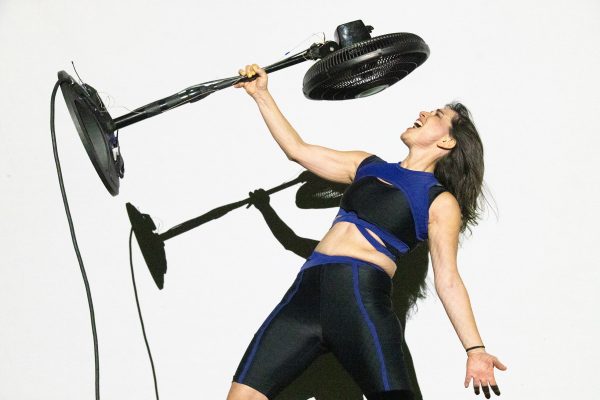
A few weeks ago I got a gig working the book table at BODY/SHADOW, a Douglas Dunn + Dancers performance at Judson Church.
In preparation I perused the books– all penned by Dunn– for sale. One in particular caught my eye; a small black book titled Aidos. I flipped to a random page:
“Shame at the desire to be different; shame for any day I don’t strive for excellence.”
“Shame to dance; shame to be still.”
“Shame that only understatement takes my breath away.”
I flipped to another:
“Shame to behave as if the disintegrative body could personify the infinite luminescence of mind; shame . . . I forgot . .. they’re inseparable.”
“Shame at presenting dances I love rather than dances everyone might love; shame at positing an “everyone,” and to boot charging her with paucity of curiosity.”
I liked the parallel construction of the sentences: the both/and quality of each admission; that is until the book, and my being, started to feel heavy.
Shame is interesting. It’s cathartic in the way that Reddit is. Admissions of guilt become smaller and less weighty when shared. But it’s also navel-gazey and dead-ended. That’s why, when I saw Argentine duo Micaela Fariña and Gonzalo Quintana’s La consagración de nadie (Unsuccessful) at La MaMa a week later, I was relieved. For a play dealing with failure, shame was largely absent. Micaela Fariña and Gonzalo Quintana have been making theater together for over 10 years. Their works explore, among many things, the “musical treatment of bodies in space”. Unsuccessful, their latest operatic play, is no exception.

Unsuccessful begins without us; us being the thirty some theatergoers gathered at the entrance to La MaMa’s black box theater. “Quietly take your seats, the show has already begun,” advised an usher— inside, Fariña is already busy at work blowing in and out of blue balloons which she ties up and scatters across the floor. Behind her, a projector displays a google search which I scribble down in the half-dark: “Como aumentar mi capacidad respiratoria?”// “How to increase my breathing?”

Part mockingly-how-to, part archival, part expository, Unsuccessful is a playful look at outsized ambition and frustrated dreams. It’s about arrival, and the ‘failure’ to arrive. Mostly it is about passion. Fariña stars as herself in this one-woman play, the multi-hyphenate Micaela Fariña: opera aficionado-actress-director-playwright-singer. The germ of this piece rests in 1989, the year of Fariña’s first ever performance. Culled archival footage– the piece opens with her family’s first ever home video, in which Fariña sings at length, her father unable to divert her attention– and projected Google searches, are supplemented by Fariña’s real-time articulation of the archival footage: “Here I am in 1989!” she exclaims to us. A wobbly recording of a bowl-cut wearing Fariña appears on the projector. She sings her heart out as the present-day singer looks lovingly up at her younger self.
What follows is a condensed personal history told through archival footage, anecdotes, and song.
We learn of Fariña’s move to Verona and watch a recording of her singing to a group of unenthused elders, including a video of a particularly funny performance where a pianist loses their sheet music. In it, a twenty-something-year-old Fariña tries to maintain her composure. Contrasted with these ill-fated home videos are performances by the present-day Fariña. I was excited by her vocal dexterity, and, after one climactic scene in which she imitated different bird calls, was left wanting more.
What I especially love about Unsuccessful is how many entry points were offered up for audience participation. Throughout the play, Fariña calls on the audience for applause, which comes in peppered, unsure bursts. At other points the audience is invited to laugh with Fariña, acknowledging, as she does, how fraught her various efforts were. We are alternately encouraged to meditate on the devastation of a frustrated dream as Fariña looks out at the audience in consternation. Our orientation to the piece, and the archival footage, is indubitably informed by our position to Fariña; we are only let in as much as she wants. The piece feels astonishingly personal while operating, simultaneously, at an emotional remove.
I don’t sense that Fariña is reckoning in real-time– or for that matter the first time– with her actual or perceived ‘failures’. While I don’t doubt that shame or disappointment at one point featured heavily in her personal narrative, what is left out of Fariña’s ‘condensed history’, emotionally or otherwise, can be implied by way of the universal. She doesn’t give space to the full spectrum of emotions regarding her ‘failure’ in becoming a successful opera singer. We are instead left to infer the ‘missing parts’, which is done via self-insertion. While Unsuccessful leaves room for inquiry, I found it refreshing to sit with something so settled. Fariña not only details her life story but tells us what she thinks of it too.
In this sense, Unsuccessful is not interpretative so much as reflective, serving as a mirror to see one’s own ambitions, failures, and successes. At one point Fariña asks in desperation, “Why do I like this!?” I couldn’t help but recall the many times I, facing my own artistic hurdles, asked the same thing. While it’s easy to project one’s own personal journey, ambitions, etc., onto the piece, it is equally easy to be with Fariña, invited– as we are– to navigate her oscillating emotions as she (retrospectively) details them.
I jot down ‘Tolentino’ in the dark as she talks about visiting her six times removed maternal grandfather’s grave in Tolentino, Italy. It is from him that she was able to get Italian citizenship. In Fariña’s desire to legitimize her connection to the art form– to establish a lineage, artistic or ancestral, in which she can locate herself– I see myself. I reflect on the perfectly twenty-somethingness of it all when a suggestive email exchange between Fariña and a mentor is projected onto the wall behind her. Fariña reads the exchange aloud with increasing speed and intensity. “I especially like you in black…” her mentor writes, as she deliberates over what to wear for an upcoming performance. A shaky recording shows how the lights cut out not a minute into said performance, obscuring her meticulously planned outfit. A peal of laughter ripples through the audience.
The varied uses of archival documents (home videos, photographs, correspondence, anecdotes) correspond to the tonal variance of the piece itself. Where archival footage is at times used to invoke humor, it is elsewhere used to establish a throughline of self-seriousness. This is perhaps the most real aspect of the auto-biographical play; it is simultaneously self-effacing and sincere, able to address both in tone and medium the myriad orientations one might have to their own personal journey.
At the crux of Farina’s articulation of ‘failure’ is an approximation of the desire for fullness—- the propulsive energy of wanting as more fulfilling than execution, or arrival itself: what it means to forefront passion. And yet, Unsuccessful is a play about arrival all the same. We sense it in Fariña’s ability to take stock of her journey thus far; to find humor in self-criticism, and express fervor for her art form: a truth that surpasses all outcomes. We might more aptly describe the play as a kind of return. Towards the end, an exhausted Fariña says at last, “This was and is me”. It somehow comes, within a singular breath, as both a non-exhaustive and conclusive sigh of relief.

Leave a Reply