
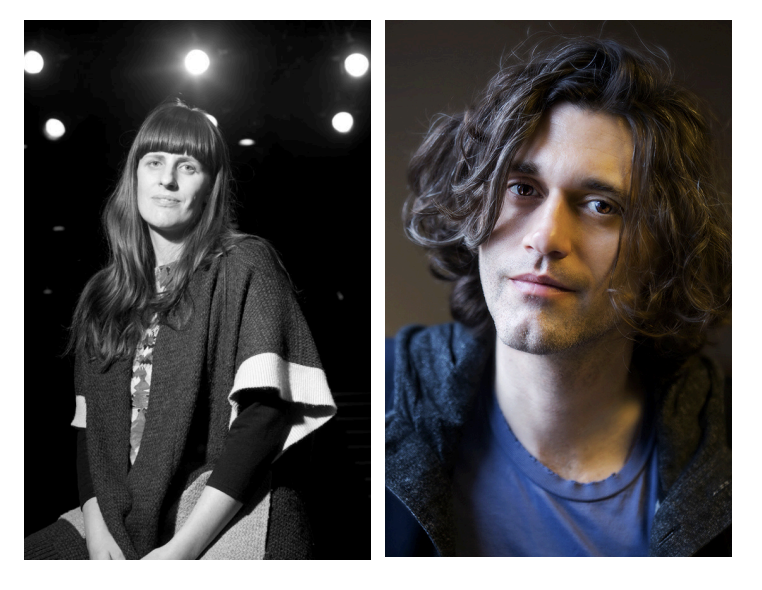
We go to the theater to be tricked, to spend an evening denying our daily struggles and investing in our false reality of choice. An audience would be an easy mark for Tartuffe.
Lucas Hnath’s new adaptation of Molière’s farce, directed by Sarah Benson at New York Theater Workshop, complicates the notion of theater as escape by deploying recognizable faces whose personas exist alongside their characters rather than disappearing into them. Matthew Broderick plays Matthew Broderick as Tartuffe. As Madame Pernelle, Bianca Del Rio dons her signature beat. In a set resembling a tennis court, Orgon, Elmire, et al. bounce accusations and confessions back and forth, fighting for their version of truth.
At the heart of Tartuffe is a question of credibility. Whom do we believe and why? This question is as relevant today, to our divided, bewildering nation, as it was in seventeenth-century France. Hnath and Benson’s production suggests that we are most likely to believe people who are familiar to us, perhaps even the people we see on TV.
If that sounds like a Trump invocation, it’s because it is, though Benson and Hnath are quick to rebuke that analogy. Their Tartuffe isn’t about America today; America just happens to be following a familiar script, that’s all.
Earlier this month, I spoke with Sarah Benson and Lucas Hnath about the new adaptation, their casting process, and why audiences love a scam.
This interview has been edited for length and clarity.
Annie Rasiel: Tell me about the tennis motif.
Sarah Benson: During the process of researching the play, I came across this piece of research about how Molière’s company, The Illustre Théâtre, performed in tennis courts. This was a practice that several companies did, but his company performed in tennis courts often. I was fascinated by bringing forth that question of play, of the game, and the idea of verbal volleys–which has always felt very present to me in Lucas’s plays–and so this felt like an exciting, charged space to bring into our production. It’s a space for a game.
AR: What are the stakes of that game?
SB: People are fighting to be believed and to be right, and for people to like them, for them to get what they need. It’s about people fighting to be truly believed and heard.
AR: As you approached this adaptation, what aspects of the original play felt non-negotiable, and what aspects did you want to rethink?
Lucas Hnath: This was a question very early on. The basic structure is in place. I explored many options for how loose we wanted the adaptation to be or how much to adhere to Molière’s text. At some point we even talked about whether it needed to remain a period piece. There are certain plot elements that are very specific to the period, the main one being the marriage plot, which don’t make sense in contemporary terms. That is a cornerstone of the play’s dramatic engine. If the marriage plot had changed, then it would have been a fundamentally different play. Then I wondered why I wasn’t just writing my own play. So, the objective was just to try to see the whole play.
I worked from a literal translation. I found a text that simply did the work of trying to explain what the words in French mean. That’s it. No attempt to convert it into verse or rhyme anything. From there, I tried to write the play in my own words. That was the first pass, just going through the translation and trying to parse it as best I could in my own language. It evolved from there. If there was a decision that I couldn’t understand a character making, then my objective was to try to understand why the character was making that decision and to make it feel as necessary as possible. There are points where I diverged from what Molière wrote in my attempt to understand the characters’ choices. Along the way I crafted the verse. Accidents would happen; I would find certain rhymes that would take the line in a different direction than what Molière wrote, but I would just run with that.
AR: Is there a specific moment that comes to mind where you had trouble understanding why a character made a certain decision, or you felt you had to justify it in the text?
LH: I never thought I needed to justify anything in the text. That would imply that the text is explaining it. I would think of it in terms of difficulty. If something was coming too easily, then I let it be difficult. One example of a place where I departed a bit is in Orgon’s decision to believe Elmire. It’s slower. He begins to believe her in stages.
In the original, Orgon’s mother, Madame Pernelle, also comes around in the final act and realizes that Tartuffe is a fraud. I saw no good reason for her to agree. I didn’t think anything was going to change her mind. It was more interesting to me for her to stand her ground and then, curiously, Cléante and Pernelle find themselves agreeing in the last page or two of the play.
SB: We also talked so much early on about Orgon’s susceptibility. That had always been somewhat of a head-scratcher. What makes him open to this scam emotionally? What is the portal to susceptibility? Lucas pulled out this compounded grief Orgon experienced over losing his father and his wife and what that opened up in him. That rings really true, I think, in terms of someone being open to anything to make them feel whole again, to make them feel better, you know? Things like that made the play much stronger emotionally for a contemporary audience.
We had a radical commitment to making this play work today and be funny today. Obviously, there’s so much political resonance with the text–we’ve heard so many amazing, divergent responses in terms of how the piece speaks to today’s slippery political reality–but we didn’t want to play into that too much.
AR: You have an extraordinary cast, including people we aren’t necessarily used to seeing off-Broadway. Can you talk about how the ensemble came together?
SB: Early on, we were constantly asking ourselves, how do we make this text really, really funny? My experience of Molière in the past had been mixed. I would read the plays and find them so funny, but in production it often felt sort of staid and distant. So we started talking about the actors we’re obsessed with. David Cross and Ike Ufomadu came up in terms of comedians. Lucas and I are both interested in the kind of comedy that’s surprising, in actors who can hit comedy in an unexpected way, which brought us to people like Ike and David, but also Emily Davis and Ryan Haddad, who are incredibly, brilliantly funny.
We talked a lot about the character of Tartuffe and the various versions of what he could be, including the vampiric, overtly villainous sort of Tartuffe. Then Lucas brought in the idea of Matthew [Broderick], and I thought it was such an inspired thought. Matthew has this relaxed, easy breezy energy, which rings very true in terms of how scams and cons really happen.
Bianca Del Rio was also someone that Lucas was really excited about, and I’m obsessed with Roy and Bianca [Bianca Del Rio is the drag persona of performer Roy Haylock]. Madame Pernelle was originally written as a drag role, as all the older roles were at the time. We became interested in that layer of performance, which is part of performance history and feels right in terms of how she’s functioning as a bookend in the play. She’s this comic envelope. She tells you how to see the play and then tells you what you’ve just seen. We were really interested in how Bianca would cut through all of that.
We talk so much about how Elmire is this “straight” character, in that she doesn’t have much overt comedy, but we’re also seeing the emotional chaos of the play through her eyes. Amber [Gray] is someone that I had history with. She was in An Octoroon, and we’d been wanting to work together again. She’s just so spectacular and brilliantly precise textually, but also brings layers of sentiment and depth and surprise as well.
I could sing an aria about each of these actors. It’s been a phenomenal company to work with. They’re folks that come from a range of performance traditions, but there’s actually a lot of commonality in the group that we found in the rehearsal room.
AR: I read that you were casting while you were writing. Can you talk about how casting shaped the writing?
LH: More often than not the writing shaped the casting. I was trying to find an entry point into the sensibility of this Tartuffe. I had watched a fair number of archival videos where I found the take on Tartuffe, on his whole act, effortful. It didn’t seem necessary for what Molière had written, and it didn’t seem particularly true to now. I found a kind of touchstone in the work of Wallace Shawn, and I had seen Matthew do brilliant work with Wally’s text. So when I wrote, I would do my version of Matthew. I would try to impersonate him.
I also found myself very stumped by Valère, because I could see lots of uninteresting takes on this eager, impetuous young lover character. Once Sarah mentioned Ike, I watched his stand-up and started writing the verse in his cadence long before we ever talked to him. Many of the casting ideas came out of whatever seemed to scan well with the text.
AR: Is that process–casting in your head and then writing in that performer’s voice–something you had done before?
LH: All the time. I had been secretly working with Deirdre O’Connell probably for 20 years before we ever worked together. I told her, “I’ve been doing your voice at home a lot.” She’s actually been the basis for several of my plays, long before we ever got to work together. She’s the original Hillary!
AR: That makes sense! I can see that. Can we talk more about Bianca Del Rio? I’m really interested in the choice to cast an established character like Bianca Del Rio as Madame Pernelle. You credit Bianca, the persona, not Roy Haylock. How are you playing with identity and performance here?
LH: This was something that we explicitly talked about during casting. We were resistant to the idea of bringing in performers for this role who would craft a fully separate identity from themselves. We wanted the line between performer and character to be a little thin–which relates very directly to what I was doing at home, writing in the voice of different actors. We were very interested in people’s actual voices, sometimes literally the sounds of their voices. With Bianca, that first scene is tricky because it almost exclusively exists to serve as exposition. It is a massive exposition dump right at the top of the play, and you’re getting hit with all of these character descriptions and names. My reference point, my entrance into the scene, was that it had to be a roast. Bianca goes down the line and just reads everybody. I never thought in a million years we would actually get Bianca, but I found it very useful to write in her voice, to play on this existing character that we all know.
Trust is really valuable in comedy. When you know some of the people on stage, you feel safe with them. You have a reference point for understanding what they’re bringing to the table that actually facilitates some of the comedy.
AR: You have an established shorthand with them.
LH: Yes, in the same way that people would use stock characters in these plays.
SB: It’s like how commedia characters function, a bridge to understanding. Today, people live in popular culture; we have a sort of intimacy with cultural figures. I’m always interested in character and person coexisting, which drag does in a really profound way. That was something that really came to the fore here, folks who could hold both. This is one of the reasons I was so excited about Matthew. He can hold two truths at the same time. There’s something here about people not using character as mask, but rather standing beside their characters.
AR: I want to talk more about the character Tartuffe. I know that you were writing him as Matthew from very early on. How much of the role did you develop in collaboration with Matthew?
LH: By the time Matthew came in, it was a completed draft.
SB: He was as excited about the idea as we were. A lot of the physical life we found together in rehearsal. This was a very generative group. Matthew found a lot of idiosyncratic, brilliant moments in the room that informed how Tartuffe watches. Matthew discovered that he is always watching them and looking for those gaps and vulnerabilities. That was amazing to witness, to see him as an actor watching the room, watching their dynamics, studying them. It was thrilling to see. That was a surprise for me, just how much he’s watching. You know, he’s in all these crazy situations where you’re like, how’s he gonna get out of this one? How’s he gonna get out of that one? He’s continually got his back against the wall. But Matthew never plays it like that. He is always watching. He’s a true opportunist, looking for the next possibility. Matthew magnifies the audience’s ability to see those moments without playing Tartuffe as a villain.
LH: That was exciting to discover.
AR: I know that you have really resisted the one-to-one Trump Tartuffe comparison. Can you talk about what nuances you think that analogy misses?
SB: The impulse to do the play came out of social situations–which are often reflected in public situations–where people were openly lying and being emboldened by others, and reality itself felt slippery. I began to be fascinated by what people actually believed. It was strange and unsettling for me. Obviously that behavior is happening in part because of the civic, public, political life that we’re all living inside of. This work comes out of those feelings. I wanted to dig into that situation and understand it better.
If the play becomes about Trump being Tartuffe, I think it’s less possible for people to see how it resonates for them personally and to actually care about the characters. The play becomes a mapping exercise that people can put in a glass box, and be like, Oh, that’s evil. Evil Tartuffe. Evil Trump. And then we can all feel better about ourselves.
We tried to use the play as a site to excavate what is underneath that, how issues of manipulation and belief show up in a multitude of situations. I’m always more interested in the marvel of the feedback loop that happens in the theater, this open frame environment where everyone’s having their own experience of the material–how amazing is that? I never want to overdetermine that by telling people what the play is, quote, unquote “about.” I would rather use the material as a sort of intervention or destabilizing force.
AR: It can be very limiting to have one concrete analysis.
SB: We also see that the literal history of the show is Molière wrestling with political authority. That’s in the text. We wanted to trust the play and to see what it would be to bring that to life. The text has one of the craziest textual births of any classical play. It has such a dramatic history around state power and wrestling with political authority. We wanted to trust what it would be to bring that to life and to light today, hundreds of years later.
AR: I love scammers. Based on the glut of podcasts and documentaries and TV shows about scammers and scams, I don’t think I’m alone in that fascination. What do you think that’s about? Why are audiences so drawn to characters like Tartuffe?
LH: I have a suspicion. It goes back to one of the reasons that I’m wary of the Trump/Tartuffe comparison. The first is that it doesn’t match the given circumstances of the play. The other reason is that, despite the title, the more important character in the play is Orgon. He actually has the most power. Tartuffe is a pretty powerless person; he comes in without many resources.
I think people are interested in scams for the same reason they are interested in magic tricks and how magic tricks work. There’s something about a scam that–when you understand it, when you see its mechanism–tells you something about how our minds work. Magic tricks rely on glitches in the way that we see. When you learn how they work, you see those glitches. Scams reveal something about human nature. They tap into schadenfreude for some people, and there’s a naughty bit of intrigue, of this is how you can control a person.
I was looking at something online today, and I saw that Dale Carnegie book, How to Win Friends and Influence People, and I thought, that’s just mind control, isn’t it? That’s secretly what that’s about.
AR: It was Charles Manson’s favorite book!
LH: It’s about controlling other people. There’s a kind of fascination, because it helps us see something about who we are and how we operate. And I think there’s a little bit of something people get from watching a scam go down. There’s a kind of fantasy that’s being indulged there. So I think it has something to do with that.
SB: A scam is such a concentrated way of looking at why people do what they do, which is also always the question we’re always studying in the theater–What moves people to behaviors? No one really can be persuaded of anything; it’s just what makes someone open to an idea. That’s the question of Tartuffe. What makes Orgon open to this? It’s a theater question.
Photos by Pavel Antonov and Rebecca Martinez.
Leave a Reply