

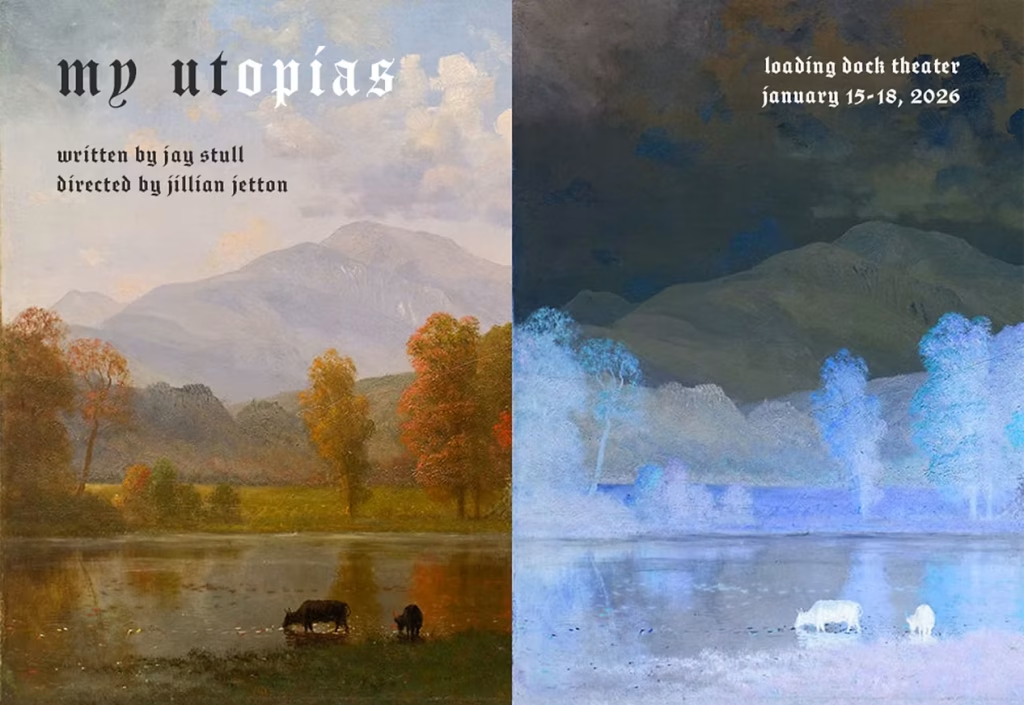
One of the joys of festival season is not just seeing new ways of making theater onstage, but offstage as well. As part of the production of Jay Stull’s my utopias, which ran at Loading Dock as part of Exponential Festival, tickets were on a sliding scale from free to $50, and each performance ended with a potluck sourced from both the production and the audience. In the vein of similar experiments of budget transparency from organizations like Soho Rep, I sat down with the creative team Jay Stull (playwright), Jillian Jetton (director), and Emily Abrams (producer) to get a peek behind the scenes at just one of the ways independent downtown theater is produced in 2026. Before speaking, Emily sent over the budget outline for my utopias:
Creative + Production Personnel: $15,450
Actors (7 actors): $18,525
Materials: $3,850
TOTAL: $37,825
my utopias ran for 5 performances from Jan 15-18.
Ethan Karas: You sent over the budget last night, and one of the biggest things that sticks out to me is that about 90% of the budget is on personnel. How does that break down?
Jillian Jetton: Theater is about people. You need lots and lots and lots of people to make good theater, and I think that paying people well is always the most important thing. The fact that people are getting compensated is more important than anything else that can happen on a show. We didn’t do this intentionally or talk about it, but I think a lot about the interview that they did of the Soho Rep show while you were partying, where they were like, what if we just paid everyone $10,000 and we had like one table on stage? And that ethos, that’s not right for every show, but there’s some of that ethos in this. Acting is the primary thing that happens in the show, and so having good actors was deeply important to us.
Jay Stull: It’s not so much a show about spectacle; it is a show about performance. Everything went to paying extraordinary people as much as we could.
Ethan: Are you approaching it from the lens of: these are the people we need, let’s figure out how to raise the money for that? Or is it: this is the money we have, how can we make this work with the amount of people that we can afford?
Jay: It’s a little bit of both. I’ve been making theater in New York for maybe between 10 to 15 years. When I first started making theater, I would run a Kickstarter and raise most of the money for production through that. I would also work with actors that were emerging in the same way that I was 10 or 15 years ago. And sometimes what that meant is that you were paying artists a $500 stipend for six weeks of work. So nobody was living off of any of it, and nobody’s living off of this either. I also wanna make that clear because as an artist working in my early thirties, the resources available to me required crowdfunding, and it also required paying people much less. Now I have a side career that funds the fact that I also make theater.
I didn’t want to do a Kickstarter or crowdfund for this, and I was in the position to have jobs that could step in for them. And I think the ethos of the piece, there’s a potluck aspect to it, so there’s some aspect of people contributing to feeding each other at the end, but I didn’t want to be like what I had done before. So that’s essentially where the budget came from. And I’m a little bit older, so I want people reading this…If you’re in your twenties or thirties, if you do come into extra money, please put it into retirement first. (laughs)
Ethan: You mentioned this time around not wanting to do a Kickstarter. Are there things about the broader funding landscape that make crowdfunding or Kickstarters not as viable as they used to be?
Jay: I’m not creating my own theater company or LLC, and that is a route that I think is really important and some artists that I admire deeply do that. But I think short of not having gone down that road, I didn’t feel like I had a Kickstarter in me, in part because a Kickstarter comes close to…there are a lot of places or needs right now to donate to, and I felt like if I wanted to be more formal about it, I would’ve gone the route of: “here’s my LLC theater company in my name and please donate to this,” which feels official and important.
Ethan: What is the actual tangible support that the Exponential Festival gives you as theater makers?
Jillian: We get $500 [per production], and then they do a fundraising campaign, and that might go up a little bit more. It’s an artist’s fee basically. They also arrange the venue, and then the venue does a door split. At our venue, it’s 60/40, so 60% to us, 40% to the venue. It’s door split on ticket sales, and we didn’t have to rent the venue. They [Exponential Festival] cover documentation (videography and photography), insurance, and they also provide front-of-house staff. We were also part of this fellowship; we did monthly meetings over the course of the last five months or so, where we would talk about strategies of self-producing, budgeting.
Jay: And there was a lot of information about grants…some of the funding for this is not just from my jobs, it’s from NYSCA and NYFA grants that I’ve received. That guidance as to developing the kind of language for a grant…invaluable. And a lot of these grants you can apply to for the fiscal year, even if your show happens in January. So if it’s after the fact, it’s still viable. For people who are interested in funding their own, there is a lot of money through government and citywide arts councils, and you’ll wanna look into those early deadlines, because a lot of them require fiscal sponsorship. If you aren’t a nonprofit, you can get fiscal sponsorship through Fractured Atlas.
Ethan: When it comes to the production elements, you’re the one hiring all of the people, you’re the one who is in charge of materials and everything. What was that like for sourcing things?
Emily Abrams: A lot of our designers were calling in favors from friends, and a lot of us were trying to find a table on Facebook Marketplace under the For Free section. A lot of the materials were gotten from Big Reuse, Remix Market, or MFTA. MFTA is Materials for the Arts, which, if you are a non-profit or fiscally sponsored through a 501(c)(3) that is specifically an arts organization, you can go to their warehouse and basically do a shopping trip. I would equate it to Goodwill for artists, but free. I would say the vast majority of the materials in the show were acquired secondhand, and then, for some of the more specific stuff, Amazon online shopping.
Ethan: Other than more money, are there other ways of support that would be helpful at this level?
Jay: I think when I was first starting off in theater, I was just very deeply misinformed that there would be some point at which I would find stability. And there are so many resources that say, “No, you will not, you will never find stability…you will either make a killing or you just will be in debt.” And I had oftentimes viewed the day job that allows me to stay in this negatively, like I wasn’t being paid for what I loved. And then, at a certain point, I started to view it as the thing that enabled me to participate. It enabled me to go to grad school. It enabled me to sometimes fund productions. It was flexible enough to keep me in New York. Without it, I would not be here, and I would not be making theater. I wish I had known that if I wanted to have a long career developing an artistic voice, I needed to have a career that actually could pay me, that could run alongside it and not exhaust me, but also support it. I’ve been a tutor for the LSAT for a long time.
Ethan: Jillian and Emily, what are the day jobs or side hustles that keep you sustained as an artist?
Jillian: My current main side hustle is I customize Squarespace websites for people. It’s a very niche thing. And in the last couple years, I also have been doing a lot of production management, similar to what Emily’s doing on this production, for other larger productions.
Emily: Just a couple months ago I took a full-time job at a theater school.
Ethan: Are there other kinds of support that would help you?
Jay: The city government should be funding or subsidizing the space at least, which would allow the festivals, which currently subsidize space, to subsidize artists.
Emily: Rent is definitely the most expensive thing, and a difficult thing during rehearsals. When I was starting out in the city and producing, I had been in educational institutions where I would rehearse and make shows at my school, and then go put them on in fringe festivals, where the only thing I was having to pay for was the performance space. New York rehearsal space is really, really expensive and difficult to come by. There’s a lot of people who are all fighting for the same couple of spaces.
Jay: The biggest costs are gonna be cast, personnel, and space. We’re grateful to not have the cost of space, but I don’t think Exponential should bear the cost of space; I think the city government should bear the cost of space.
Ethan: What was the rehearsal schedule for this? What were you able to pay the actors?
Jillian: Four weeks of rehearsal, about 25 hours a week before two days of tech, and then we just did the show for five performances. Each actor’s getting $2,500, so it’s $500 a week.
Ethan: How is pay calculated for you guys? How do you arrive at a pay that feels good with you?
Jay: We wanted to provide the actors with a pay schedule that wouldn’t be so outside of what they might get on an Equity production at an off-Broadway theater. I mean, obviously, there are different levels, but this is a small, approximate thing.
Jillian: And we also knew that it was a time of year that a lot of them probably wouldn’t be in another show, although many of them, of course, had to pick up other things. We had one actor shoot a commercial and was gone for a week of rehearsal. And I was like, yep, you gotta go, you gotta make that money, you know?
Emily: All of those actors, just like Jay, have other things that they do to supplement their income to be able to do this. The rehearsal schedule was built to be part-time in such a way that both the production could get what it needed from the actors to be able to develop the show, and also that the actors got the flexibility to be able to continue the other things that they were doing outside of here.
Jillian: None of us are making a living on this. (laughs)
Ethan: Are there any other stones left unturned that you feel are important to say about this production or how it was produced?
Jillian: This is sort of a tangent, but in my dream, I don’t use Amazon to make plays happen. And I think that just takes planning, it just takes being ahead of things, getting things on eBay. Like Emily was saying, calling in favors, borrowing things. I think that is something that moving forward I really want to try to prioritize because we all know Amazon is the devil, and it’s incredibly convenient.
Jay: I would also say in the spirit of the play, which is called my utopias, that so much of what we’re talking about is how we navigate a decidedly dystopic world for making collaborative art. And so I just want to say I’m grateful to everybody alongside me and us making theater in a world that doesn’t think it has value. In my utopia, I would love a city government and a state and federal government that understood that out-of-control property taxes that enrich people also make it impossible for space to exist, for people to create and gather together. So I wish that it were subsidized or free. I wish we had healthcare and didn’t have to spend $1,000 a month. And I wish we had affordable housing. Those fundamental blocks of organizing society would make it possible to pay artists more. So a lot of the things that we’re talking about, the logistical nightmare of scheduling, has to do with people taking on jobs to afford healthcare, to make their hours for their union, or just to pay their Obamacare premiums. And I just wanna put out there that those things could be organized radically differently for human flourishing.
Jillian: Government support for life, government support for survival, makes art possible. You can’t make art if you can’t survive.
Emily: I couldn’t say anything more beautiful than what they said. (laughs) I’m just gonna co-sign.
Jay Stull is a playwright, director, dramaturg, and teacher. His work has been developed or produced by 2ST, the Alliance, the Amoralists, Ars Nova, Jackalope, New Light Theater Project, PlayCo, Roundabout, and The Tank. He has been supported by fellowships or residencies at Yaddo, the NYTW, the NYFA/NYSCA Artist Grant in Playwriting, Exponential Fellowship, the Sewanee Writers’ Conference, the Lincoln Center Directors Lab, The Civilians R&D Group, and the Early Career Directing Fellowship at Clubbed Thumb. He teaches theater at Harvard and NYU-Tisch in the Playwrights Horizons Theater School. MFA: Columbia
Jillian Jetton is a director, maker, and curator of new performance. Raised in the Bay Area and based in New York by way of Philadelphia, her background spans scripted, devised and physical theater, video art, and experience design. With support from HERE Arts and a NYSCA Commission, Jillian is developing SEE/UNSEE by Lila Blue, a song cycle séance inspired by Hilma af Klint, previously shared at The Brick (PRISM Festival), developed in residence at Z Space, and in retreat at the Lake Lucille Chekhov Project. Most recently, she directed the sold-out run of my utopias by Jay Stull in the Exponential Festival. Alongside Matthew Antoci, Jetton stewards and co-curates SalOn!, a quarterly gathering of micro-acts founded by Theresa Buchheister in 2014 (@salonseriesbk). MFA Sarah Lawrence College, BA Brown University, Headlong Performance Institute, Mercury Store Directing Lab. jillianjetton.com / @jillianjetton
Emily Abrams is a director, producer, and silly human. Currently, she is a Member of New Georges Jam. Previously, she served as the Resident Director of Spiegelworld’s circus-burlesque-spectacular THE HOOK for over 596 performances and was the Immersive Director of SUPERFRICO, where she created dozens of interactive and site-specific performances. Most recently, she directed the Site-specific world premiere of The Royal Pyrate and was the Associate Director of Slam Frank. She has worked for a plethora of renowned arts organizations including: Ars Nova, Virgin Voyages, New York Theatre Workshop, Spiegelworld, Studio Theatre, Manhattan Theatre Club, Roundabout, Asolo Rep, The New Group, Norwegian Cruise Lines, The Kimmel Center, People’s Light, LifeJacket Theatre Company, and more! In addition to directing, she has won StorySlams at The Moth and First Person Arts, where she tells true stories to live audiences. She is represented by the Michael Moore Agency.
Leave a Reply