
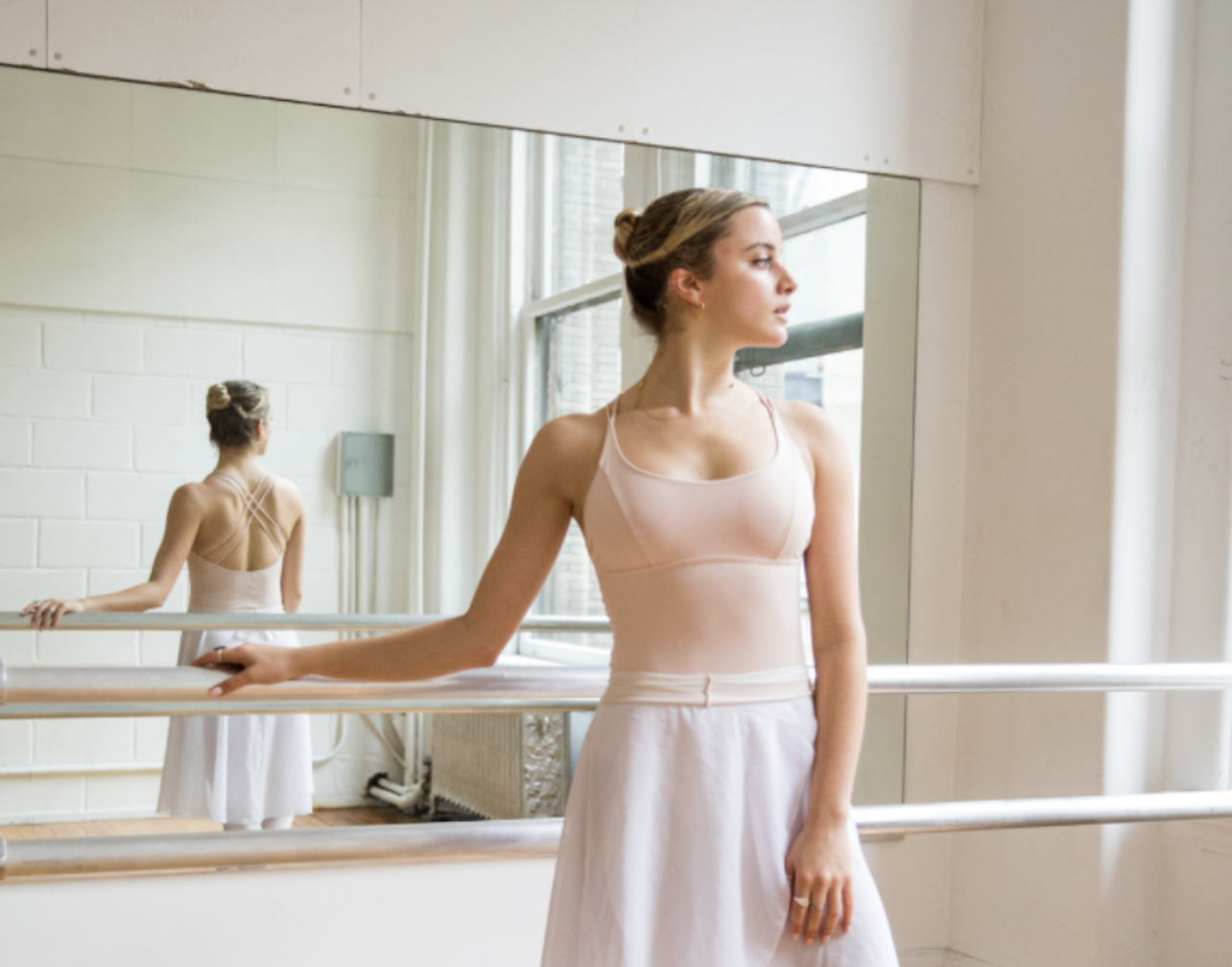
On a Thursday evening in early December, at the start of the holiday season, I arrived at a dimly-lit event space on Ludlow Street. The windows of the space were fogged, and I could hear the pulse of a DJ set from the street. As I walked in, I immediately regretted my decision to pair sneakers with trousers and not adhere to Coco Chanel’s rule of taking off a singular accessory before leaving the house. The people at this event were impossibly cool and sleek: dressed in dark colors, they seemed at home speaking over loud music. Placed in the corners of the room were high tables, one featuring a two-tiered cake with a sort of royal teal icing–though in the low lighting, it looked black–and adorned with silk bows. The bar served a well-curated selection of beverages, and on silver platters offered up translucent squares adorned with brightly colored specks. They looked like see-through Jacques Genin’s Parisienne chocolates, except they were jello shot cocktails. On the back wall hung a mirror with a humble wooden bench perched in front of it. A few minutes earlier, this section of the room had served as a stage for a group of three dancers. The piece began with the three women seated on the bench. With accompaniment from a violinist, each two women observed the third complete a solo while resting in a stylized pose. Projected onto the wall at the front of the event space was a slideshow of photographs and videos of women in pointe shoes in traditional and slightly altered neoclassical balletic positions. The women donned ballet-inspired sportswear, and some wore their hair down. They looked like ballerinas, but people, too. The occasion for the event was the launch of a new casting agency called CA.ST, the newest venture of Cardboard Stage, a company founded and run by Dasha Schwartz, a former dancer with both The Dutch National Ballet in Amsterdam and The Alberta Ballet in Calgary.

A few days after the event, I met up with Dasha to hear about the trajectory of her career. How had she gone from being a ballerina to the director of a multi-hyphenate company? As an “Agency of Human Movement,” Cardboard Stage provides talent and choreographed performances to help bring ballet in contact with broader audiences. The company offers opportunities for dancers to perform at functions and events, just as had been done for the CA.ST launch party. The day Dasha and I met, she had a performance scheduled that evening in a loft in Greenpoint. She’d be dancing a piece she choreographed with two other dancers.
Dasha was born in Toronto, the second oldest of five. As kids, Dasha’s mother enrolled her older brother in ballet classes at The National Ballet of Canada’s Ballet School. While one of the most prestigious ballet academies in the world, it happened to be the local ballet school closest to the Schwartz’s household. After a few years of study, Dasha was the only sibling still pursuing ballet, but at a certain age, students must apply to take part in the full-time program at the school, which requires an intensive audition process. She didn’t get in the first time, so she auditioned again, eventually getting a coveted spot in a class of twenty dancers. The school, which is one of the few dance schools to also combine academics, mostly trains international students who move to Canada to study and board at the school. Dasha was one of the few day students. She spent her days in the studios and classrooms with her peers, but ate dinner with her family every evening. She did not, she tells me, have a dance mom. For this, she is eternally grateful.
Admission into the school doesn’t ensure all students will graduate from the program. Each year, the school carries out an extensive evaluation process where students perform for their faculty to determine if they’ll be invited to stay on for the following year. This ritual inevitably leads to divisions within cohorts. Friendships are suddenly tested in the face of competition. Dasha didn’t necessarily think she wanted to be a professional ballerina, she tells me–“which is kind of crazy, because normally you would only audition for a program like this [National Ballet of Canada’s Ballet School] if your dream is to be a ballerina”– until halfway through her training. Prior to this moment, it was mostly the sheer force of determination to ensure she stayed at the school for another year that kept her going. At the age of fifteen or so, the school offers its students the ability to study abroad at other dance academies. It is rare for a ballet school to emphasize such a global focus of the art form, but it seems the Canadian Ballet School worked hard to encourage this mindset. Dasha spent two summers studying overseas, first in Australia with the Australian Ballet, and then in Amsterdam, with The Dutch National Ballet, the company she would later join. Dasha was drawn to Amsterdam because of the work of Dutch choreographer Hans van Manen. After her year in Amsterdam, she was invited to stay on as an apprentice– the position between ballet student and full company member that usually lasts a year, but she had another year of high school to finish. There are such few employment opportunities in professional ballet. Not many ballet students would prioritize academics over a chance at a career. Dasha did. The company promised to hold a spot for her.
If Dasha were ever at risk of being cut from her school, it would perhaps have been for her size– a thought that feels as improbable to think as it does to type, and harder still to imagine a teacher communicating to a student. Throughout her training, Dasha says, her body was always a problem. Anyone looking at Dasha today would be confused by this, noting instead how pulled together she looks, her natural sense of style, and her almost gray-colored eyes. But, so inscrutable are the physical standards of ballet, Dasha’s experience is, unfortunately, quite well-documented, as is the shame that follows. I’m amazed by her ease and discomfort as she recounts years of being told she was too “big” and “muscular.” I can’t help but notice a young girl sitting near us, hoping she can’t understand what we’re saying, and also hoping the world she grows up in will be kinder. Perhaps Dasha’s comportment is a testament to this possibility and the change that’s already occurred.
Despite the Dutch National Ballet’s excitement for Dasha’s talent– “I was always a very artistic dancer with my technique under control”– her body would become a problem when she moved to join them. She arrived in Amsterdam at the age of seventeen, assuming adult responsibilities for the first time in her life–cooking, laundry, opening a bank account– while starting a professional career as a ballet dancer. After only a few months there, as an apprentice, she was given the lead in van Manen’s ballet Five Tangos. She’d be the sole woman dancing on stage with four men. This is somewhat of an unheard-of opportunity for a young dancer. Her family purchased tickets to come see her perform, but then, a few days before her debut, the director of the company pulled her aside and notified her that he’d be taking her out of the ballet: “He was like, we can’t let you on stage because we’re worried you’re going to injure the boys.” Her entire family sat in the audience watching another girl dance her role. It’s hard to imagine such cruelty anywhere but in a fairytale for children. This moment marked a change for Dasha. She was sick of being punished for something she couldn’t control and the complete lack of sympathy for certain indubitable somatic facts: weight fluctuates, and bones don’t narrow. She had many interests, nurtured from time spent out of the classroom as a day ballet student, and parents who had never pushed her towards ballet. She decided to leave the company and take a break from ballet. She moved back to Canada and enrolled at McGill University.
At McGill, Dasha felt very little pressure to follow any particular path and took classes broadly in subjects like Russian literature, moral philosophy, and Japanese visual art. After years of grueling judgment and criticism, McGill offered the space and freedom to explore. She continued to take ballet class and work out, and slowly found herself becoming at peace with her body. In fact, once she let go of the idea of a perfect ballerina body, she felt herself becoming fitter. She decided, on a whim, to attend an open audition for the Alberta Ballet. “I was like, great, a free class.” She got in and left McGill.
She stayed with The Alberta Ballet for a single season. While on tour with the company in New York, she learned of a master’s program through NYU’s Steinhardt in Ballet Pedagogy run by the former American Ballet Theatre soloist and star in the beloved film Center Stage, Sascha Radetsky. The program would allow her to train directly with him. She also caught the New York bug and realized that a graduate program would offer her a visa. Despite not having a college degree, Dasha applied to graduate school and got in: “I called my parents and was like I’m moving to New York and going to NYU for my master’s… I just ran with it. If they kicked me out, they kicked me out.” Despite an attempt by the school to do so– she was asked to send her college transcripts– Dasha completed the program at the behest of an administrator who fought for her to stay. She loved her time in the program, and in the end, Dasha was asked to become a teaching artist with ABT, a job that allowed her to go around the city and teach ABT’s certified pedagogy. Sasha became and remains a close mentor of hers.

After her master’s, Dasha was living in New York, teaching, dancing, and seeking out dancing opportunities as a freelancer. One day, she decided to audition for the national tour of Christopher Wheeldon’s American In Paris for fun. She went for the first round of auditions, which was all dancing, and was asked to come back. She arrived at a second audition completely unaware that she’d be asked to sing. “Everyone changed their outfits and had their hair done, and I literally wore my ballet shoes and sweatpants. The woman before me auditioning sounded so angelic, and I was standing outside the door shitting myself. I didn’t know what to do.” She went in and made a joke to the group auditioning her, “I was like a tough act to follow, right? But no one laughed.” When the pianist asked if she had any music, she admitted she didn’t but offered up Happy Birthday as an option, which she dedicated to the casting director Allison. “So I sang Happy birthday to Allison and did some jazz hands.” Absolutely mortified by the experience, she considered fleeing the audition immediately, but they called her back, perhaps because it’s such a dance-heavy show: the original cast featured two ballet dancers as the leads, Robert Fairchild of New York City Ballet, and Leanne Cope of London’s Royal Opera. The next audition would require tap dancing, which Dasha did not know how to do. Besides hip hop, tap is perhaps the least similar style to ballet, an art form that emphasizes, aside from musical accompaniment, silence. Ballerinas spend hours beating their pointe shoes against hard surfaces to remove any potential noise on the stage. Dasha bought a pair of tap shoes, YouTube-d basic steps, and showed up for audition round three. During the audition, she tried as hard as she could to make the least amount of noise–out of fear she’d be terribly off the beat–determining at the end, once again, that there was no way she’d be cast in this show. It was about to be the holidays, and she had plans to go to Paris. She hadn’t heard anything and decided to write the whole thing off and enjoy her vacation. On the plane to Paris, her phone miraculously got service, and an email notification alerted her that she’d been cast in the national tour. As soon as she landed in Paris, she had to turn around and go back to New York. “I feel like getting into NYU and being cast in a Broadway show with no talent are two miracles of my life.” But it was December 2019. The tour started in January 2020, and three months in, COVID hit. The tour was canceled, and Dasha ended up back in New York, quarantining in her apartment.
During her year at Alberta Ballet, Dasha found herself choreographing a lot. Cardboard Stage had actually started during her time in Amsterdam: “I was 17, just turning 18, and was going out and meeting all these people who’d never been to the ballet. Meanwhile, I thought the work that we [Dutch National Ballet] were doing was so interesting, but it was so siloed. I thought maybe if they had more exposure, they would go.” Dasha had always loved choreographing and decided that she wanted to start collaborating with other types of artists and do performances outside of a theater. That was the start of Cardboard Stage. Dasha continued to choreograph at McGill, using her classmates for projects, but was having trouble building a network. So, she built a very basic website where artists could apply to work with her on this burgeoning project. Stuck inside, Dasha, like many artists during COVID, tried to figure out how to possibly fill her time if she couldn’t take class or perform. She turned back to Cardboard Stage, “I did this thing in COVID for Cardboard Stage called The Six Feet Apart Challenge. In an attempt to connect the dance community online and encourage people to think creatively within the limitations of their space.” She asked fellow dancers to submit videos and got hundreds of submissions, across the globe and mediums: videos poured in from painters and composers and dancers who didn’t do ballet. When restrictions loosened, Dasha partnered with dancer and actress Juliet Doherty and made a dance video in a warehouse in Red Hook with the brand Live The Process. It was the first brand deal for Cardboard Stage. Dasha saw video as another means of increased accessibility. Cardboard Stage started a dance video series until they could resume in-person events. When in-person gatherings resumed, and in the hopes of bringing in even more new audience members, events became even more immersive and innovative: “I wanted to create memorable moments as an introduction to dance.” She choreographed to Frank Ocean.
On the surface, COVID stopped a lot of Dasha’s momentum in her daily life in New York, but it also sharpened the focus of what Cardboard Stage could become. Dasha began meeting more and more trained dancers in New York and realizing how many of them, without the structure of a company, were hungry for opportunities to perform. Ballet doesn’t have a freelance culture, and Cardboard Stage could provide this opportunity: this is why she launched CA.ST– an abbreviation of Cardboard Stage– her agency.

While Cardboard Stage started as an outlet for creation, outside the confines of a company, it started to build into a project that would allow for dancers to dance on their own terms by taking ballet out of the bubble that causes it to be so unforgiving. By broadening the audience of who was watching performances, Dasha also allowed her dancers to exist amongst people in the world as people themselves, people who just happen to dance. One of Dasha’s dancers, a more recent member of Cardboard Stage, Ella Ross, a former dancer with Miami City Ballet who recently arrived in New York, told me that Cardboard Stage has allowed her to dance in a way that accommodates her life. “When I left my ballet, I definitely knew I would be dancing less… It’s [Cardboard Stage] a way to be able to work with other dancers and do really cool projects that sometimes might be more interesting than just performing on a regular stage would be.”
“When I try to ask people why they don’t go to the ballet, they say it’s because they feel disconnected from what’s happening on stage,” states Dasha. The work of Cardboard Stage proves that ballet doesn’t need to happen as it’s traditionally perceived, at a distance from the audience or in formal settings. Dasha hopes, too, that Cardboard Stage’s agency will encourage companies to seek out dancers for advertising campaigns and events and that dancers in turn will be able to expand the use of their training. She wouldn’t call herself a businesswoman– we bonded over this feeling– but I was struck by the size of Dasha’s vision and how she’s the very exemplar of her company’s mission: a dancer who has reformulated her relationship to ballet with the kind of agency rarely afforded to professional ballet dancers.
In the months since Dasha and I met, controversy arose in the ballet world when actor Timothee Chalamet declared he’d never want to work in art forms that have to fight to keep themselves alive, before specifically listing opera and ballet as prime examples. The world revolted, and thousands flocked to the internet to reply to Chalemet’s callous ignorance. Some companies, like The Metropolitan Opera, responded directly by posting a video with Timothee’s words superimposed on footage of every department involved in the company needed to put a production on– “no one cares?” they seemed to be asking. Dasha is a perfect person to respond to this sentiment, as it is the very attitude her work aims to address. I reached out to hear her thoughts, “As an actor, you’d think he’d have a deeper respect for ballet, but Timothée isn’t entirely wrong. Ballerinas don’t get the same notoriety, exposure, and financial backing as actors and athletes do because they aren’t respected by mainstream audiences… At Cardboard Stage, we’ve made it our mission to make the classical arts more accessible to new audiences, while also redefining the stereotypes surrounding ballet… Too often, people imagine ballerinas only in tutus, like tiny figurines in a jewelry box. In reality, ballet can be expansive, modern, and deeply connected to culture today. That means embracing different bodies and beauty standards, collaborating with other industries, and bringing ballet into unconventional spaces. And it starts by hiring ballerinas. We can dance, choreograph, model, and movement direct. If it takes someone like Timmy to spark the conversation, so be it. What matters is that ballet continues to evolve with the times.”
Today, after many twists and turns– and acts of sheer bravery, luck, talent, determination, and hope–Dasha has found herself in the exact right place at the exact right time. In a life that looks far different than the one she decided on at fifteen, Dasha appears to have everything needed to forge ahead, this time, entirely on own terms.

Feature photo by Phoebe Cheong.
Leave a Reply