

If it weren’t for my erudite Anglophile cousin, I would never have known to see Lucy Prebble’s The Effect at The Shed (from March 3-March 31). An early Prebble fan, she one day turned on I Hate Suzie during one of our cousin hangs– usually involving a pronounced intake of processed foods– and despite consuming sour candy as if it had any nutritional value, I couldn’t stomach it. Just seeing Suzie spill the contents of a champagne bottle during breakfast made me uneasy. Surely that’s Prebble’s point, but the veracity was too much for me and I probably insisted my cousin shut it off (and she probably didn’t). But Cousin Leila is my superior, a woman I look up to and admire, and when she tells me to go to a cultural event, I go; especially when it relates to England and theater– a country that understands the stage and what ought to happen upon it.
I wouldn’t have missed Prebble’s show for a carte blanche dismissal of her work after her television show left me uneasy, but out of distrust for The Shed. It’s hard to see The Shed, which opened in 2019, as a genuine part of New York City’s artistic ecosystem.
I have been very fortunate, this past year, to begin something of a journey into criticism: seeing, thinking, and writing about work. While I am very lucky to pursue this path, I’ve also been deeply humbled by the individuals I’ve met responsible for creating and mounting productions. These individuals have made my ability to think about performance– the decision to mount certain productions at particular times, and the history of a particular medium—richer and fuller. The more work I see, the more I understand the sheer number of experimental and downtown– a term denoting the historical role Downtown Manhattan had in the existence of a particular type of performance, but now an adjective used to describe work evoking that era, locale, and quality– productions going on at one time. These works, which will never have at their disposal the marketing resources of major theaters, help to clarify the nature of theatrical productions in New York City. There are, it seems, either large marquees and theaters, or scrappy black boxes, and very little in between– although I suppose The Public are Playwrights Horizon offers up a medium-sized marquee. What’s more, the talent involved in shows doesn’t designate where, amongst this dichotomy, a show may be placed. Just earlier this month I saw Ann Bogart’s two-person show Existentialism at LaMama, a small, but very well-respected and highly historical theater in The East Village. Theatrical quality, prestige, and location seem to elude any type of coherent or parallel relationship. Like much of theater, I have come to see, sometimes it’s about how much spaghetti has stuck to a wall. Shows are testaments to a method of trial and error. Their successes and failures are often irrelevant to the context in which the work was performed. However, despite this inverse or incongruous relationship, funding remains a morally and politically charged tool.
The Shed, part of Hudson Yards seems to have appeared without truly filling a niche—they are a space for experimental works, but they’re showing Kenneth Branagh’s King Lear this fall. The theater itself (the architecture was likened to a designer handbag to The Vessel’s shawarma) is nestled next to a Target (currently displaying large ads for DVF’s upcoming collaboration!) and beside a multi-floor building of shops and restaurants set so far apart from each other, that my friend and I got lost multiple times attempting to find our agreed-upon spot for our pre-dinner meal. It felt strange to descend an escalator to a courtyard and enter a theater as if live performance were the New York City equivalent of a mall’s megaplex.
I had similar feelings when I saw a show in mid-December at the newly minted Pearlman Arts Center (PAC) in “Fidi.” Descending the hyper-modern staircase after Jenn Freedman’s Is It Thursday Yet?, I caught a glimpse of the bones of the Oculus. I did not feel like I was in a city, but some sort of futuristic design convention. Even in New York, where real estate looms free and upwards, the decision to make a grouping of such ostentatious buildings (The Oculus, Brookfield Malls, PAC NYC) seems hasty and random. At The Eataly in Brookfield later that evening, I stared at the New Jersey skyline. I was sipping a glass of wine in a mall. The absurdity was not lost on me.
While the future of New York City may rest in malls, the imposition of these grandiose, well-endowered theaters paints a portrait far grimmer than an influx of suburban sensibility into our urban metropolis. With each new theater erected, the space between Broadway and off-Broadway, experimental and establishment, small and large spaces, grows larger and presents a more imposing standard of success in an already competitive field. It’s not that we should ban the introduction of new cultural centers, but instead create spaces that exist to bolster art by working artists who have yet to make it. Whose acknowledgment by The Shed could help to establish their career—but perhaps even this notion plays into the dynamic that makes me uneasy.
Imagine if the money behind The Shed, or PAC, was spent towards funding grass-roots local arts companies, or they opened their door to limited-barrier entry use of their facilities. Going on The Shed website now shows an opportunity for an Open Call for artists to apply for residencies and opportunities to display their work. Surely a fabulous opportunity for all those successfully awarded but imagine if it was The Shed called upon artists to join them out of a pure interest in their work– no application needed. You make work in New York City and here is a beautiful facility in which to display it. A woman can dream, but entering the theater made me forlorn. Capital has such sway over terrains it shouldn’t control! Broadway, as an institution, is equally culpable of putting sales over art, but at least the theaters are historical buildings that have helped to make up an actual neighborhood.
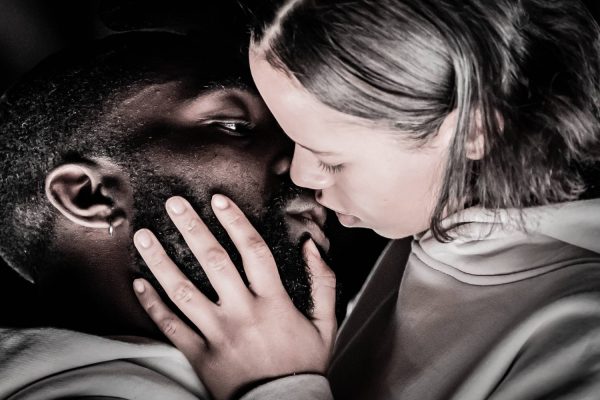
Entering The Shed, you’re directed towards an escalator. My friend had seen Sondheim’s Here We Are that winter and commented on how the space had completely changed since then– PAC NYC has the same feature; the ability to reformulate easily and often. We went up four flights of stairs, passing empty gallery space to be used for the Frieze Art Fair, and made it to the theater for the Prebble show. Outside the theater, LED-light signs displayed the name and playwright of the show boldly, as well as the name of the two lead actors: Paapa Essiedu (known for his work with Michaela Cole, and as the first Black actor to play Hamlet for the Royal Shakespeare Company) and Taylor Russell (Bones and All). An eerie futuristic– and its unknowability– tone was set. As we entered to take our seats, the dimly-light, dark room, with intense black features, and pulsating music started to make my head spin. It felt more like an attempt to approximate an idea of Berghain than a theater. Sitting, I hoped the sensory overload would go away.
The sparse yet severe state of the set and theater is a trademark of the production’s director, Jamie Lloyd. Lloyd is responsible for A Doll’s House with Jessica Chastain and Cyrano de Bergerac with James McAvoy. The only objects on stage were two fold-up chairs and a white bucket. Lights, as we would come to see, made up the rest of the stage’s dimensions, casting shadows in a way to designate separate rooms and barriers between each character.
Unceremoniously, four actors appeared. The Effect tells the story of a drug trial in England, based on the botched drug trial for Theralizumab in March 2006. In this play, two young people are brought in as subjects– Connie and Tristan, female and male respectively, and despite differences in class backgrounds (the play’s origin is England after all!), the two subjects fall in love. What is the source of love, the play asks. Is it real, or is it a product of the drug?
A subplot emerges involving the two doctors conducting the trial: Dr. Lorna James, the trial’s administrator, and Dr. Toby Sealey. While both are psychiatrists by training, Dr. Sealey is a wellness guru on the rise. Dr. Sealey, played by a brilliantly skillful Kobna Holbrook-Smith, seems to be using this trial as his entree into the nexus of medicine and business, in contrast to Dr. James’ clinical, steady, and human approach. And despite paradigmatic differences, they used to be involved. They met at a conference where Dr. Sealey took an interest in Dr. James (her legs specifically, if I remember correctly), and the two started a fling, even after Dr. James was warned, on the plane home, of Dr. Sealey’s philandering ways– too late, she’d already slept with him, she recounts with some delight.
At the show’s midway point, Dr. Sealey is shown giving a Ted Talk-like lecture (not an actual Ted Talk as he has yet to be granted that tremendous honor) about the power of psychiatry declaring that he doesn’t harvest organs of the body but instead marvels at the most complex organ there is– the brain! He exclaims this while reaching into the ominous white bucket and pulling out the actual organ. Dr. Sealey, the son of a heart surgeon (what he could consider a biological harvester), is determined to prove his value to society despite the implicit ordinance of subspecialties in the medical field (Prebble is spot-on in capturing the dismissive in-field attitude towards psychiatry), that his arrogance could never exist solely in his professional life. Of course, in his private life too, he has delusions of grandeur, and an inability to care for people beyond himself. The relationship between the two fell apart when Dr. James’ feelings ceased to matter much to Dr. Sealey—but as we’ll see, Dr. James’ feelings don’t seem to matter much to herself either. And so, The Effect tells the story of two coinciding love stories in the context of a highly medicalized, sterile environment. Connie and Tristan first encounter each other while supplying urine for a sample. Can love form when you’re constantly being asked about your bowels?
It doesn’t take long for Tristan to fall for Connie. This could be the result of the tiny cast, but we’re meant to suspend disbelief and understand these two subjects are part of a larger group of individuals, we just happen to be watching them (so often when I see plays, I think of Bob Dylan’s lyrics “You just happen to be there, that’s all” ring through my head). The two actors, dressed in nondescript light gray sweatsuits and white sneakers, are entirely committed to their characters, so much so that I assumed Lloyd was actually the age of the young undergraduate she’s meant to play. She could be nineteen or twenty, she was so untouched and innocent, both entirely in her own world and anxious to enter a larger one. It takes her a second to see Tristan is enamored with her, and in her defense, it isn’t entirely obvious why he should be. Except that he is a boy, and she is a girl in the most cliched innuendo-dripping sense of the words. They are necessarily different and that difference, in its rampantness, draws them together. It has to be the case that romantic feelings will arise. Although the simplicity of the scenario is a bit cloying, and the pace at which it happens is too quick. We know they’ll fall for each other. Why not let them unfurl a bit more?
I did finally buy it, though. While the two of them are loitering in a vacant room– the play takes turns in centering characters. When they’re not acting, they’re either seated or standing on the perimeters of the stage, or for the young couple frozen in the middle. It is occasionally the case that the doctors recite their lines from the chairs on the stage’s perimeter– they start dancing for each other. Connie does a series of ballet-like steps with such ease that her lack of training comes across exactly as intended: darling, charming, and loveable. In an attempt to bond, she suggests Tristan try dancing next—partially because he was so quick to comment on her moves. How can he not marvel at her genuineness? He agrees and performs a series of movements he’d normally perform at a club. Tristan moves with such litheness, authority, and earnestness that the plausibility of their mutual feelings is undeniable. Though they don’t know each other well, they are comfortable in the presence of the other and want to grow increasingly more so.
The difference in dance type helps to underscore their backgrounds. We’ve already been told that Connie is from Canada and is an international student at a university in London– Prebble said in her March New Yorker profile that she didn’t want to alter the cadence of the actor’s voice and rewrote the part to reflect Taylor Russell’s actual origins– while Tristan is from working-class London, Hackney specifically. It isn’t specified, but Tristan seems older, maybe because he’s taller than Connie, but they’re both meant to be around uni-age. Tristan, however, has a much hazier life plan. He shows he’s smitten with Connie by suggesting she goes traveling with him. He’s about to embark on a gap year and will use the compensation from the study to fund his travels. He tries to entice Connie with adventure, but she is both set on finishing her studies and has a boyfriend, who has a kid, is in his forties, and it turns out, is a professor– though not hers we learn after Tristan asks her directly.
The clinical trial is to test an antidepressant drug. At their intake, both speak freely and frankly– both characters are nothing if uniquely and unabashedly themselves. Connie is honest, and Tristian is smooth. Connie isn’t depressed but gets sad. She has joined the trial out of an intellectual interest in the subject. She’s a psychology student. Tristan flirts with Dr. James as a buffer between each question. The two actors appearing next to each other, are then put to a series of word association tests. They’re asked to speak the word as it appears regardless of its color. This test seeks to catch any sort of pause in articulating the word, which will capture an unresolved emotional fraughtness. What comes from this test is a bit obvious and given that it takes place at the show’s start, you’d think it was pointing towards material for later, but it ends up being purely unexamined. Connie pauses at words like “father” and “weight” and Tristan giggles when he has to say the word “breast.” Gender at its most stereotyped. Nowhere else is it suggested that Connie overtly struggles with weight. Are we meant to understand her pause based on her gender? Despite his apparent immaturity, Tristan appears to be a better romantic prospect than his sense of humor may suggest. In the scene after they dance, there’s a series of scenes between the two actors, in the middle of the stage, that’s meant to show the stages of them inching towards sleeping together for the first time. In the moments of contact, we see the two actors assume deeply intimate positions– Connie lies on Tristan, Tristan balances on Connie’s lifted legs holding onto her hands like an airplane– that I wanted to look away. It felt too private to witness. But in witnessing it, it was indeed quite sweet. They are, in fact, well-matched. Their differences really have brought them together.
If the central question is if the drug is responsible for the feelings, the other question is are both tests’ subjects actually taking the drug? An earlier interaction between the doctors leads the audience to understand either Tristan or Connie is on a placebo. It’s left ambiguous but based on the interaction you’re meant to think it’s Connie, which felt like some sort of unexpected thwart. Surely if the choice was between the boy or the girl getting their heart broken, it would be the boy. In the context of Connie and Tristan, it seemed more likely that his feelings were real and hers were transferential– she has a boyfriend, after all. And yet, Prebble is one step ahead of us. It is Connie, existing sans drugs, who has fallen for the boy!
Furry arises when their doses are continually increased and the two of them are found out by Dr. James. Concerned from the start that the mounting feelings can’t be organic, Connie goes to Dr. James and begs for further intel at which point she reveals that Connie is on a placebo in a desperate attempt to get the two to separate as sexual activity can undermine the trial’s effectiveness. Connie assumes a cold demeanor towards Tristan, and he starts to go mad trying to understand what he’s done. But then she too starts to go mad. They both display short tempers and a quick ability to lash out at each other, leading to an altercation where Connie admits to thinking Tristan is on something of a “gap life” and Tristan imagines the future Connie has with her older boyfriend– one day her husband. He will steal her youth, Tristan says. One day, she’ll be solely responsible for taking care of him.
In an attempt to make sense of the worsening situation, Dr. James calls on Dr. Sealey to figure out what is going on. In a cruel twist, Dr. Sealey reveals that in addition to testing the subjects, the trial has tested physician bias too: both Connie and Tristan are on the drug and Dr. James isn’t as well as it appears. The plot of Dr. James and Dr. Sealey’s relationship intertwines, as we find out, with Dr. James’ depressive tendencies. She has suffered from clinical depression for years but despite her profession, will not medicate. Dr. Sealey reveals that it was her depression, and her inability to do anything about it, that drove him away. Dr. Sealey berates Dr. James’ lack of faith in medicine and refusal to embrace technology– he tells her that one day, what they’re testing will be perceived as The Four Temperaments– this line was brilliant. Dr. James is unwilling to consume the inorganic chemicals and manufactured antidotes she prescribes to her patients. Let them be the guinea pigs; at least her anhedonia is natural.
Both then and now, they’ve been in conflict over the fragile state of her health. Shaken by having compromised the study and now learning she too is a subject; the play takes on another tone. While previously explorative yet cohesive, Dr. James’ illness makes the play lose its sharp focus. After the confrontation. Dr. James mimics Dr. Sealey’s earlier lecture. She too holds the brain and discusses the organ, but this time she’s bemoaning the pitfalls of having a faulty one. She knows there’s something wrong with her and she’s plagued. But her enactment of these feelings feels random and listless. Afterwards, she drags the brain in its bucket by her chair and it’s not entirely clear why. The extent of Dr. James’ pathology is hard to comprehend when wrapped up in the melodrama of a past relationship that doesn’t center her suffering but his. Her rage of the depression seems more like the shame of having been abandoned than an actual expression of past misery felt.
The play has a hard time finding itself after this misstep, but it must end. Connie and Tristan are seated and hunched over for the duration of the doctors’ dialogue. Its ending coincides with the final administering of the drug– 250 mg– and Tristan’s subsequent seizure. When he emerges, he’s in a hospital (here and throughout the play the additional props are mimed) and Connie has come to visit. The doctors, consistently steady, looming, voyeuristic presences, have faded into oblivion. The trial has ended, and Connie and Tristan now exist as a pair in the outside world– however, he has now been diagnosed with amnesia, although it could be temporary, and doesn’t remember Connie despite her visiting every day and working out a routine to trigger his memory, which includes a gallantly mimed hand job. She has ended up caring for a man and wasting away her youth, just not the man they expected.
The absolute attribute of this performance is the quality of the acting. Once the play started, I felt instantly as if I’d been transported to the West End. The sheer commitment to character, most notably in their dialects– Dr. Sealey speaks with a plummy posh accent, Tristan sounds straight from Upper Clapton Road– the intricacies of the British acting training shine through. Taylor Russel’s performance, in its fastidiousness and magnetic extension, is of a t caliber because of the stupendous cast around her. Paapa Essiedu, as an actor, transcends. In Michael Coel’s I May Destroy You, he appears as a detached and resentfully brooding lad. Here, he conjures a thin layer of hipness only to show the depths of vulnerability a seeking has. Both suit him both physically– he has notable somatic comfort– and emotionally with total ease. Michele Austin as Dr. James is so believable as the objective and probing clinician that even when she flirts with Tristan it seems for the sake of her work. Perhaps it is her steadfastness to the primacy of this character’s emotional tenor that makes it hard to believe that she too is suffering. She plays it off too well for the majority of the play for it to be true only in blurry sections.
Prebble’s question is never answered. We don’t know what caused the love between these two people and if it lasted past the institute’s doors. What could have been love seems to have been replaced with obligation and necessity. Connie rents them a flat and reveals to Tristan it’s embarrassingly shabby, hard to imagine given Connie’s supposed wealth, but like many British cultural products purporting to be about class (sorry Madame Fennell), that differentiation seemed more of a hope than a fleshed out idea. Connie gets Tristan up to his feet and helps him exit the hospital– he leans on her and hobbles out.
The two doctors come back on stage and discuss what will become of the trial. Dr. James reveals to Dr. Sealey how Connie and Tristan have ended up together. Perhaps the drug could be marketed to prolong marriages, Dr. Sealey suggests. Imagine if Dr. James slipped him the drug to keep him with her. Dr. Sealey leaves the stage, a move marking his next progression to an even higher rung on his climb for psychiatric fame—he’s bound for an actual Ted Talk, no doubt. Dr. James is left alone on the stage where she walks into the light of a trial room, once inhabited by a subject, and says plainly “End Experiment.” Of course, this could be exactly what it seems– the end of the experiment– or Dr. James could have killed herself. The truth of the ending is secondary to the blows the three characters have suffered at the hands of Dr. Sealey’s grand pronouncements to forge progress. Their humanity has come up against an opportunity for data, information, and capital. While normally I’m reluctant to consider the applicability of a play’s “moral” in my daily life, this ending didn’t seem that far off– in fact, it seemed baked into the very theater in which I was seated.
Leave a Reply