
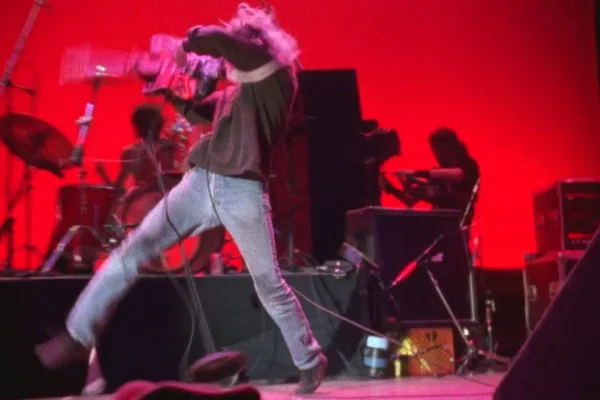
On April 17, 1991 at the OK Hotel in Seattle, Nirvana played Smells Like Teen Spirit live for the first time. At the time I was working in a book warehouse in Georgetown, an industrial area in south Seattle, and this guy I worked with, Richard, was a huge, huge music fan. He said he was going to see Nirvana at the OK Hotel that night and if we hadn’t seen them before we should see because their live shows were the best. It was a Wednesday and while I can’t remember specifically what I was doing the night of the show, I imagine I was drinking at The Comet Tavern and had a good buzz on and debated going all the way down to the OK Hotel and decided not to go because it was far and those guys played all the time. I’d just catch the next one. Oops.
When, six months later, I finally did see Nirvana live on Halloween at the Paramount with Mudhoney and Bikini Kill, it was earth-shattering. Not that I hadn’t already known about Nirvana. I had listened to Bleach countless times and by the time of the Paramount show Nevermind had been out for almost two months. But I had never seen the band play live, at a hometown show.
At 2800 seats the Paramount was considerably larger than the OK Hotel, which I think had a maximum capacity of maybe 200; it was also larger than the Moore Theater, where the show had originally been scheduled. But it still felt human-sized, Nirvana was still human-sized – you could still randomly run into Kurt in Ernie Steele’s bar on Broadway – and the music was still new. Nirvana hype hadn’t yet taken over the world, the show still felt local, specific and personal.
Even though I was a latecomer to the Seattle scene, having arrived in August 1990 with some college friends to start a theater company, I still felt a part of things. Maybe that’s because the music scene was only one part of a teeming arts scene. The worlds of film, theater, dance, poetry, fiction, visual arts and nightlife were all intertwined. Even the music scene contained a wide array of genres and sounds, it was hardly as homogenous as popular culture would have you believe. The cafes, bars, restaurants, storefront galleries and performance spaces were all frequented by the same people, there was an interconnected and interdependent creative ecology where artists talked with each other, shared ideas, collaborated, argued and experimented. It was a heady, exciting, intoxicating place and time, creatively rich and ripe with possibility.
Seeing Nirvana, Mudhoney and Bikini Kill at the Paramount was a revelation, not because it felt that it was the beginning of something, but rather because it felt like the culmination of something, something hard to define and not-quite-clear. It wasn’t just the bands – though of course it was the bands – but it was the place, the people, the moment, the energy, all of it converging in this one moment.
For me in my early 20’s, feeling like a perennial misfit and outsider, the show seemed like an affirmation of my experience of the world. When, during Nirvana’s set, Olympia artists Nikki McClure and Ian Dickson started “go-go dancing” wearing gender-reversed t-shirts reading “BOY” and “GIRL” earnestly/ironically flailed away to the music on either side of the stage, they further captured a spirit of rebellion and liberation that was already in the music. It was both a declaration and a denial, a smirk and a blush, a healthy distrust of the establishment tempered with hedged bets of hope that we, the different ones, the outsiders, had found each other, and things were finally changing.
Not long after that night, Nirvana really blew up, eventually playing massive stadiums, and I never saw them play live again. When I think back, it seems like only a few months passed between that show and when Kurt died, though in fact it was several years. But time moved so quickly then, and so much happened, those years went by in a brilliant blur of art, chaos, emotion and imagination.
I associate the intensity of my life at the time with the intensity that drove Nirvana’s music and connected with the fans like myself. Nirvana’s music conveys Big Feelings, but it isn’t performative or merely showy; it is coiled-up, focused and intense. The emotional power of Nirvana’s music is about connection – Cobain dug deep and somehow managed to get the music into the world with an artistic focus and clarity of vision (sound?) that is the hallmark of genius.
The band attained stratospheric commercial success that meant playing to massive crowds, but the music didn’t actually translate well to stadiums, I don’t think, at least from what I can tell from the videos of those big shows. The music wasn’t designed for stadiums. (They never expected – or wanted to be – bigger than Sonic Youth!) The dynamic variation (loud/quiet/loud) works best when you can really hear the quiet parts, the loud parts work best when they overwhelm the audience and the room. It is big, loud music that is actually intimate and small.
In his book How Music Works, and an associated TED Talk, “How Architecture Helped Music Evolve”, musician David Byrne explains that commercially successful music acts ended up playing in “the worst sounding venues on the planet” – basketball arenas and stadiums. He observes, “Musicians who ended up there did the best they could, they wrote what is now called arena rock which is medium speed ballads,” rousing, stately, Wagnerian anthems, a “soundtrack for gathering” in anonymous masses.
In Seattle in the early 90’s, it was not uncommon to see a band that would one day be huge playing to a sparse crowd in a small venue. My friend Danny was the music critic for Seattle’s alt-weekly The Stranger and I was frequently his plus one. One night he invited me to join him to see this new British band at the nightclub MOE. It was a weeknight, the crowd sparse, maybe 50-75 people, as I remember it. The band came on and they sounded as if they really wanted to be the Beatles. The songs were catchy, the front man had a lot of personality. In fact, it felt as if they were already playing a stadium, just waiting for the rest of us to catch up. The music had a grandiosity and pageantry to it, it was not meant to be intimate or to connect with the audience, it was show-y and performative and peacock-y. Lots of fun, little substance. That band, Oasis, got huge pretty quickly, playing their rousing, stately anthems in stadiums to gleefully intoxicated adoring crowds, as intended.
I’m not making a qualitative judgement. Writing and performing arena rock that actually works both in the stadium and on the radio is not easy, and I like a rousing anthem as much as the next person. But the experience of being part of an anonymous mass of tens of thousands of people singing along to a well-known anthem by a band that you can barely see and who can’t see you is markedly different than being in a room of 200 people listening to a band that is right in front of you.
It is different to be in such close proximity to the musicians that you can see them and they can see you, that you can hear the breathing and feel the sweat and energy of the people around you – the connection is palpable, kinesthetic. It is different when, while you might not know the musicians personally, maybe you are within two degrees of separation, you frequent the same social spaces, share some cultural touchstones and influences, geographic points of reference and sense of place.
It is self-evident that the experience of seeing live performance in a storefront gallery or small club is different than seeing a live performance in a stadium. The surface differences are so obvious that it is easy to just stop there, but I think there is something fundamentally different in what is actually happening between audience and artist in both scenarios that it is worth inspecting more closely.
Performances in smaller spaces where the artist and the audience can see each other, where they are part of the same milieu, are not merely performances – they are generative, co-creative experiences. Scientists have found that audience members’ heartbeats sync up, and are exploring how social cognition works; scientific research into mirror neurons have drastically change our understanding of spectatorship. In these smaller spaces there is a kind of phenomenological intersubjectivity that happens, where the inner experience of the audience members and the inner experience of the performers are projected out into a shared imaginative space, affecting and shaping one another.
Thus, it is these smaller spaces where invention happens – experimentation, exploration and novelty. This is where new things are actually incubated and created. It is hard to define what the outer limit of intimacy is, but at a certain point the distance – both physical and psychic – is too vast to bridge, too distant for that intersubjectivity to really happen. And it is at that point where art becomes entertainment, when it is no longer about connection and co-creation.
Once a show, or an artist, makes a work for large audiences, or is performing their work in large venues, it is about reliable reproduction night after night, it is about dissemination and documentation (on tour, on video). That is not a bad thing, it is an understandable response to the market-driven imperative to achieve scale and become profitable. The system as it is designed – and our society, and the mechanisms by which we discuss and evaluate art – skews our attention, and assignation of value, towards profitability as the artist’s main goal and society’s arbiter of success. But what if there was another way to look at it?
Leave a Reply