
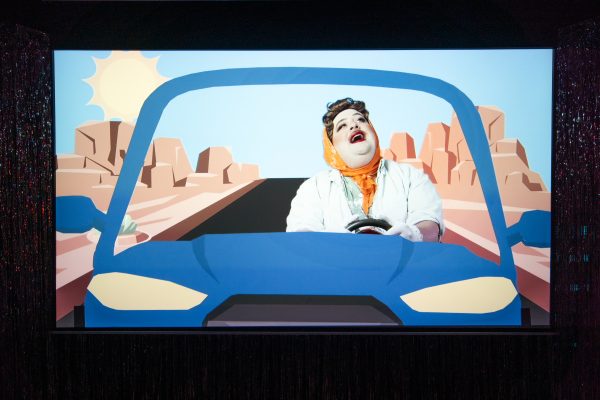

Geraldine Realigned Drives from Gay Place to Gay Place and You’re in the Car Too ostensibly follows a drag queen, Geraldine, on a road trip working her way through a list of great American gayborhoods (Austin, Texas and Asbury Park, New Jersey). However, performer Cam Cronin and his co-creator Billy McEntee, friends since college, use that context as an entry into a work about self-actualization, competing human desires, conversations not had, and making peace with parts of yourself you rather neglect or think away. The show is also an homage to drag, an art form Cronin holds deep respect for.
This interview has been edited for length and clarity.
Eve Bromberg: I want to start by asking about your background and how this project came about. I know this is the second run of Geraldine – is this the second run at The Brick?
Cameron Cronin: It’s the second run in general and at The Brick. It’s had one home thus far! The show is a product of an ongoing friendship with Billy and the pandemic. Billy knows my personal history well, and a fair amount of my personal history is part of the show. I’m gay and I’ve always wanted to do drag but had never done it before, so we discussed how to carry out drag in a guerilla format, in a non-queer space. We asked ourselves how to incorporate all these ideas and formats and started writing in 2020.
EB: What is Geraldine Realigned? What is the show about?
CC: The show is me, Cam Cronin, trying to say something about fulfillment and self-actualization. To do that he’s dressed up as a drag queen going on a road trip to America’s great gayborhoods to have some kind of experience. He is now, in front of you, relaying what that experience was and trying to talk to some general sense of what his experience is and his thoughts about the world. At some point, it starts to break down and falters in its attempt to find this initial understanding, and at that point, the question is “What do we do?” What do we do when something does not work like we hope it would and how do we turn it into something that’s more real and communicative despite it not going how expected we it to?
EB: Well, it’s interesting, it’s almost like within the show, you’re showing the limits of the show as it exists. Is it sort of a working project that you’re bringing the audience into?
CC: It’s funny, I’ve sort of joked with Ryan [Dobrin, the director] and Billy that we’re never going to be open. Of course, we are, but that’s kind of the energy [the production opened May 8]. I wouldn’t call it a work in progress, that’s not what we’re putting it up as, but the energy about it is a work in progress. If I were still acting and performing full time, I would have ambitions about doing something polished and tidy in a big house, but I believe that theater can be, and I use this academically not economically, poor. Theater doesn’t need to be super flashy, its barrier to entry is so low. Theater could happen in a living room somewhere. Not that that doesn’t take real time, effort, energy, and craftsmanship, but that it can be very very simple and not require a lot to be an affecting performance. I hope that throughout the show, it starts with an air of wanting to be bigger and highly produced, and ends up being messy and simple. I like that progression, and that’s earnestly what I and Billy believe about what theater, and you know life as well, is about. It isn’t about keeping up with the Jones, but the conversations you have with someone when you’re kind to them for forty seconds.
EB: How does Geraldine Realigned fit in with contemporary theater? Do you distinguish a one-person show and play, at least as the art form is defined academically?
CC: I am not an academic, but I would struggle to think that Douglas Wright’s I Am My Own Wife is not a play. I would also struggle to say the work of Spalding Gray and Mike Daisey aren’t plays either. That feels to me artificial, to create a boundary or definition that wouldn’t include that kind of performance. I have very few points of view where I think this show fits in from a landscape standpoint. I’m so appreciative of Billy, who as a creative dear friend of mine, trusted my instincts and believed that my story was special and worth sharing. To your academic point, I think there’s got to be at least two people in a room to create a piece of work. I come from a Catholic background and there’s a saying “Whenever two are gathered, there’s a church.” There is not a hardline, to me, between communion, religiosity, and theater.
EB: Can you tell me a bit about Geraldine? Who is she? What does she want? Is there a sort of implicit commentary in this piece that in order to get closer to who you are, you have to get farther away, abstract who you are, or sublimate?
CC: Starting with the second one. I think distance is important. I honestly believe that. In my job as a management consultant, I’m an outsider. I come in and look at something. I don’t know everything that the people who are in a job know, but by not knowing I don’t have allegiances. I’m able to see things as they are. It’s fair to say that plenty of performers, whether they are drag performers or actors who work in the theater or film, I think a lot of folks would say they learned more about themselves by playing another character. For me, in putting on a voice and trying to adopt another character’s intentions, I do feel I learn more about myself.
To your first question, “Who is she?” When we first started talking about this project the drag name I always wanted to use was “Hilda Dion,” but it didn’t make sense with the show for it to have the meaning associated with the show, whereas Geraldine Realigned is an anagram of each other. That anagram and transformation thing shows that all these same components are here and if you look at it differently it says something different. Geraldine is very silly and hapless. She uses lots of spoonerisms when speaking – you may not catch everything she says every time. Dina Martina is a big influence on us. She’s a queen who’s been working forever. She’s in PTown every summer. She’s hilarious and sort of like deeply stupid in the best way possible. As a performer, you have to lose your self-consciousness of wanting to sound competent and composed. Geraldine has some of those qualities. She’s an older lady and on her road trip, she gets lost at almost every point and ends up in different cities. There’s a part of me that is similar to Geraldine and I’m challenging myself to view those parts of myself with respect.
EB: Do you mean that you can’t quite always plan and sometimes human stupidity is allowed to take over?
CC: Yes and being less concerned about getting everything right or being competent and being okay with being silly or hapless. Aren’t we all, in so many ways?
EB: It does seem so. What are you considering the great American gayborhoods?
CC: She tries to go to Austin, Asbury Park in New Jersey is a big gay mecca. San Francisco and she also does, at the end of the show, she does come back in sort of a different form and ends up in Provincetown, Massachusetts, on the absolute end of Cape Cod. I’m not sure if you’re familiar with the town.
EB: Yes, Provincetown is known as being a gay haven where John Waters lived and worked and Roy Cohn used to go.
CC: Yes and Tennessee Williams was there. In the 80s, they did a lot of research on HIV/AIDS because of the enclave status that it has with gay men and it’s maintained a place for LGBTQ folks, and so Geraldine ends up here.
EB: So she sort of ends up where she’s supposed to end up?
CC: Yes, she does. There’s a moment where our more theatrical elements get stripped away like lights and projections, but then she comes back unexpectedly in a way to guide me and the audience members towards the progression of the show. For most of the show, she’s very cartoonish and two-dimensional, but in her last appearance, she’s moving around in the world. She does seem to emerge exactly where she should.
EB: Walking away from this work, given that it’s so much about queerness and identity, is there a singular idea you’d like an audience member to come away with? A singular idea of what it means to be gay? Or is that not the purpose of this show?
CC: Funnily enough I think this goes back to what I was just talking about, about your identity being a work in progress. I think if people have a clearly defined view of themselves that is very established that they’re comfortable with. I might hope that this show asks them to ask themselves more questions or to consider something else. I hope they walk away knowing that we’re all in the process of trying to land the

plane. It’s the same thing I was saying about the state of theater generally. I hope people are more comfortable with scrappiness in general. If I had one thing, I hope it’s something akin to that.
Leave a Reply