
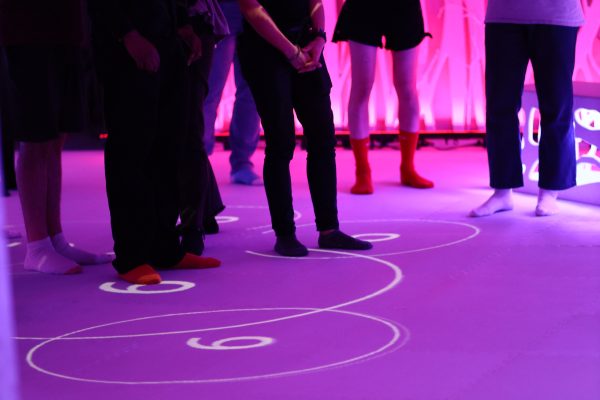

The audience, a group of ten people padding along in their socks, line up silently along the back wall. The glowing outline of a circle appears on the floor. Someone is brave enough to step in.
This is Third Law, an immersive experience of the Adam and Eve story where you play the creator. A network of interlocked circles on the ground serve as your control panel, triggering changes to the lighting and sound based on the number of people who stand within them. Four people in the center circle means you get to choose your soundscape, labeled ‘from engine to mushroom.’ Four people in the smaller one in the top left triggers ‘knowledge,’ an amorphous voice questioning if the apple is really that bad. Four in the bottom right switches out the actors circling you, mid sentence, for you to choose a different Adam and Eve. The world is whatever you (with your fellow audience member) make of it.
The piece, devised by director Coral Cohen and the ensemble, is a collaboration between What Will The Neighbors Say? and CultureLab LIC, where it had its world premiere on May 11th. In it, two actors play through an interaction between Adam and Eve, leading up to the eventual choice of whether or not to eat the apple. You, of course, are responsible for the decision. Its primary mechanic, finding innovative ways to incorporate audience agency, is a (literal) step forward in the field of immersive theater. It is hard not to appreciate the effort towards innovation.
It is extraordinarily impressive, for example, that all six of the actors who are standing, motionless, at the front of the room, are ready to jump into either role at any given moment. They all possess an encyclopedic knowledge of the script and blocking, and part of the fun of this production is getting to try out different combinations, seeing how different actors deliver the same line in new ways. You can see the audience experimenting with this, giving each performer their turn. All six of them have a flower crown hung up on a hook behind them, whoever is selected to play Eve takes it down to distinguish themselves. Adam and Eve are no longer defined by gender; the burly Scottish man is just as likely to be crafted from man’s rib.
This mechanic, however, makes it difficult to pay attention to the script. Multiple times, at the emotional height of the scene – Eve telling about the snake, Adam explaining to her how terrible it was to be alone – enough people step on the ‘Beings’ circle, and the momentum stops. Minutes go by as we go through the procedure to choose a new pair, and we forget what was just being said. In some instances, this was caused by sheer accident, when the number of people required shrunk down to a measly two. Being the creator appears to be more arbitrary than one might have thought.
At other times, however, this is indicative of a more fundamental problem with the show. In an era of touch screens and commodified attention, engagement is not enticing anymore: it’s compulsive, and we get the same dopamine rush from watching the ground light up as we do scrolling on Instagram. The iPad baby in us wants to keep stepping on the circles, keep making things happen, even if for no apparent reason. The beginning of the performance, where we first learn the rules, features a narration of God creating the universe. The text of this is almost completely lost on the audience, who are more preoccupied with finding out what sounds they have to choose from than the story. When we finally do process what is going on, we are left feeling like we are playing catch up – a feeling that will continue for the rest of the show, we are constantly being drawn in multiple directions. It is hard to ever feel connected to the text, to feel like we are the creator that these humans are play-acting, when they are more dolls for us to play with than anything else.
Despite this, however, Third Law is still enjoyable, and at times thought-provoking. Eve, explaining why she wants to eat the apple, tells Adam how boring paradise is. They do the same thing every day, eating fruit and tending the garden. It suffocates her. For the audience member tuned in at this point, close to the end of the show, it is a revelation – being the creator has gotten boring. Power is just as stifling as paradise. We have experimented with the same four lightscapes until we have exhausted all the options, and the thrill of stepping on circles has faded into monotony. If we were Eve, we too might be fighting for a change.
Perhaps this is why the mechanics include the otherwise incidental ‘ritual’ sequence, which sufficiently shakes up the proceedings of the show. One of two benches to the sides of the circles sits with the projected label ‘ritual,’ just waiting for someone to sit on it and trigger a zany dance sequence to Sammy Davis Jr’s ‘Rhythm of Life.’ All six actors move off of their pedestals to either side of the room, performing regimented movements choreographed right down to the uncanny smiles. This sequence is genuinely delightful the first time someone ‘discovers’ it, but it, like all our choices, becomes repetitive on a second experience. Even the moments of respite from the game tell us how bored the creator must be, a perfect mirror to how bored we have become.
Third Law is certainly a piece worth seeing, if not just because of the risks that Cohen and the whole company are taking. As with anything innovative, there are substantial mechanics to be improved, but that should not overshadow the way that they have laid the groundwork for a new kind of audience participation. Every tea-stained piece of cloth and green-tinged lighting design signals a deep attention to the bounds of artistry, exploring a new kind of performance experience. Adam and Eve story or not, it is clear that a creator is present.

Leave a Reply