

For young women on social media and the real world alike, girlhood has become somewhat trendy in recent months. Apprehensive of adulthood, increasing numbers of individuals have clung to the rituals that characterize a girl growing up, posting videos on platforms like Instagram of birth control and group debriefs captioned simply ‘girlhood.’ Tiktoks to songs like No Doubt’s ‘Just a Girl’ have become the background music to a viral movement that features mary janes and makeup sessions. As maturing gets scarier, our younger years feel safer. And yet, girlhood might actually be the scariest thing of all.
Complex as it is, it is no wonder that so much art has focused on the story of girlhood, and Clare Barron’s Dance Nation is no exception. The play, featuring a raw look at a preteen dance team preparing for a competition, was performed at Barron’s playwriting alma mater, Brooklyn College, from April 12 to 16. Directed by Katy Early for her MFA thesis, Dance Nation gives us a look into the contradiction of being thirteen, complete with characters who, in the same scene, might play with horse figurines and masturbate. In its graphic, no-holds-barred style, Barron makes girlhood into a battleground, emphasizing its darkness as much as its innocence. Characters paint period blood onto their cheeks like war marks. Contrary to the trivial way adolescence is perceived, for the duration of Barron’s play, a dance competition becomes life or death. For audience and character alike, girlhood is not for the faint of heart.
Over the course of “Dance Nation” we will learn about most of these girls in detail, but our real protagonist is the passionate Zuzu (Tulani Browne), the audience stand-in, who has been given the coveted lead part in their Gandhi-themed competition piece. Amina (Tasiya Roseborough), the group’s clear star, is on her way to a Russian ballet institute but has not. Zuzu, a good dancer but not a great one, is perhaps the least interesting thing about this story. Although we get glimpses into her life outside of the studio, by and large, the only thing that matters to Zuzu is dance, and we aren’t able to connect with her, as a person, outside it. In the first of many revealing monologue-like moments, Zuzu tells us that Amina’s dancing is something special, bringing people to tears. “I didn’t make them cry,” she laments, as if a requirement.
Perhaps the most realistic thing about girlhood in “Dance Nation” is how singularly caught up the girls are in their chosen extracurricular, their obsession with dance becoming almost cult-like. Their lives are narrowed down to the dance studio. We never see them in any other context. Multiple times the lights turn red as they writhe on the floor, chanting in unison about their Broadway-dancer idol or nationals. Dance, to them, is the most important thing there is: a perfect representation of how intense everything can be when your worlds are so small.
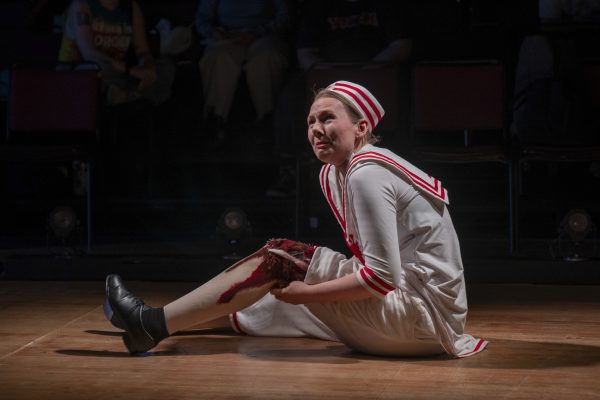
The play opens on the group in sailor outfits, convincingly tapping and shuffling around the stage to the soundtrack of “Anything Goes.” When a dancer gets injured at the end of the song – complete with a translucent bone sticking out of her skin that made the audience on both sides of the theater audibly retch– we never see her again. The girls ask about her once, and then it is like she never existed. That the stakes are astronomical is somehow the most natural thing in the world.

Everything else in the play is heightened as a result. Intensity is the foreground of everything the girls do. There is a laundry list of all of the ways that the text delivers an ecstatic, frantic reality. At one point, we see three girls in their homes: one attempts to insert a tampon, one masturbates, and the third pulls horse figurines out of her bag. For a preteen, girlhood is being a child and an adult at the same time, navigating how one state feeds into the other. Shock factor aside, the text shines when it delves into territory that reveals a more true depiction of girlhood than found in sterile modern media. A male, adult, audience might never have imagined it could be so violent and so complex.
It would be too easy of a criticism to trivialize these girls’ worries as frivolous or inconsequential, although Barron knows you are thinking it. Directly before their competition, Dance Teacher Pat (a confidently authoritarian Ryan O’Connell-Peller), delivers a dress-down instead of a pep talk. “Your problems are not real problems,” he tells them, and he’s right. Barron uses the opportunity, however, to illustrate how unfair a standard that is to cast onto a group of preteens. Devolving Dance Teacher Pat to complete ridiculousness, the audience laughs as he circles them, snapping his fingers. “Someone just died,” he tells them, before snapping menacingly again. “People are suffering,” he says. “Dance for them.” Humor exposes just how strange it is that those two things would go together. That is a girl’s job to worry about both.
The Brooklyn College performance is one of a recent deluge of “Dance Nation” productions in the New York City academic scene, being performed at Fordham, Barnard, and Brooklyn Colleges all in 2023-24. The story connects with young people, those who remember their own girlhood or still feel like they are going through it. The difference here comes with Early’s direction, which glimmers in nuanced ways under the light of such a strong show. She signals her vision early on, with an added sequence where the girls pick up the lights from the side of the stage, illuminated only by them as they perform exaggerated expressions as if in the mirror, training for their big auditions. The entire sequence has a surreal aspect to it, bringing us the frenzy the show requires. The best directorial choices come in the small looks that characters give to one another practicing plies or watching their friend fail. Those are moments that feel authentic not just to the age of the characters, but to being a human.
Early begins the show with a voiceover from a child, a girl who tells us she is the winner of a New England Jazz Dance competition and that we should silence our phones. Hearing her self-assured, high-pitched voice, one wonders how she’ll look back on girlhood in twenty years.

Leave a Reply