

[LONDON, ENGLAND] I saw Thomas Ostermeier’s An Enemy of the People at the Duke of York Theatre twice, on purpose. It’s a sublime text to be working on today, wrought with all the conflict currently comprising today’s discourse: mass movement, protest, censorship, and political representation – likely the reason why there are concurrent Broadway and West End revivals. A parable about societal ills with a rockstar edge and highly successful audience participation, Ostermeier’s An Enemy of the People (adapted by Florian Borchmeyer) is sanitized, kitschy, and thrilling.
Ibsen wrote An Enemy of the People after the (lack of) success of Ghosts and The Doll House in 19th century Norway, works which centered on taboo subjects at the time, such as emancipatory politics, female autonomy, and the inner workings of married life. But he was criticized and censored for holding progressive views. Ibsen poured his frustration with his societal shunning into Enemy’s lead character, Dr. Stockmann, who becomes ostracized after revealing the contamination of the local baths, disturbing the social and economic order of his small pocket of 19th-century Norway.
Ibsen’s main gripe is the “damn compact liberal majority,” a majority that “has might on its side, not right,” which poisons our society, making followers out of the masses, and censors dissenting opinion. Ibsen’s liberal majority echos of the white moderate that Martin Luther King Jr. highlights and chastises in A Letter from A Birmingham Jail: “I have almost reached the regrettable conclusion that the Negro’s great stumbling block in his stride toward freedom is not the White Citizen’s Councilor or the Ku Klux Klanner, but the white moderate, who is more devoted to ‘order’ than to justice; who prefers a negative peace which is the absence of tension to a positive peace which is the presence of justice.” This mass middle-ground complacency does nothing to foment much-needed change.
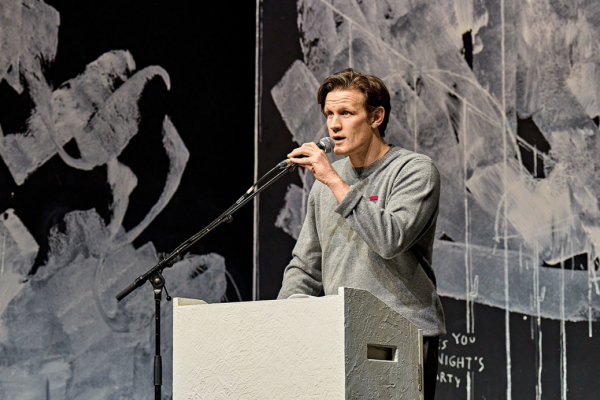
Ostermeier’s An Enemy of the People is as punchy and righteous as Ibsen’s, if a little anti-intellectual, soliciting feelings over thoughts. Transposed to a small pocket of England in the present, Dr. Thomas Stockmann (Matt Smith) and his wife Katarina (Downton Abbey’s Jessica Brown Findlay) have just settled down with a new baby when Dr. Stockmann discovers that the local baths are rife with disease. Assuming he will be lauded for such a revelation, Dr. Stockmann is soon disabused of any notions of glory by his brother the town mayor (Paul Hilton), who makes it clear that cleaning the baths is prohibitively expensive and would decimate the tourist industry the English town is built around. He is buoyed and then stabbed in the back by his old friends and fellow former student idealists, Hovstad (Shubham Saraf) and Billing (Zachary Hart), at the behest of town councilwoman and local paper publisher Aslaksen (Priyanga Burford).
In attempting to situate the production in the present, Borchmeyer discards Ibsen’s themes of liberation and progressivism, focusing on capitalism, wealth hoarding, burnout, and local council corruption set against the backdrop of Elon Musk’s Twitter and Broken Tory Britain. It’s certainly entertaining, but it fails to capture the subversiveness of Ibsen’s original story, leaving us with a narrative cleansed of any real progressive ambition. The more compelling modern-day parallel to Ibsen’s fight would be the wider geopolitical context of, say, climate change and war; instead, the production swiftly baits and switches the strident (champagne) socialism of the first act with a myopic, domestic, almost corporate wellness focus in its second act. You could imagine Dr. Stockmann posting cutesy Instagram infographics about how ‘mental health is health.’ In the second act, Dr. Stockmann goes behind the backs of the town stakeholders to gather the local people into a town hall and speak to them directly about the contaminated baths where he lays out his views in a treatise reminiscent of the famous Trainspotting speech (Choose life. Choose a job. Choose a career. Choose a family. Choose a fucking big television…). Despite the lack of any concrete political messaging in this stylized town hall treatise, Dr. Stockmann clearly gets it right about the state of society: his manifesto is welcomed with the audience’s vocal agreement.
The players posed questions to the audience directly, post-intermission, rumors of which I heard flying around the theatre from the second I stepped in. At my first viewing, early on in the run, I was confused by whether this audience participation was staged (smooth answers, no mention of Gaza, Extinction Rebellion, or the universal threat to free democratic expression that one might expect); by my second viewing towards the end of the run, I was sure it was not (fellow audience members earnestly placing themselves in the shoes of townspeople battling their local council). One thing that did not change between my viewings was the uniform negative response to the question “Who believes their politicians represent them?” posed during the second act. This struck me as hypocritical: everyone can’t think politicians aren’t representative. Statistically, someone in this 600+ audience must have voted Tory, England’s current majority political party.
If we all hold this same viewpoint, then aren’t we the liberal majority whom Dr. Stockmann is railing against, hindering progress with our meaningless assent to banal opinion, identifying problems but doing nothing about them, content in our roles as polite hand-raisers in a theatre filled with people who hold the same opinion? Ibsen’s own critique of the liberal majority and the masses is reflected in the theatre in real time. Ostermeier and Borchmeyer’s adaptation chooses style over substance in a slick production which does not engage with the new set of complex ironies inevitably created by transposing the setting to the present.
For an actor known for playing characters, Matt Smith is slightly wooden, though certainly gives his town hall treatise the gravitas it deserves, see-sawing between a zealot and a men’s rights activist. The rest of the cast is sincere, warm, and comfortable with standout performances from Paul Hilton as the corrupt town mayor (Hilton should play every seedy, gangster-like character available), Priyanga Burford as businesswoman-cum-local councilwoman and town hall compère who brilliantly parries with the audience, and Zachary Hart as the wonderfully chaotic and genuinely funny Billing, a local newspaper editor.
A particularly memorable moment from the second viewing was improvised (surely polished over the run) when Hilton – as any corrupt politician would – escaped an audience member’s question by pretending to receive a phone call, which drew much delight from the audience. In such a polarized world, finding something that the liberal majority can come together and enjoy is truly a treat.
Leave a Reply