

My interest in theater, and acting, came from what I perceived as an intellectual limitation in ballet, where training is relegated to silence. While discussions of technique and aesthetic preference exist, they’re usually outside of the classroom, reserved for classmate bonding, or a rare moment of closeness with an instructor. Dialectical engagement does not exist for the ballet student as it does for the acting student, where discussions of Stanisklavky’s Actors Studio and its many offshoots are part of learning the craft. How might a Meisner student approach a line? Mark Ruffalo was one of Stella Adler’s last students, can you tell? The absence of discourse is why, I believe, contemporary ballets (except for the work of NYCB choreographer-in-residence Alexei Ratmansky) lack such imagination. The pieces are created in a vacuum given the uncertain role the medium’s history plays in its artistic progression.
A lack of formal discourse, within a classroom, highlights a more foundational reality of ballet: it supersedes human touch. The discursive act invariably allows for the influx of problematization and complication, which thwarts clarity and challenges the precision endemic to ballet’s technique. But in acting, mess is embraced. The admission of competing desires, and complications that abound in those admissions, push the practice forward. On stage, relationships are distilled as they are in real life– incoherent, incomprehensible, and rife with conflict. It’s conflict that advances plots. Nowhere is this displayed more clearly than in plays with two characters, a form I’ve grown particularly fond of.
Given that this subgenre has become my catnip, I was eager to see Colt Coeur’s world premiere of Still by Lia Romeo. Directed by the company’s artistic director Adrienne Campbwell-Holt, whose performance education also began with ballet, Still closed on May 23rd at DR2 Theater in Union Square. Campbell-Holt’s career spans both Broadway and off-Broadway. She founded Colt Coeur in 2010, worked as the Associate Director of Dear Evan Hansen, and won the Lucille Lortel Visionary Director Award in 2018. Campbell-Holt has earned a reputation as a particularly adept director, handling heartfelt stories with sensitivity and care. Romeo’s work was in good hands.
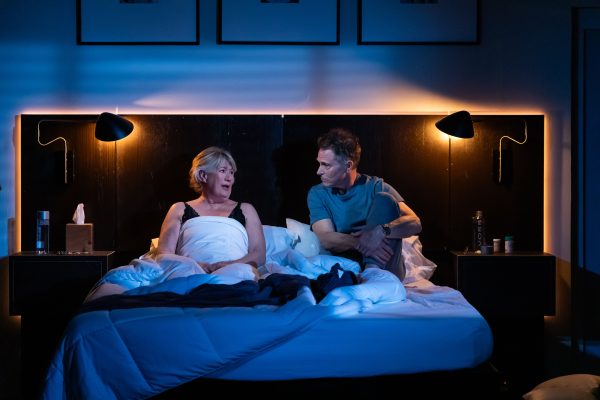
Still tells the story of Helen and Mark, two former lovers reuniting and rekindling their romance in a Hotel in Baltimore. The set– displayed as two different rooms: the bar where Helen and Mark meet, and Mark’s hotel room where they end up– captured the setting perfectly. Everything, from the encased glass bottles, compromising an accent wall, the stock images of an urban skyline above Mark’s bed, and the frosted glass on the closet doors reminded me of the Charlottesville Marriott I’ve stayed in for each of my nieces’ bat mitzvahs. Helen played by fabulous Jayne Atkinson, is a writer living in Baltimore who’s never married or had kids. Mark, played by a frustrated yet suave Tim Daly, is some sort of businessman with a now ex-wife and two daughters. When catching up, Mark recounts what his daughters are up to; one of them sells porcelain rats on the internet and lives off her profits. It is instantly clear, in their comportments, that these two are not a good match. Mark is type-A and rigid; concrete and uncomfortable with challenge. Helen is sophisticated, cosmopolitan, curious, and expansive. She looks deeply out of place in the chain hotel bar. There’s a shift in mood when Mark reveals his divorce and recounts the last time the two saw each other, at a party where Helen wore a red dress that Mark remembers in great detail. In recounting, Mark can’t help but express his overwhelming attraction to Helen. But he follows these comments with praise for her work. It seemed to me the red dress, however revealing it was, embodied the central conflict between the two. It isn’t just Helen’s body that Mark’s besotted with, but her mind and the life she has led as a result of these two elements in concert.

Helen reveals to Mark she has cancer as an explanation for why she hasn’t written in some time. Mark then kisses her and they knowingly gaze into each other eyes. What happens next is the obvious step of their reunion, however dangerous it might be. Once we enter the room, the conflict as Romeo sees it, is revealed. Lying in bed next to each other, Mark discloses his plans to run for Congress (this declaration seemed both half-baked and juvenile– more a testament to male entitlement than an actual genuine want to partake in public affairs). Helen embraces this idea with the utmost enthusiasm and they start to run through his position only for her to realize that he’s a Republican. ‘Are you a Republican?’ She asks him directly, horrified. ‘Yes,’ he says. He’s always been conservative, he says. She can’t understand. They were friends with a gay couple in their youth, which Mark doesn’t seem to think this challenges his ideological stance. When Helen asks if he thinks they should be allowed to get married, Mark states yes, personally, but in public, he’d rail against his homosexual friends if needed. This, to Helen, constitutes as the most odious part of his beliefs. But Mark’s private, public distinction quickly becomes inconsistent when a detail from their past surfaces. Helen became pregnant when they were together and had an abortion. She uses this reunion to ask him about it. How did he feel about her choice to end her (their?) pregnancy all those years ago?
Helen, in recounting the experience, paints a picture of a mostly silent boy, somber in the face of this reality and too young to be involved in decision-making. He deferred to her, and she was certain then (as she is now) that having a child was not what she wanted. And yet now, after the fact, he’s uncomfortable and feels guilty. How could such a decision be made with such ease? As the discussion surrounding this choice goes deeper, Mark turns into a pundit for the right, combatting Helen not as her former lover, but as a moral authority expounding on the rights of the unborn. It fell harshly on the ears and felt out of place. Why was he taking a political stance in a private matter, particularly when he’d just claimed to do the opposite? This strange posturing seemed to hide what he actually meant to articulate to his long-lost love. He had wanted to build a life with this woman who felt uncertain about irreversible domestic choices– either with him or in general. In being unable to face the reality of their differences, Mark opts for a robotic political exterior.
This moment highlights the shortcoming of Romeo’s play. She hasn’t let the story unfold naturally but overlays a highly structural framework over a deeply human consideration. The need to so concretely pinpoint the difference between Helen and Mark comes across as overly controlled, to the point of contrived. Their differences are apparent from the start, their breakup being a testament to this. It’s obvious the two are drawn to each other, have thought of each other over the years, and love each other. That love exists but their union can’t work is the interesting story here. By not focusing on what was right in front of her, Romeo missed an opportunity for a deeper-felt narrative. Any pressure Romeo might have felt to produce a poignant work of art was misplaced, a discussion of politics would have invariably surfaced. They’re two ambitious individuals in a heterosexual relationship. Helen, as a creative intellectual, would have felt hemmed in by becoming a mother and wife. Her work would have suffered and she would have grown to resent Mark. Mark, feeling let down by Helen’s inability to fully domesticate, would’ve turned on her.
The personal is invariably political, but as it stands, for the character of Still, politics come across as anything but. Each character collapses into a husk of their parties’ tenets and yet all around the room are past experiences and feelings that could have been bitten into and parsed apart. What did Helen make Mark feel? What was Mark like in this youth? How did they spend their time together? What did the apartment they shared look like (one can’t help but think of Vivian Gornick’s descriptions of the apartment she shared with her first husband in Fierce Attachments. How the reluctance in the relationship surfaced in the decor of the shared space)? Did they take film pictures of each other on a road trip across the country? Did Mark read Helen’s early drafts? I left the theater knowing less about the characters than I did when the play started. When did they realize they’d never work out? Did Mark wear polos while Helen wore peasant blouses?
The most compelling moment of the play is in its last few seconds right before Helen leaves the hotel room, and Mark, to return to her life. Mark suggests that despite not wanting the same things, they continue to love each other. How would that even work? Helen asks. I had no idea, but the thought, in its incoherence, was nice to entertain.

Leave a Reply