
There is a moment in Samuel Beckett’s Waiting for Godot that I return to whenever I think about the relationship between dance and language. It’s an often misquoted scene, but it happens when the traveling Estragon and Vladimir ask Lucky to dance:
ESTRAGON:
Perhaps he could dance first and think afterwards, if it isn’t too much to ask him.
VLADIMIR:
(to Pozzo) Would that be possible?
POZZO:
By all means, nothing simpler. It’s the natural order.
He laughs briefly.
VLADIMIR:
Then let him dance.
Silence. [1]
The “natural order” is not to think, contemplate, reason, or make sense, but to dance. Beckett is offering not just an order of operations, but an understanding of the ways that physical movement as an embodied practice elicits and provokes thought. But dance comes first. Movement can have a relationship to meaning. For Lucky, who is mute and unable to rely on speech, dance is the more immediate, and essential way to translate lived experience. The scene asks us to consider if perhaps thought is only really possible after we have moved, or only possible through movement.
There are times when it feels like something can get lost between the moment I see, feel, and experience a dance and then go to write about it; other times it feels like the movement escapes translatability entirely. But Beckett’s insistence on the intrinsic relationship between dancing and thinking reminds me that dance is, of course, a language too. Dance writes itself through cultural codes, through gestural syntax and vocabularies, and through choreography. Cognitive processes are produced through and in service of movement expression.
I was especially reminded of this the night I saw the Emerging Choreographers of the Hunter Dance MFA Program as part of the 19th annual La MaMa Moves! Dance Festival. Directed by maura nguyễn donohue, the program fosters returning professional artists and educators as they pursue dance and dance studies. Eve Jacobs, Maiya Redings, and Cory “Nova” Villegas’ choreography consider what endures in dance, how we might understand dance as a kind of ‘text’, and how movement shapes and develops the narratives of our lives.
Attention
Four dancers occupy four corners of a square. This is the opening spatial arrangement of Eve Jacobs’ “Four Statements on Attention.” The quartet (Alexander Anderson, Jay Beardsley, Savannah Jade Dobbs, and Eve Jacobs) run, skip, and sit within the square.
One. The dancers stand at their corners, shifting their gaze back and forth, evaluating and plotting their next move. They communicate to each other this way – through visual cues, a glance, a nodding of the head. Two, three, four, five. They run towards a different corner, arms extended. Six, seven. The quartet meet each other at the center of the square and sit cross-legged, eyes closed in a moment of meditation. Eight, a balancing position, the suspension of a leg in the air while the other bears the body’s weight, and nine, they stand again at the edges of the square, where they began.
The dancers watch each other, attentively, as if mapping out a children’s game. Sometimes they even clap their hands together or touch each other’s shoulder; they could be playing tag. Instead of rigidity and stiffness, this Cunningham-esque movement sequence is whimsical and alive. The everyday movements prevent what Professor of Performance Studies Andre Lepecki refers to as “the choreographic apparatus of capture”[2] – or, choreography as a mechanism of control, containment, and discipline. Jacob’s piece focuses on a transformative and reciprocal somatic exchange through quotidian, playful techniques of the body.
The dancers then carry out four full-length mirrors pointed at the audience. They move horizontally across the stage and suddenly, the viewers are exposed. I catch a glimpse of myself as they walk past – furiously jotting down notes and stop. I am forced to take in the way that I, too, am a part of this choreography. I wonder if I am really paying close enough attention, after all, if I am so focused on getting this down. There is the square formation the dancers often find themselves in, but then there is the formation of these chairs, lined up, that the audience sits in as we partake in the scene. Now, we exist within the four corners of the frame of these mirrors. We are pulled onto the stage, revealing our own participation in the dance.

Chopin’s Nocturne in E Flat Major (Op. 9 No. 2) plays and we are left with Dobbs and Jacobs and their mirrors, which now lean against the brick wall. They face one another and mirror each other’s movements. Like mimes, they touch up their hair, zip up their pants, and roll on the floor. They are a dancer and her shadow. Then the shadow temporarily breaks free and engages in play with the dancer: tapping her on the shoulder, miming an elongated telescope, and then a bow and arrow, touching feet and then toes.

Jacobs’ way of attending in dance maintains a particular awareness, a heightened mode of listening to the ways the body moves and responds to movement. After all, how many times a day do we let the mechanics of movement slip away from our attention? How often do we scroll our fingers on glass, shift in our office chairs, wash our dishes, or brush our hair without particular consciousness? “Four Statements on Attention” inquires about a different approach to dancing, and living, in which we expand and sharpen our perceptual capacities.
Salvation
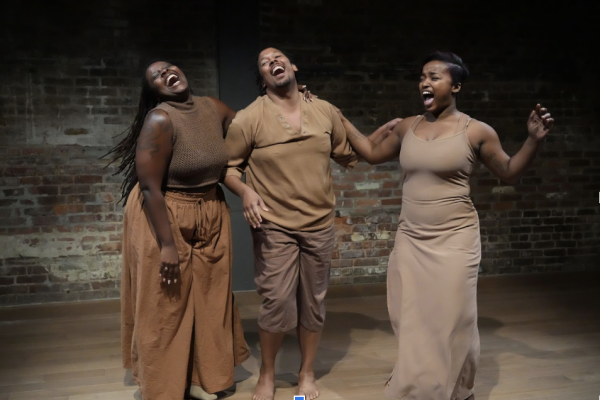
The sound of a heart pumping and a red light flashes to its beat, illuminating three bodies who lay on the ground, gasping for air. They clutch their chests and reach their hands out towards the audience. We enter excerpts from Maiya Redding’s “Bright Lies, Dark Truths” – gasping and grasping – listening to these sounds of survival. The dancers, oscillating between shadow and light, visibility and invisibility, unsettle the audience. The spectacle of pain that opens Redding’s piece is a preview of what is to come – through narration and dance, we watch this trio (Maiya Redding, Niara Seña, and Darvejon Jones) endure, sustain, and submit their bodies in collective Black struggle – and they say their names.
“My name is Carrie.”
“It’s Derrick.”
“My name is Natalie.”
The trio stand in a line covering their mouths, their eyes, and their ears – see no evil, hear no evil, speak no evil. It is our first clue that we are not, necessarily, getting the truth from our narrators. “Derrick” stands before us and says, “I’m always honest. I went to Harvard Law. I’m a real man, so I don’t dance. Don’t even ask me.” And then, before we can ask him, he is dancing. Contradictory antagonisms are at the heart of “Bright Lies, Dark Truths.” He tells us, “It’s a lot of work.” The performance of Black masculinity falters as “Derrick” begins to beat his chest and gasp, once again, for air. There’s a straining muscular effort in his movements exposing the inherent impossibility of these normative and racialized cultural performances.

“Natalie” stutters when telling us her name again. “I am the most confident person,” she proudly announces. “I’ve never been uncomfortable in my body.” She throws her head back in laughter, but there are tears in her eyes. The truth seeps through.
“Carrie” steps forward and tells us that she “doesn’t have to live paycheck to paycheck.” The sound of rain and thunder rises to a crescendo and then Ella Fitzgerald’s “Here’s that Rainy Day” takes over as “Carrie” begins to dance. She repeatedly twists her wrists, shakes her hands in the air. In her movements, she appears to be reaching forward or upward towards something, but some unseen force pulls her backward again. She is almost within reach.
“Derrick” adds that he is “not traumatized at all.” He lets out a compulsory laugh. “And I always talk like this.” Derrick repeats this line, over and over again, in an intensifying panic. He runs across the stage, leaps into the air, falls with his head in his hands, emerges with a large grin, and extends his hands out as they shake, beg, and twitch.
We are watching, in real-time, the political workings of code-switching break down and become visible. W.E.B Du Bois argued that a kind of racial “double consciousness” is formed when one is consistently forced to “look at oneself through the eyes of others.” [3] Redding’s choreography maps the psychic and somatic manifestations of this burdensome reality.
We learn that the dancers are not Derrick, Carrie, Natalie or any of the other names they tried on throughout the performance, but instead Maiya, Niara, and Darvejon. Darvejon breaks the fourth wall and invites the audience to practice saying his name. “It’s three syllables. I’ll say it, then you’ll say it.” Dar – ve – jon. We say it back to him. And then, Niara moves towards the center, stands under a blue stage light, and says, “My name sounds like the bellows of my ancestors and it feels just as foreign as the land they were brought to.” It is less narration and more prayer, as we witness a kind of spiritual practice actualize on the stage. These are the poetics of Redding’s choreography. Darvejon and Maiya, in a final duet, hold their chins up and point their heads to the sky towards other possibilities for Black life.
Celebration
Maracas, bongos, and the rhythmic timeline of la clave, that two-step base beat characteristic of Afro-Caribbean music, set an acoustic landscape. Two chairs and a table are promptly set up, where a musician sits and begins to drum; some dancers lean and chat against a wall, while others make quick, undulating movements with their hips, syncopating their footwork to the polyrhythms of salsa. Cory “Nova” Villegas’ “Las Leyendas” is a club scene, the spirit and sound of the barrio.
Through expansive stylistic variations, the opening excerpt, “What is Salsa?” answers the very question it poses. “Las Leyendas” underscores the distinct patterns of movement that honor a multitude of Afro-Latinx and Afro-Caribbean traditions. As dancers negotiate cross-cultural contact on the dance floor, we witness this vibrant fusion materialize in the rhythmic back and forth between dancer and musician.
It is a festive occasion. The audience is invited to dance and clap along, and we do. We keep the beat for the dancers, as the ‘lead’ musician passes the maracas around for us to shake – we take turns playing along. Salsa is, after all, a social dance. Author Brittmarie Janson Perez writes that salsa “is protest embedded in everyday life: songs heard over the radio or record-player, and music danced to at parties and in night clubs or discos.” [4] The call and response patterns we partake in throughout “Las Leyendas” embody street talk and the block party – the sounds of everyday worries, gossip, and prayer – and point to how this kind of participation permeates Afro-Caribbean culture.

Villegas, dressed in a two piece suit and bowtie, mouths the lyrics: “Salsa is flavor and spice, Latin soul, rhythm.” She shimmies her shoulders, points at the audience, and winks. While salsa as a dance style focuses on the couple form, with clearly demarcated gendered roles, Villegas has queered the traditional arrangement. In her suit, she and the musician face each other and perform individual salsa shines, creatively improvising footwork patterns, hand flicks, and hip movements.
“Say Agua!” commands Villegas. The dancers and audience follow in what becomes a celebration of Afro-Caribbean religious tradition. Water features heavily in Yoruba cosmology and Orisha worship; it holds significant spiritual symbolism that Villegas pays tribute to here. In this final excerpt, Villegas joyfully embodies Yemaya, one of the most prominent Orisha deities associated with water – the healing, purifying, and protective powers of the oceans.
When I yell back, “Agua!” I am reminded, suddenly, that it is raining outside the theater. How fitting this seems! When Villegas pours water on her face at the end of the dance, I know that in leaving The Club at La Mama, I will experience a similar kind of renewal. All of the performances of the Emerging Choreographers of the Hunter Dance MFA Program gesture toward the radical future of dance-making and a renewed sense of being alive.
END NOTES:
[1] Beckett, Samuel. Waiting for Godot. Faber & Faber, 2006.
[2] Lepecki, André. Exhausting Dance: Performance and the Politics of Movement. New York: Routledge, 2006.
[3] DuBois, W.E.B. The Souls of Black Folk. New York: Dover Thrift Edition, 1994.
[4] Perez, Brittmarie Janson. “Political Facets of Salsa.” Popular Music, vol. 6, no. 2, 1987, pp. 149–59.
Leave a Reply