
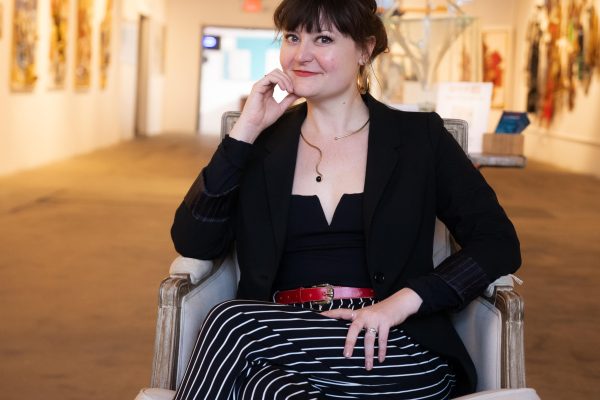

One of the miraculous things about New York City is how much goes on without your ever knowing about it. Every day a piece of art is made, a performance is rehearsed and mounted, or a writer sits to start what could be their magnum opus. That feeling– of joyous frenzy– that creation is both possible and essential, is what I felt while speaking with Tess Howsam, the Aristic Director of Culture Lab LIC since 2022. Culture Lab, a multi-disciplinary arts organization in the heart of Queen’s Long Island City, is challenging the forces that make viewing and producing art prohibitive in New York City. Housed in a building gifted by the former plastics manufacturing company Plaxall, the organization mounts fine and performing arts shows, a series of community outreach programs, free outdoor concerts, and artist residency programs while touting affordable or free admission to their events. As Howsam laid out everything Culture Lab does and her job’s responsibilities, I was mesmerized by how ambitious the organization is and how perfectly suited Howsam seems to her post. A playwright, actor, and director, Howsam has spent her career producing interactive multimedia exhibits as well as running a theater company she founded in 2012, Exquisite Corpse Company. Read below to hear my conversation with Howsam on the daily machinations of running a hybrid arts organization, how Culture Lab’s programming has been inspired by its community members, the potential for international collaboration, and the future of arts in New York City.
This interview has been edited for both clarity and length.
Eve Bromberg: Let’s start with a brief history of Culture Lab LIC. How did it come to be?
Tess Howsam: Culture Lab LIC was officially born in February 2020 [OY!] but before there was Culture Lab LIC there was Long Island City Artists, an artist-run organization that our executive director Edjo Wheeler is/was a part of when he found this space in 2016. Edjo and other like-minded artists ran the space originally as a temporary pop-up art venue that Plaxall gifted as part of a community give-back program. It started as a space to host pop-up art gallery shows with the occasional performance and then over time, Edjo founded Culture Lab LIC as a not-for-profit arts center and Plaxall continues to be our main sponsor by giving us this incredible space, one of many buildings they have in the area, to activate and give back to the community and artists alike.
EB: What is Plaxall?
TH: Plaxall was a plastic manufacturing company in Long Island City. Once their production ceased, they decided to allocate their warehouses to the community by renting or gifting space to nonprofits and arts organizations. That we have this space, from Plaxall, is part of the magic of Culture Lab. In New York City, finding a venue that’s been gifted to artists as an investment in a community is almost unheard of. It’s our Cinderella moment for sure.
EB: Especially because Long Island City has undergone so many changes. I would be interested to hear about the impact of the neighborhood changes on your organization.
TH: The organization was first Long Island City Artists and became Culture Lab LIC officially some four years later. But it’s funny, the change to Culture Lab also happened at a time when the community was really in need because of the pandemic– I can only speak to what I’ve heard as I didn’t join the organization until 2021– but almost immediately we started doing food donations and pickups and then we started a series of free outdoor concerts in our parking lot, which we still do today with our outdoor concert series “LIVE! At Culture Lab LIC” from May until October. We put bands on our outdoor stage and there’s a backdrop of Manhattan that is truly gorgeous.
What’s unique about Culture Lab is that we’re a center for all: those who have been pillars of the community for years as well as newcomers. Beyond LIC, further into Astoria and Flushing, we’ve started to get the word out about our programming and its accessibility. I think that’s an advantage Culture Lab has as a newer arts organization; we don’t have an established demographic, we’re for everybody. That’s what I was originally drawn to with Culture Lab, that we’re a hybrid arts center for everyone. You can come for one medium but end up experiencing another. If you come for our free concerts you end up walking through the gallery space and seeing one of our curated arts exhibits. Maybe you didn’t think you were into fine arts, but maybe a painting will speak to you. Come for the concert and stay for the fine and performing arts!
This year I and my team are offering a new program called “Culture Lab After Dark” that’s geared towards late-night activations of our space with drag and burlesque shows. After Dark is showing us yet another side of our community that we want to celebrate and serve. Some people come for the drag show and then end up seeing our exhibitions or come while there is still a concert in the Lot– it’s almost an Alice in Wonderland-type experience. You turn the corner and are met with something unexpected!
EB: And it’s all happening in one space under one roof! That itself is extremely rare!
TH: Exactly.
EB: So your background is in both acting and playwriting, and you run your own theater company, Exquisite Corps Company (ECC). Is your company still running now?
TH: I’m primarily a director of immersive theater pieces and installation art now. I have served as the Artistic Director of ECC since I founded it in 2012 with a group of like-minded artists. That was the direction my career had gone before joining Culture Lab, and in joining the organization, especially given its youth, I’ve had to put a pause on running ECC full tilt. I tell people that starting and running Exquisite Corpse Company is what set me up for this role at Culture Lab. For so many years, I was curating art shows on Govenor’s Island that then turned into immersive experiences, and in my 20’s I was planning warehouse parties where I was booking bands, burlesque dancers, and aerial dancers. Something that’s always been dear to me as an indie theater maker and artist is how the arts can collaborate to strengthen each other rather than fighting for the artistic scarcity we get told exists because of limitations of funding– why not join forces so we can pool our funding?
EB: As Artistic Director are you responsible for all programming or are you part of a team?
TH: I work closely with Edjo Wheeler, our Executive Director, but my job is to primarily design the programming calendar. Artists send us proposals for a wide variety of work– curation, dance, music– and my job is mainly to design and curate our season each year. As the organization grows, there will hopefully become heads of each artistic department but currently, it’s just me and a full-time staff of four! I program our concerts that happen Friday through Sunday, and our gallery shows that are up for either a month or two months. I like to have at least two featured theatrical productions a year that Culture Lab is co-producing. This year we have our After Dark programming and our very new child, The Arise Spring Dance Festival. In the fall, we have our New Works Festival that I’m producing which will feature our four artists in residence’s culminating projects.
I run our Emerging Artists Residency awarded to four artists out of around 200 submissions. The only requirement for applying is that the work be performance-based. Our current artists in residence are House of Chow, an Asian Hip Hop group, Gaby FeBland of Foreshadow (shadow puppetry), Danie Kohna creating a contemporary circus show, and The Museum of My Heart by artist Helixx Armageddon, which will feature her original music along stories and memoirs of community members on topics of love and loss. These four artists represent the kind of work we seek to highlight at Culture Lab: hybrid pieces that don’t fit seamlessly into a single discipline.
EB: How did your current The Search For Utopia, a collaboration between American and Slovakian artists, originate?
TH: It was the result of a community member, Laura Zaltos (whom I worked with for years through ECC) introducing me to the director Michal Klembara of Malý Berlín, a nonprofit in Slovakia– The Search for Utopia is an iternational collaboration between our two organizations. After meeting Michal, he ended up doing a site visit to Culture Lab and we bounded sharing about our two art institutions. His institution also focuses on interdisciplinary programming. Through conversations, we decided to do a show together. There’s a world in which this show will next travel to Slovakia and hopefully connect with those folks as well. Continuing to find international collaborators is something I’m very invested in for Culture Lab. I previously worked as a co-director on two different immersive projects for a German theater company, Das Letze de Klinode. The shows focused on stories about emigrants from Germany to America, and the experience, of being brought into that community, offered me a unique perspective on my positionality as an American. I hope that in building these international collaborations at Culture Lab, we can continue to expose our community in New York City and Long Island City to these different viewpoints.
EB: Did you learn anything particular about Slovakian nationality through this collaboration?
TH: I was speaking to someone as we were curating the show and they asked if all the Slovakian contributions included lush paintings of green fields and I laughed because the work being presented is rather brutalist! One of the artists, Natalia Simonova, is using actual rust in her paintings which call into question socialist ideas in Slovakia. The evening of our opening, which got delayed because the artwork got stuck in customs, was the night of the Trump assassination attempt which was only two months after the assassination attempt of the Slovakian prime minister Robert Fico. There was an interesting ripple through the space. Even though we’re coming from different places, there’s so much to be said that’s shared and it seems to me there’s potential for crises to be less alienating if we focus on that.
EB: This has been the sort of overarching question that we’ve been talking about, but, what is your experience of curating both the fine arts and performing arts, and how do you approach tackling two very different media?
TH: The fine and performing arts have always been connected to me. Storytelling for me has always been rooted in visual and fine art and I’m a bit of an art history nerd. Exquisite Corpse Company, for instance, is an interdisciplinary performance-based company, so we’ve always included collaborations with fine artists. In 2015, we mounted a show exploring the artists and artwork of the Vienna Secession called “Secession 2015”. To create the show we asked a group of artists, both fine and performing, to respond to six Secessionist artists. Take Klimt’s The Kiss, as an example. The artwork was used as a shared jumping-off point for both the playwright Laura Zaltos’ playlet and was presented in an art gallery showcasing fine artists’ interpretation of The Kiss today. When I think about the Culture Lab season, how we select the fine art shows and what’s happening performance-wise, the goal is to have work that’s in conversation. That doesn’t always happen, but I try to plan around an understanding of the experience of the patrons when they come to Culture Lab’s space.
EB: What do you see as the future of arts organizations? Do you think other organizations may follow suit in presenting multi-media artworks?
TH: In any institution, both the mission of the organization and artistic leadership influence what’s being presented. I’m someone who loves multidisciplinary work and I do think there’s a quality of interactivity that is valuable and something we’re going to see continue to develop particularly after the pandemic. Whether it’s through submissions of proposals, previous connections, or individuals inviting me to their shows, Culture Lab’s unique contribution is that we’re listening to what artists in New York are trying to present. We want to highlight their work and have other New Yorkers come and see it.
EB: You also seem to advocate for a loosening of demarcation between disciplines.
TH: Yes, Culture Lab ultimately wants to push boundaries rather than reinforce descriptions.
EB: Do you think there’s a future for this cross-disciplinary approach to curating?
TH: I think we will see more of an attempt to present multiple media works under one roof. I think we’ve already noticed an increase in it– take BAM, for instance. In the last few years, they’ve built out their gallery program. The same is true for HERE arts with the fine art in their lobby and the transition of the space has become more of a gallery than a lounge. I do think the increase of performing and fine arts uniting in this capacity will lead to increased visibility and accessibility– and that I find very exciting.
Leave a Reply