
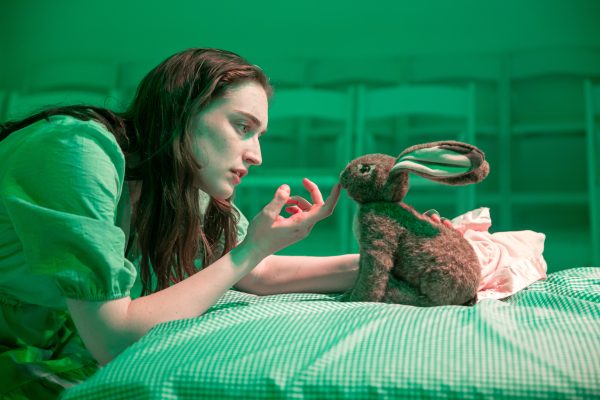

Playwright Sophie McIntosh’s latest play, Cunnicularii, which ran for two weeks in July at Chelsea’s Alchemical Studios, centers on the seldom discussed ‘fourth trimester’– the time between birth and 12 weeks postpartum. The play takes its name from a sketch by William Hogarth entitled, “Cunicularii or the wise men of Godliman in consultation.” The etching features Mary Toft, an 18th century trickster who fooled medical professionals into believing she had birthed rabbits. Partly inspired by Toft, Mcintosh’s play tells the story of Mary (Camille Umhoff) and her new-born daughter Josephine, who happens to be a bunny rabbit. Balancing gravity with humor, McIntosh’s surrealist portrayal of the postpartum experience calls into question both the expectations we continue to place on mothers, and the necessity of healthcare in the weeks following birth.

Mary goes into labor early on in the play, announcing the first of many anxiety-inducing scenes. A distressed physicality and complimentary lighting punctuate Umhoff’s cries. Her pain feels disconcertingly real and I’m excited for it to be over. When Mary’s obstetrician pulls a stuffed bunny rabbit from between her legs, Unhoff is visibly perturbed. To laugh, or to commiserate with the understandably confused mother? Unable to connect with her crepuscular daughter, Mary spirals into a deep depression: feelings of maternal attachment, of instantaneous love and understanding, are, for Mary, absent. We keenly feel her desperation “to want to want to love” her daughter. On the other hand, Mary’s husband, Howard, played by the cherubic Juan Arturo, is the ‘perfect doting dad.’ Bordering on a trite depiction of the well-meaning albeit unobservant husband, Arturo’s character proves to have depth in the end; later, he cries about the inevitability of his messing up as a parent.
Cunnicularii is an admixture of new and old, the schismatic pairing of which is an apt portrayal of our current dystopian state of affairs. The play’s 1950’s costuming, for example, in addition to a prop rotary phone, harkens back to a U.S. pre- 1973, a time before the codification of abortion rights; to which we have returned. The metaphor, of the rabbit, and the reference to Toft, acts as an entryway for viewer compassion: I too, would be concerned if I birthed a rabbit. That said, the idea doesn’t seem to extend beyond the comedic. Postpartum depression is not simply the result of feeling ‘let down’ by the birth (even if one’s child is human), or of unmet expectation, but a result of genetic inheritance and/or hormonal imbalance. In one scene, Mary performs a failed attempt at breastfeeding as her fanged-rabbit daughter viciously gnaws at her chest. A playful twist on the difficulty of breastfeeding, the bunny doesn’t offer much in the way of illuminating the challenges of new motherhood any more than a human child would beyond the increased discomfort and pain offered by a set of fangs. I fear that the bunny, and more specifically, the inter-species challenge of the dynamic, obfuscates the root of Mary’s depressed state: is she mourning lost agency? Lack of spousal support? Is motherhood simply not what she thought it would be?
Nonetheless, the bunny offers levity to a play about a woman’s relentless grief. And thankfully so, as certain scenes are difficult to watch. Mary’s unexpected and self-administered ‘hysterectomy’ being one of them. Having recently received a hysterectomy herself, McIntosh seems to write herself into the play at this moment. Does this occur in a dream state, or is it a moment of surrealist indulgence? I am mystified as to its relevance to the plot: is the hysterectomy an act of rebellion? A palliative for bodily disidentification? A condemnation of reproduction altogether?
Whatever its motivation, the scene is followed by another of Howard’s unknowing remarks: “Are you still bleeding,” he asks? To which Mary responds, dead-eyed, “I won’t bleed anymore.” This foreboding allusion is swept up and lost to Howard’s garish ignorance, “Great!” he exclaims, “we won’t have to keep buying new sheets.” This comment was lost on me. Sitting there, I could not unsee the visual of the hysterectomy. Should a play be so realistic as to horrify?
Towards the close of the play, Mary goes in for a 6 week check up,“My problems are more emotional than physical,” she declares. With routine disinterest, her doctor (Benjamin Milliken) thumbs through his checklist— “Maybe you could ask me questions” she suggests. He throws one out: “How long did it take your mother to recover after giving birth to you?” To which Mary responds: “I never thought to ask.”
This interplay lasts for some time, Milliken throwing questions at Mary to which she responds, “I never thought to ask.” Sitting there, I realized that I have not asked my own mother some of these questions. I am unsure as to whom these accusations of thoughtlessness are lodged, and feel it’s unproductive for Mary to stand as a siphon for questions unasked. I feel a twinge of guilt nonetheless. The scene continues. Mary timidly tries to advocate for herself. Even without total knowledge, Mary wishes “to talk about it more,” both a medical request to her doctor, and McIntosh’s invocation for us to discuss the postpartum experience more openly and honestly, inviting us, ultimately, to speak candidly about the myriad realities (and possibilities) of parenthood, even those including a bunny.

Leave a Reply