

Matthew Freeman, like most New York City creatives, has a day job. The award-winning playwright, who premiered his latest play, The Ask, in early September, spends his time out of the theater as a giving director at the ACLU. For the past thirteen years, he has asked rich, liberal donors for vast sums of money, from 9-5, and spent nights working on drafts of scripts. At long last, he’s decided to combine the two.
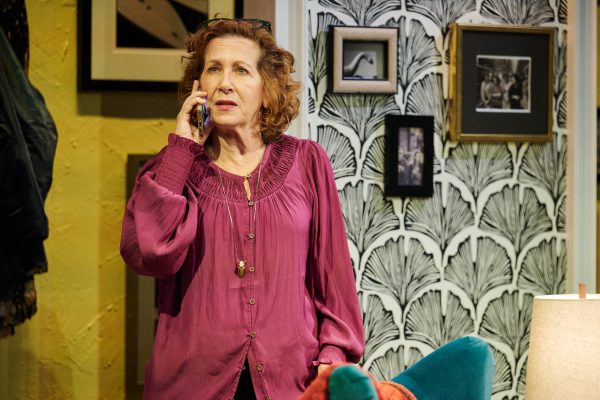
The Ask, running at Wild Project until Sept. 28th, dramatizes what one has to imagine is Freeman’s day-to-day experience. Tanner (played by Colleen Litchfield), a nonbinary, spiky-haired young (ish) fundraiser from Bushwick sits nervously in a butter-yellow apartment on the Upper West Side, waiting for Greta (a well-cast Betsy Aidem) to return from the other room. By the end of the show, they will ask her for as much as $500,000 – a gambit, especially when Greta is unhappy with the ACLU’s current direction. Greta, a now-extinct species of rich working artist who has just sold the family house in Maine but couldn’t bear to get rid of the one in Florida, is abrasive underneath her warm, familiar demeanor.
“Your colleagues called the constitution a white supremacist document!” she exclaims with incredulity while Tanner struggles to find the right response. She will call Clarence Thomas a traitor and later tell Tanner that identity groups have gained undue influence within the ACLU.
At its best, Freeman’s script paints a thought-provoking picture of the differences between generations of progressives. This is clearly his intent, drawing out discussions that resonate with the audience, and evoking conversations with real-world aunts and family friends. A restrained tension runs throughout the show, making it clear that both characters are nodding politely to the other’s opinion rather than truly entertaining it. Both perspectives, presented with equal strength, will be the way that audience members identify with the play. It is hard not to take sides. Freeman knows this and has painted an honest, at times, empathetic, portrait of two people who will vote the same way in November but cannot truly understand each other.
This comes to a head in the last fifteen minutes, when the two discuss (which to say, Greta argues at Tanner) inclusive language. Once we arrive here, you know that this is the destination the play has been hoping to go all along.
“You can’t even say the word women,” Greta repeats over and over, objecting to Tanner’s claims that the ACLU strives to protect ‘pregnant people’ in the wake of the Dobbs Decision. A lifelong advocate for women’s rights who has had an abortion herself, we understand that Greta feels marginalized, abandoned by the liberal rights that she has fought for. By the very nature of the two-hander, we are forced to reckon with Greta, seeing her as more than just a liberal stereotype. Directed towards Tanner, though, someone who has been followed into bathrooms and whose identity ‘might even have been a struggle,’ (as Greta presumes) audience members are forced to contend with both perspectives. The Ask’s greatest strength comes when it understands that both generations are equally right.
The play rarely, however, reaches this height. Much of the ninety-minute run time is devoted to a comprehensive dissection of the way the ACLU has changed – the clear subject of discussion at what is, after all, a business meeting, but one that has less emotional relevance to the play’s larger themes. This ends up being the criticism that sticks after the curtain is down. Greta, who became an ACLU member when the group defended the rights of the Nazi protests in Skokie, can’t believe that an organization once devoted to free speech now seems to police it. She asks how issues beyond the Constitution, like universal high-speed internet and the erasure of college debt, are at all relevant to civil liberties. It’s a question that many in the audience, myself included, may never have considered.
The Ask is an interesting– at moments, even important– premise weighed down by its own ‘play’-ness: forced to get to what matters over a convoluted road of character development and forced conversation. We spend so much time on the ACLU purely because it’s the only thing Greta and Tanner have in common. Worse still, is the uncomfortable amount of time devoted to their personal lives. Within the play’s first fifteen minutes, the two strangers have ‘bonded’ over discussions of dinosaurs, and Greta has disclosed that her nephew died from alcoholism. It’s not the way that strangers talk to each other, however well-meaning they may be. Until we get down to business, the dialogue is stilted with the awareness that it needs to make these two characters – because it knows that these are, in fact, characters – appropriately sympathetic to both the audience and each other.
In the end, Tanner spins their conversation. “What I see here is someone who loves the ACLU,” they say, someone who cares so much that they’re willing to fight for it even when they think it’s wrong. While The Ask may struggle somewhat in its execution, it’s clearly written by someone with a deep love of theater. It’s only a shame we might disagree on the specifics of how that should look.

Leave a Reply