
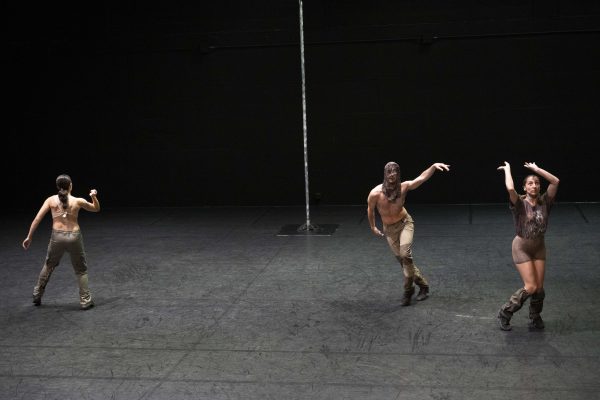

Lenio Kaklea, a Greek choreographer based in Paris, has typically merged movement, text, video, and scenic elements in her European performances since 2009. For her U.S. debut at New York Live Arts, part of L’Alliance New York’s Crossing the Line Festival, Kaklea adopts a minimalistic approach. In “Αγρίμι/Fauve”—which means “wild beast” in Greek and French—Kaklea and two other dancers, Georgios Kotsifakis and Ioanna Paraskevopoulou, perform on a nearly bare stage. The set comprises three metal poles and two punching bags, allowing for an elemental exploration of Kaklea’s current interests: the organized repetition of movement, shifts in human power dynamics, and the boundaries between the human and the wild.
“Αγρίμι/Fauve” is structured into three separate acts, presenting a cycle of encounters based, in turn, on Kaklea’s observations of the digital, urban, and natural worlds. Each scene incorporates movements drawn from the routines human beings engage in and the tensions—affections and afflictions—that may arise from them, resulting in choreography with a quasi-anthropological quality. While no narrative thread connects these scenes, they all share a spirit of the wild.
In the opening scene, the three dancers perform movements commonly seen on TikTok and Instagram, such as twerking, crotch grabbing, and hip slapping. The dancers move sensually and provocatively, like playful flirts, and perform exaggerated gestures—thumb-sucking, catwalks, hip dips, and death drops while twisting and arching their backs. They wave their arms into asymmetrical shapes, constantly looking back at the audience, making direct eye contact as if the audience’s gaze is their camera. Moving back and forth across the stage, they repeat these familiar movements, approaching and distancing themselves from the front row while frantically throwing hip thrusts. A dissonant electronic score blares along. The no-holding-back moves highlight the untamed and unrestrained nature of the virtual sphere, where everything is performed, and everyone is exposed.
While the first scene reenacts choreography taken from social media, the second is built on Kaklea’s observations of human power dynamics in a stylized physical negotiation that one sees in urban spaces. The three dancers pace aimlessly up and down the stage, forming interconnected minimalist choreographic phrases. As two dancers face each other, one steps forward while the other steps back. The phrases become longer and more complex—the dancers move to the side and add steps, mirroring each other, while the third dancer flows between and around them.
Picking up speed, the performers become perfectly synchronized as they execute a repeated, expanding phrase. They move as a tight, cohesive unit, each dancer depending on the others to maintain their rhythm as they carry out methodical steps, jumps, swings, and body rolls. They catch each other as they fall, draw each other near, and then move apart, relying on one another to stay in sync. Through a continuous negotiation of physical space, the dancers adapt their speed and trajectory in response to the flow of other bodies around them.
Kaklea’s constructed patterns call to mind the dynamics of relationships humans have with their environments, tamed or wild. She shows the codependency of these relationships and the anxiety it creates. At times, the dancers approach each other suggesting an affectionate connection—a gentle pull; other times, they share space through harsher movements—an abrupt push. Moves that evoke human domination and submission, force and persuasion, rupture and collaboration between self and others. The dancers move fluidly, creating a constant shift in roles of those who lead and those who follow. If any single part of this interconnected system falters, the entire unit may collapse.
In the final act, the stage becomes a space of stillness. The scene begins after a voice-over delivers a text by French anthropologist Charles Stepanoff, which speaks of Indigenous hunting rituals. Once the dancers re-enter the stage, lit only by flashlights each one holds, they push the two punching bags dangling from above, turning them into pendulums, the long shadows swaying, changing forms on the black stage backdrop. What we perceive are not the objects and subjects on the stage, but their shadows and reflections, as if reality is merely a simulation.
The dancers move toward three metal poles anchored to the stage floor, stand-ins for physical trees. They slowly climb the poles, a demanding physical effort, reaching an intimate space far from the crowd below. They remain at the top for several minutes, occasionally changing positions as they observe the world from above—like animals in the wild. Eventually, they descend, and Kaklea cuts open one of the punching bags. A rush of water spills out, crashing onto the stage, dousing the imaginary forest with wet reality. As the sounds of wind, rain, and thunder gradually become louder, the lights go out, leaving us to contemplate how our cultural practices shape and are shaped by our physical and virtual environments.

Leave a Reply