
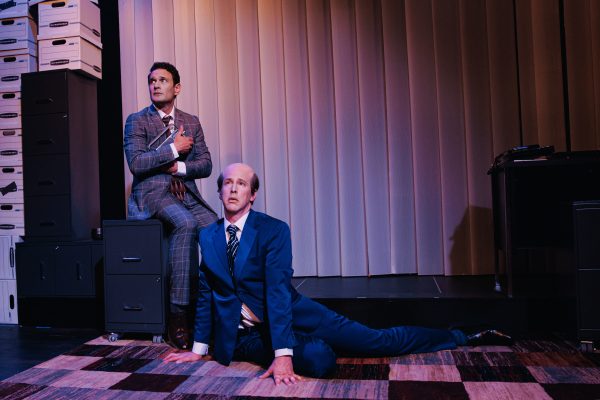

The ‘Cellino v. Barnes’ play ads have been almost as inescapable as their real-life inspirations in recent months. Facebook and Instagram have become virtual billboards with plastered actors across the screen in mock legal commercials declaring that you, the onlooker, have been ‘served.’ It’s only fitting. The Ross Cellino and Steven Barnes that most New Yorkers know, – staring up at you from bus stops, subway stations, and tv sets – would be proud.
This is the exact connection that the play wants you to make. Most of the show, directed by Wesley Taylor and Alex Wyse, relies on the audience knowing the titular personal injury lawyer namesakes, ubiquitous figures across New York, and pioneers of legal advertisements. Their jingle blasted across the airwaves for decades, and just the opening hums will send any New Yorker into a frenzy of jurisprudence-induced nostalgia. They were everywhere until their dramatic split in 2017. Bus stations that once shared pictures of their faces were replaced with competing advertisements, each man’s solo face taking up an entire bulletin. This fall, their journey from inception to breakup has been immortalized into farce by Mike B. Breen and David Rafailedes, playing at comedy club Asylum NYC. It’s a story as ripe for dramatization as it is for winks and nudges.
If such a thing as ‘inside joke media’ exists, then ‘Cellino v. Barnes’ must be the textbook example. The entire script relies on you knowing the jingle (800-888-8888, sing it with me) and that you’ve seen Barnes’s shining head on enough billboards to recognize Noah Weisberg’s bald cap. What are Cellino (Eric William Morris) and Barnes (Weisberg) other than one big running New York gag? Breen and Rafailedes play into the absurdity that has made the two larger than life. When they tell us they will “sue the crap out of you if you don’t silence your phone” it’s exactly what we hoped they would say – and so it is only right that the play itself be over the top, a caricature of a caricature. But, what, then, happens when you have nothing but the inside jokes to keep the show afloat? The caricatures, with nothing to make them interesting, fall to billboard levels of flat.
If you’re looking for plot, this play will not deliver. ‘Cellino v. Barnes’ is fueled by comedy alone – Morris and Weisberg deliver joke after joke without a second’s break for the entire show – but they simply aren’t funny enough to fill the story-shaped void. In the 2007 sequence, for example, we learn that Barnes is in charge of the legal issues and Cellino is in charge of office toilet color. This bit – which shade of white do you like more – continues for far too long. Not only is it not funny enough to justify the joke itself, but it also doesn’t matter in the larger context of the show. The play is a collection of similar moments, without purpose or pleasure, that make the 80-minute run time feel much longer than it is.
Perhaps the most apparent issue of the play is that the story doesn’t have enough conflict to keep it moving. Starting in 1997 at the firm’s inception, the audience is aware of the prominence that awaits these men, and so the question of whether or not they’ll get enough cases to keep themselves afloat isn’t interesting. When the two have a disagreement in 2007, it isn’t over anything related to their relationship or goals, but rather because Barnes wants to use their wealth to build hospitals (“why be an ambulance chaser when you can be the ambulance?”). It’s something that would play as a one-off joke, but is confusing when substituted for real stakes. The show ends in 2017 – year of the fateful destruction of the firm, and no doubt the moment that audiences have been waiting for – but, we come to learn, the breakup was a mistake. An accidental fax sent, which the two agree to let stand for the vague notion of publicity. This, a betrayal to the very Cellino V Barnes that got us in the door, is the final straw in a litany of purpose-less “conflict”.
Morris and Weisberg do the best with what they have, and many of the good moments of the show are a result of their willingness to commit to its absurdity. The boxing scene at the end, for example, or when we flash to a commercial that they deliver mid-jazz hand. The scenic design, too, by Riw Rakkulchon, has them rolling around the stage on filing cabinets on wheels, playfully skirting the line between the legal and the fun. There has to be more. One inside joke does not a piece of theater make. A play must have some reason to exist that is greater than the sum of its parts, to be able to stand on its own. If ‘Cellino v Barnes’ captures anything, it’s how two-dimensional those advertisements were all along.
Leave a Reply