
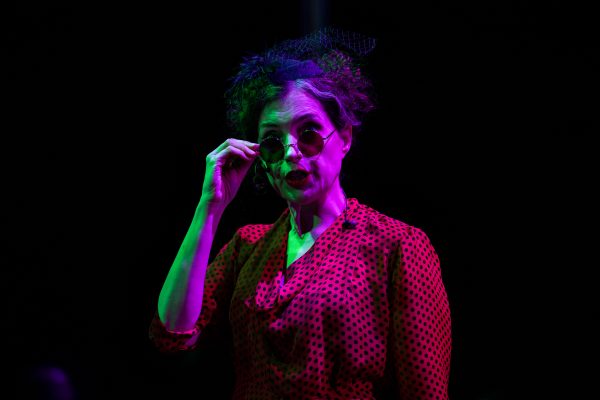

“Suppose beautiful Madeline Harvey”
This single phrase, sometimes a question, always invocation, is repeated by three characters. In altering shapes, the words capture the essence of Object Collection’s Suppose Beautiful Madeline Harvey, Richard Foreman’s final performed text, directed and adapted for the stage by Kara Feely with a live score composed by Travis Just. The work, staging, and adaptation of this production is in constant motion, questioning perspective, and ultimately interrogating time and experience itself: a revelatory, visceral, sensorial, tracing of an action between states of matter and their in-betweens.
Freely’s direction, of Foreman’s words, forces the active construction of meaning on its audience whilst delivering stage pictures so breathtaking, an atmosphere so confounding, and tones so miscellaneous, that the removal of a black cloth from a wooden chair can leave you agasp and suddenly in tears. Aesthetically, Madeline Harvey is beautiful. The opening image is of a bar, reflected down a central line, with clutter and screens on metal frames. A skateboard hangs on one frame, and bottles of alcohol stand on the bar. The back wall (at first) is mirrored, seemingly acting as the back of the stage. Around a third of the way through, the rear wall opens up to reveal the full depth of La MaMa’s Ellen Stewart Theatre, great and vast. From this point forward, there seemed to be a new surprise every minute, eventually revealing Travis Just, Chloe Ro, and Jack Lynch playing live music, a large collection of chairs arranged in a grid, and an organic monster. Travis Just’s compositions generate a sense of symphonic movement, through these transitions, in sweet harmony with the stage’s evolving image. Our monster is a leafy, green figure shifting through space.
Each theatrical element is carefully balanced, combining into total triumph, a cohesive whole, an idea that also floats through the performance text. There is something unconscious and maybe unidentifiable about the power of Foreman’s words, especially when his voice booms from the sound system for clarity and power, singing throughout Object Collection’s production. Ksander’s scenic design, like a disturbing set of Russian dolls, gracefully compliments the theatre’s architecture. David Pym’s video design, bowling animations and microbial whirls, offer an unsettling and eerily nostalgic visual. Karen Boyer’s costuming was styled with specificity and flair, with polka-dotted dresses constantly recurring between characters and appearing from suitcases, the same that Madeline Harvey wears herself although in a different color (black versus the protagonist’s red), to the erotic spacesuits (they’re pleather) and woolen trench coats of the later sequences. The design team’s harmonious work created a material language aligned with a theatrical experiment that feels distinctly original and playful without compromising cohension.

There is a precision to the text, which the performance upholds. In brief moments a character holds an object in a particular way or manipulates their body manually, reminding us of the performing body; these actors are not vehicles for telling a story but the story itself. The production referred, at one point I wondered if we were supposed to see John Lennon and Yoko Ono as two characters came on stage dressed as the part (or that of a generic bohemian fixed with long hair) before they faded back into the darkness. A skateboarder zoomed across the stage three times, the first two occurrences in the early repeated sequence, appearing from either side of the stage in mirrored variations, and once again upstage, in the larger space beyond the bar (that coincided with the revelation of the live band). Each time exactly the same. There was an elegance to every movement that could somehow be summed up by this speedy skateboarder’s reappearance. Objects and bodies at once objectified and alive, both object and subject.
I sometimes wondered if the choreography– the bodies’ articulations and physical movements– might have been sharper, at, say, the Performing Garage or St Mark’s Church under the reign of Foreman. The shapes and angles of the performers’ bodies seemed to signify Foreman’s method and tendencies, now referenced without attempt at their recreation or revival. Even if, Suppose Beautiful Madeline Harvey is an original work from Object Collection, neither a revival nor an existing Foreman play, this was Object Collection’s performance, expressed through a familiar, clearly respected language – both homage and contribution.
Before September 2024, my exposure to Richard Foreman’s work was limited. While I can only add a little to the surge of moving tributes to Foreman’s legacy that have circulated since his passing, the profound influence his work has already had on me is undeniable. Having moved to America four months ago to study theatre directing with Anne Bogart, I have suddenly found myself in conversation with New York’s Downtown Theater– its past and present– a tradition I now revere and hope to be a part of myself.
It was not until the series of events coordinated by Helen Shaw to celebrate the acquisition of Richard Foreman’s papers by the Fales Library at NYU that I had a formal introduction. I have since spent hours on the PennSound digital archive (which I’ve kept bookmarked since my first visit) and perhaps even more hours regretting that I never saw a Richard Foreman play live.
On the day of the final event of this series, ‘Richard Foreman Wants You To Wake Up’, an aged Richard Foreman appeared on the stage of The Skirball Theater– a grocery bag from Morton Williams hanging from an arm of his wheelchair. Before the event began, F Murray Abraham ascended the stage to speak to the theatrical scion. After a series of tributes– by individuals like Wallace Shawn– Foreman began a Q&A session. He first complained about the lighting in the theater before describing his process of making plays “intuitively”, “second by second”, without theorizing anything or knowing exactly where a thing was going. Always, however, maintaining total control. Ironically, the Q&A became hilariously chaotic as Foreman took over from his interlocutor and started to moderate a flurry of questions from audience members leading to an eventual rapturous ovation. The contagion of love and reverence directed towards this man was unforgettable.
Richard Foreman’s work will undoubtedly live on, and this impulse of brave instinct has already been transmitted to Object Collection. One takeaway from Forman’s tribute was his quoting Beckett’s “fail better”, resolving, and telling us to “make it again”. Foreman encourages production of his plays, allowing them to be staged without a license. He insists they should not be an attempt at recreation but as something new. In that suggestion rests a compulsion to carry Foreman’s motivations forward. We must make it again, without bemoaning melancholia for the bygone days of the 1970s downtown theatre, when things seemed more fearless. We must create from an urge to create again. With this last collaboration with Foreman himself, Object Collection has certainly succeeded at that.
The final words of the play, spoken by Madeline Harvey herself, sum up the whole project for me:
here, however, I must take my stand, not against reality, but deep inside reality. Invisible, therefore, but always fed in a way that many others are never fed. Does God speak to me perhaps? This is possibly because I have constructed parts of myself folded over other parts of myself to project a certain depth. And if only I didn’t have to speak using a language—then—only then perhaps, would I—Roger Vincent—be able to tell you—THE TRUTH ABOUT EVERYTHING!
Suppose Beautiful Madeline Harvey is a performance that constantly renegotiates relationships between the performer and spectator, language and performance, space and time, to form composite, multiple realities. It is a piece that so masterfully captures and reinvents a performance ideology, culminating in a total experience beyond language or description, and in doing so, tells ‘the truth about everything’ through Richard Foreman’s echoing palimpsest.
At the performance I attended, I sat next to a young actor. He texted his friend, telling them he’d been successful in securing a last-minute ticket to the otherwise sold-out performance. He then wrote that this is the kind of theatre he hopes, one day, to be a part of. A special event indeed. Foreman’s passing casts an additional retrospective beauty onto Suppose Beautiful Madeline Harvey – a birthing legacy, an enduring search for ‘truth’, and an ever-enrapturing bewilderment.

Leave a Reply