
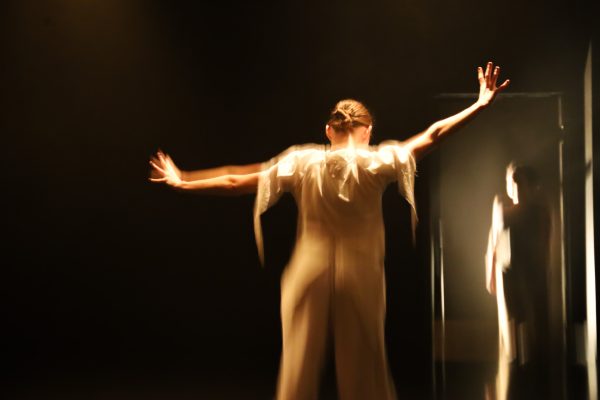
The Suite is by Julia Antinozzi and co-presented by Live Artery | New York Live Arts and Triskelion Arts.

Throughout The Suite, a story of requited yet restrained love unfolds between the Poet (Dasol Kim) and a Sleepwalker (Kelsey Sauliner). The two develop a tenderness matched by the duty and devotion of The Divertissement pair (Sienna Blaw and Pualina Meneses). Passages and barriers of light designed by Connorr Sale with Anna Wotring divide and guide the layered duet as they gesture towards and away from contact. Costumes by Sonya Gadet-Molansky dismantle the balletic binary. The dancers wear ballet slippers marked by dust and friction, except for The Sleepwalker who bourrées across the floor barefoot. At times, the sound of Ryan Wolfe engulfs them in bellowing sirens that are attended to and answered by the dancers’ movement.
I love dress rehearsals. They sit between the crux of presentation and potential. What we want from the work, what it is, and what it can be, abrase against each other so much that the empty house begins to vibrate.
Before attending The Suite’s dress rehearsal, I want to know Julia’s secrets. I ask her to share her references, thematic and choreographic and she compiles them into a typed guide giving me a peek into what she’s seeing, reading, and thinking while making this piece. I want to make sure I get it. That way, when we go for a drink after her rehearsal, I can ask her questions that pierce her material rather than skirting around. But when The Poet offers her hand to the Sleepwalker, who then holds it and brings the side of her cheek to meet it before pulling away, I begin to question if a story can be known. What if it can only be felt? Perhaps because of this, I become less interested in what The Suite is about and instead want to know how Julia created it.
What is remarkable about Julia’s process is the distance she invites between herself, her source material, and her dancers. Within this distance–the space in between text, body, image, and memory– new meaning is found. To say the work was inspired by Balanchine’s La Sonnambula flattens the dimension Julia and her dancers tirelessly carve throughout the work’s duration. Julia’s process is not rooted in mimesis but delves deeper into reverent acts of movement transmittance and transformation.

Julia’s postmodern ballet, her words, and movement is driven by an undercurrent of tasks. Aside from easily identifiable ballet technique, Julia’s choreography affixes familiar gestures of daily life with abstracted pantomime. She tells me that behind every extension of touch and beneath every gaze is a direction that has been derived, distilled, or abstracted from an external material. Julia utilizes abstraction as a compositional tool to create her movement’s distinct emotional texture. Her dancers salute, bow, courtesy, shake hands, and kiss with sincerity. Yet their intimacy is not immediate, it’s remote. Julia is careful not to have the Poet and Sleepwalker touch too soon. And when they do, their bodies join at the edges, threatening to pull away.
To generate the Sleepwalker’s solo, Julia gives Kelsey text from Allegra Kent’s autobiography Once A Dancer. In it, Kent recounts her preparation for La Sonambula and the performance of the Sleepwalker in the role Balanchine revived for her. When reading and distilling Kent’s words, Julia was not after a breakdown of the movements Kent performed but the moments of embodiment: her artistic devotion to the physical score, ballet’s form, and the piece’s feeling.
Julia creates a long list of phrases. Among them are:
unexpected presence
fluent drifts
fingertips see – eyes do not
Julia leaves Kelsey alone with the list and then comes back to her. These phrases, sometimes poetic, sometimes literal directives, guide Kelsey as she makes her own movement. Then Julia makes suggestions, a practice picked up from dancemaker Jennifer Nugent, to alter and shape Kelsey’s material. With Kelsey’s appropriation of these suggestions and Julia’s continual adjustments, her character begins to solidify. Julia notes that Kelsey is not only dancing as the sleepwalker but is dancing as Allegra Kent as well. Her character blends subject and muse. Julia welcomes the slippage of self and the personhood that inevitably flows through the cracks of adaptation.
In The Suite, Julia composes relationships that hinge upon thresholds between the known and unknown, between achieved or avoided intimacy. I asked Julia to define what I come to comprehend as “liminal romance”. A phrase from her program note stuck me because without knowing exactly what it meant, I knew I had been entrapped in one. We discussed the love that is confessed in whispers and found in the nooks inside of elbows and between cheeks pressed together. The Poet, Dasol, is often on the outer edge of The Suite’s action. With her back to the audience, she positions herself with us as voyeur, hunter, and muser. There are moments when the Poet offers herself to The Sleepwalker like a gentle suitor, her hand begging to be held.
Julia shows me another list of phrases pulled from the book Suki Schorer on Balanchine Technique.
take by the wrists
illusion of support (when no support is needed)
step in from behind
The words come from a chapter on ballet hand-holding and fingertip partnering. Schorer’s instruction becomes an abstracted scaffold for Julia’s choreography. She shows me a video from the first duet rehearsal between Dasol and Kelsey. Their movement is not far off from what I have just seen, during their performance, but it’s a raw task hinting at a deeper meaning. Julia says that over time the longing, the build, and the story has developed between them. Composition gives way to feeling. The partnership between steps–the reason why they are placed next to each other– and harmony or disruption of their pairing is where the story develops and now lives.
We discuss the old adage that characters write themselves. Do characters dance themselves? We’re not sure. But Julia says she does not always know what to do and finds answers hidden in her source material or they are given by her dancers. I have always found dance-making very lonely, I tell Julia. She reminds me that it does not have to be.
I ask Julia when she knows a dance is over and she tells me she just feels it. She also tells me someone told her to end it before it is over.

Leave a Reply