
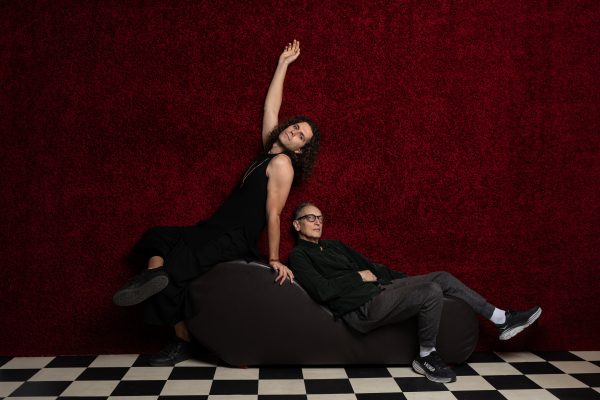

When I scheduled my interview with Jerry Lieblich and Paul Lazar—in preparation for the latest run of The Barbarians, Jerry Lieblich’s unfurling meditation on rhetoric and power (and the power of rhetoric) with Lazar’s direction at La MaMa starting this February 14th—I emailed them beforehand begging them to, when we met, be weird. I had just finished reading the first few pages of The Barbarians and was astonished by a reference to J.L. Austin–the British philosopher whose slim book How to Do Things with Words is part of every Philosophy major’s coursework–in the early pages of the script. The invocation of Austin was done with such authority, it was clear that what rested in these pages was the product of deep analysis and would have to be discussed with rigorous care. And so, I emailed them to plead, but also to ensure that I wouldn’t be phased by the esoteric or bizarre; I looked forward to engaging with the materials, and their creator and stager, exactly as they were. I see now that this was a request for Jerry and Paul to be themselves and to, over the course of the interview, envelop me in their worldviews: how this work came to be, what it’s like to work together, and how this play exists amidst more traditional approaches to theatre. When we finally met, at a bakery in Brooklyn, they not only delivered– I see now this was a silly request– but in our conversation demonstrated the seamlessness of their collaboration. They both spoke of a history of theatre with an enthusiasm for the same theatre makers, and weaved in and out of questions to demonstrate how each considered the other’s role in the making of this play. When a waitress came by our table, they ordered the same thing, twice! First a spinach and feta pie, and then variations of a fruit muffin. At one point, Paul started asking Jerry questions about the specificity of their language, they were about to start a new series of rehearsals, and he had questions at the top of his mind. Our conversation was peppered with musings on the history of New York Downtown Theatre, Paul– a special type of actor who can only be referred to as The Actor’s Actor– supplying us with countless anecdotes about the heyday of this bygone period as well as an analysis of the avant-garde (there is not an aesthetic of the avant-garde, he argues, only tendencies). Jerry, whose approach to playwriting and enthusiasm for language can be understood as almost scientific, outlined the process by which they have come to rely on language as a tool and how the form of the play satisfies a childhood interest in neuroscience.
Jerry– the founder of Third Ear Theatre Company– and Paul– known for roles in Silence of The Lambs and Bong Jong-ho’s The Host as well as his theatre company Big Dance Theatre– have been at work on The Barbarians since a staged reading of the play at New York Theatre Workshop in 2014. Brought together, somewhat, by playwright Mac Wellman, the two share a great reverence for nonnormative theatre– a term Jerry supplied during our conversation when avant-garde didn’t quite do the trick. Their mutual interest isn’t merely in the product, but the process by which the sometimes staid medium of the play can be torn apart and put back together to resemble something entirely new– and perhaps incomprehensible. While both have a traditional education in their field– Lazar studied with Esper and Lieblich holds an MFA from Brooklyn College– their approach to unconventionality is studied and considered. It is not with haste that they may throw spaghetti at a wall, but after considering the potential vector of this motion. It felt, even more so in retrospect since his passing a few weeks after our interview, that we were speaking in the tradition of Richard Foreman. That both Jerry and Paul are paying homage to him and carrying his tendencies and ambitions into our current age. I left the conversation both hopeful for the potential of deeply considered theatrical productions, and big fans of Jerry and Paul– both the unit and individuals, individually.
Read on to hear about the lifespan of The Barbarians, the process by which to approach non-conventional theatre, language as a material, and a time when The New York Times covered shows at off-off Broadway venues.
This interview has been edited for both length and clarity.
“I’m looking to the room to fuck me up and liberate me from my plan.”
Eve Bromberg: What was the genesis of this project?
Jerry Lieblich: I wrote this play leading up to the 2016 election. In the early stages of writing The Barbarians, I remembered something Anne Washburn said in a class I took with her in my early 20s at the 92nd Street Y. All the other students were women in their 70s, and someone brought in a play where Ronald Reagan was a character. She commented on the strength of taking a big swing. So, I thought, let’s make the president a character!
In 2016, I was thinking a lot about rhetoric. I studied Philosophy as an undergraduate and a friend of mine, who was finishing his PhD in Philosophy, was writing on promises, which got me thinking about speech acts. At first, I thought it would be interesting to pursue the question of what speech acts are in theatre. I started by making a play entirely out of speech acts, but, I discovered that every assertion made on stage became a speech act. That was interesting because I saw the world start to become created by its language. I realized, then, that I didn’t need to write the play with explicit acts: in being language on stage, that dynamic would be present.
As far as the writing process, I gave myself the task of not knowing where I was going and starting at the beginning and working intuitively as a way of breaking out of a more formulaic structure I’d used for previous plays. Because I was dealing with how words shape the world, and one of the characters is the President, themes suddenly started to emerge.
Paul Lazar: Jerry’s character, Fake Madame President, has a hilarious backstory that doesn’t resemble anybody who’s ever occupied or even run for office.
JL: She is an aspiring novelist, and while living at a restraining order’s distance from Iowa Writer’s Workshop writes her magnum opus. She ends up writing a novel that’s so heart-wrenching that no one can finish reading it. Because of the emotional heft of the book, she can’t get anyone to publish it. Then an intern at Simon and Schuster puts together the shredded pages of the novel, he happens to be a conspiracy theorist hence the assembling of shredded pages, and realizes that the writer has an incredible gift with language. The intern happens to also be a champion Simpolic Bureau player [not a real game] with an interest in Civics and decides this writer is the ideal candidate he’s always wanted to run for office, so he decides to run her campaign. She, the writer and future Fake President, is so rhetorically gifted that she’s able to bring crowds to spontaneous weeping and rockets into power. The play assumes a suspicion of narratives that can be used to manipulate emotionally and intellectually, for instance, the speeches at the DNC, not even to mention the RNC, both of which make my stomach turn. I’m not making a moral judgment of this type of rhetoric device, but acknowledging its existence. So, if there’s a question of why the president is a novelist? That’s why. She is in the business of narrative creation and is now using a political platform to deliver a narrative in an entirely new form. Her ascent is due to this great ability.
EB: Has Paul been the director since The Barbarians’ inception?
PL: Yes. I was introduced to Jerry via his agent, Antje Oegel, who is Young Jean Lee’s former agent and is sort of THE person for nontraditional theatre makers.
EB: What are we considering nontraditional theatre? Are we categorizing theatre type or venue? Nonnarrative works– like we’re not talking about Annie Baker?
JL: Not Annie Baker.
PL: No, I would say not. I’m a big fan of Annie Baker so I don’t mean it as a qualitative judgment, but I guess I mean work that is not bound to a set of “ givens” about acting, narrative, and representation. Annie Baker is a wonderful playwright, but she roots her work in the existing conventions of acting and narrative, and from there she does wonderfully inventive, risky, and beautiful things. “The Flick” is about three people in a recognizable situation acting quite realistically.
What I’m referencing– and you have to take each case individually because once you relinquish those givens, everybody’s approach is its own thing that can’t be classified into an aesthetic, per se– is a tradition of theatre markers and playwrights working at reinventing the form, “the avant-garde”, if that’s even the right term. Writers Tina Satter and Sibyl Kempson come to mind as neither rely on a naturalistic approach to their work.
As for how we started working together, Annie [B Parsons, wife of Paul Lazar] went upstate some summers ago and Jerry had sent me the script and I spent the weekend reading it. We also had a connection through Mac Wellman who Jerry studied with at Brooklyn College. You did that program, right?
JL: Yes. I wrote this during my first semester at Brooklyn College, while a student of Mac’s.
PL: Every single playwright we’ve mentioned, including Annie Baker, went through Mac’s program. Mac and I go back because we did his Antigone at Classic Stage Company which was quite great. Mac saw our company [Big Dance Theater] in the 90s. He saw the second production of our company, an Ödön von Horváth play at CSC, Don Juan Comes Back From The War, and liked it so much that he asked us to direct a piece of his. So, the fact that Jerry was a student of Mac’s had meaning for me. But, that’s all tangential. I read the play and was incredibly amused. I didn’t necessarily see what it would look like, but I felt very liberated by the fact that there wasn’t an apparent narrative. It had a freeing effect on me.
EB: Most people would shy away from something like this, without a narrative!
JL: Yes. Aside from already being a fan of Paul’s work, that was a green flag for me, that he didn’t ask me to explain the play to him. He was ready to hang with it immediately, which was great. It felt simpatico, instantly.
PL: That’s probably in no small part from all the work I’d done with Mac. While I’ve directed narrative-driven plays before, this kind of play, a play like The Barbarians, is probably my preference. I like the freedom it confers. I think, paradoxically, I have quite a traditional essence, but I don’t want to be trapped by that. I like things that make those trappings impossible. There is actually a narrative here, in Jerry’s play, that I’m very dedicated to. People in the audience won’t necessarily know it’s there, but I find that it’s incredibly important as an anchor: all the aesthetic and directorial decisions relate in part to the fact that the narrative is there. In Mac’s work, I’ve always striven to find whatever amount of narrative and I’ve found that in some sense of the word, in some sense, there always is one.
EB: How are you defining the “Traditional” of a “Traditional Essence”?
PL: I want to know where we are, what’s happening, what’s the sequence of events, where people are coming from. People have used the uniqueness of Mac’s writing, for instance, as an excuse or a reason to be generally weird and it’s been disastrous. It’s gilding the lily, putting an open thing on top of an open thing, and getting to the point where a play diffuses completely. As far as I’m concerned, I’m telling a straight story. That’s always been my approach.
EB: You are working towards legibility.
PL: Yes, and the writing is going to liberate it from being just a little story. Mac has a joke that’s so funny about Death of a Salesman, a play I quite like. At a performance of Salesman, a man in the audience asked why everyone was crying when it said in the title he was going to die!
EB: Paul, how did you come to direct?
PL: Annie was teaching at the Experimental Theatre Wing at NYU and there was a senior project with the ETW students the director dropped out of on a Friday, and rehearsals were meant to start on Monday. The head of the department at the time, Kevin Kuhlke, reached out to me and Annie to ask if we were interested. At this point, Annie and I were making work together but I was just a performer, but we said yes. A friend of ours suggested a Fassbinder play called Bremen Freedom, which was small enough to handle. Annie, who is a choreographer, and I ended up inspiring each other: the staging became choreographic and the choreography ended up quite theatrical. We hadn’t come in with a concept so much as we just showed up as ourselves. The Fassbinder play turned out great and freakily it moved from NYU to an off-off Broadway theatre that no longer exists called Cucaracha. The production got reviewed by The New York Times and the guy who ran CSC asked us to do a play for them, and so off we went. I didn’t plan on becoming a director, it was just kind of a thing that happened, but it suited me very nicely. At times, I have not found acting to be entirely intellectually satisfying, or at least the way I go about it. It was such a pleasure to get a job where you had to steep yourself in every aspect of a project.
EB: Can you say a bit more about the limits of acting?

PL: Bill Esper used to say, when you’re preparing for a traditional part, what you know is important, but it’s sort of about what you don’t know… you have to cultivate a subjectivity to really deeply fit into where you fit. When preparing for a role, I occlude things that would contradict my subjective perspective and I commit and try to season, leaven, and enrich that point of view. It becomes, for me, so much about feeding yourself in a very particular way, and it’s about cultivating a deeply invested narrowness. It’s interesting what you have to foster within yourself for certain roles, I’ve played roles where I’ve had to cultivate a real visceral conservatism and it’s kind of fun to find that side of yourself, but directing you play all the parts and you have to see all the points of view. It’s a mandatory multiplicity of perspectives. I like that so much more. I feel very free as a director because I don’t know what I’m doing and I haven’t identified myself as one, so my identity isn’t entangled into my job as much as it is when I act. However, performing, when it clicks in is exhilarating. There are moments in performance where you actually transcend the ego. Those moments keep you wanting to do more.
JL: It’s wild to think of a time when the New York Times would go to a place called Cucaracha Theatre and review a production that came out of undergraduates of NYU… what a world!
PL: That is so true! There’s like one mainstream critic, Helen Shaw, who’s interested in anything other than the mainstream theatre… that world has evaporated. We’re very Broadway-oriented, particularly post-pandemic. All the press coming out of the pandemic was about how Broadway was back, not theatre in New York, but Broadway.
EB: Did you study acting?
PL: I studied for two years with Will Esper, you know, Meisner Technique, and I did a lot of improvisation too, but Esper was my teacher. You’d be surprised by the number of people in Downtown Theatre who studied at Esper. Ari Fliako, for instance, who does a lot of work with Wooster Group is Esper-trained and Tory Vazquez of Elevator Repair Service as well. The way Esper works for an actor who’s doing completely nontraditional things, like what Ari does, is similar to what I’m talking about when I discuss how I like to work on Mac’s work or Jerry’s work. Underneath you have these ideas to draw from about approaching a story, a type of anchor that again the audience might not see but is incredibly helpful for the actor.
JL: Right, on this point about an anchor, there are two mistakes you can make when approaching a Mac Wellman play. One is putting weird on top of weird and having it float into nothing, as Paul noted, and the other mistake is knowing you have to ground the narrative but making that grounding a straightjacket unrelated to the text.
PL: You end up imposing a reality that isn’t there.
JL: Exactly, so it takes a delicate kind of reader who can see what is there and bring it out. And it’s very hard to do. This dynamic is something I’ve heard the actor Steve Mellor discuss. He’s been in a lot of Mac’s work and we did a play together last year called Mahinerator written in a type of English dialect.
PL: It’s a dialect that Jerry invented.
EB: You invented it?!
JL: Yeah! You smudge language enough and you get something… the grammar’s all scrambled.
PL: You’ll recognize the words, though. It’s a terrific piece.
EB: Jerry, you have a language thing!
JL: I have a language thing!
PL: The way it manifests itself in this play, or one of the ways it does, is sometimes you’ll put in a word that sounds enough like a word we know so we know what word it is, but it’s not like… what’s an example, like “you blink stow” is “you think so” so I’m wondering about that… what’s that about?
JL: Yeah, that mostly happens with the characters of the Dog Turd and Cigarette Butt, and I think that’s something of their received scrambled mind or received language.
PL: Oh I see, that’s a way a Cigarette Butt would say “You think so.” Aha, I see!
JL: I think so, but it’s also just sort of amused me in a very simple way and it’s just playing. Something that I’ve heard Steve say a lot, while he was doing Mahinerator but also watching him do Mac Wellman’s really difficult language work, like Terminal Hip, the key is the character’s saying exactly what they mean and it’s a mistake to have a paraphrased version of the meaning while you’re saying something else. If you direct in that kind of way, where you’re thinking about what’s happening independently from what the text is saying, it’s not going to work. It’s tempting to overlay a narrative, suddenly you could say they’re office clerks trying to file a paper, but if that’s not there, it’s not there.
There’s a William Carlos Willams lecture where he declares that poems are not made of images or ideas but of words. And what you’re doing, as the poet, is arranging words. That’s the stuff, the material of the poem. At some point, I asked myself what the bare definition you could ask of a play having occurred. One way of asking that is, ‘Were all the words said in the right order’? And if so, then the play happened, in some way. Thinking of it in that way, if that’s the material, that’s what my fingers are on and that’s what I can play with and smudge, and that’s opened my writing and thinking in a lot of ways.
EB: That’s fascinating to me! Given your interest in language and language as the material, I’m curious, why is The Play your form? It seems this tendency, and I’m thinking here of Joshua Cohens’ Book of Numbers where some of the novel’s very plot is in its construction, could lend itself very easily to prose.
JL: Oh that’s fun! I have a poetry practice, but that’s more recent, and in a way felt like trying to move into the house next door. I thought it would be easy, but I write such language-y plays, and it’s hard to learn how a poem works. It’s very different. I think, there’s a boring answer which is I don’t know, I was already writing plays. The more interesting answer is that I think with my ears, plays are a very auditory form. I haven’t written movies, but what makes me nervous about writing a movie is its inherently a visual form. With a play, no matter how you’re playing with the language, you’re still playing with the fact that it’s going to get spoken out loud, which some poetry does, but that’s not necessarily the poetry I’m drawn to. In my youth, I thought I would be a cognitive scientist and I came to the theatre with questions of cognition, perception, and attention. I think while I can explore those questions in poetry and a novel as well, something about the in-time experiential aspect of theatre, meant that you appreciate the perceptual experience amazingly. That’s how I’ve learned to use the form.
EB: Plays, also, in their writing, aren’t fully realized until they’re experienced out loud with other people. It’s sort of bizarre to think about, when you see a play, that it’s the product of this type of translation, and that its source, what’s on the page, isn’t the full capacity of the text. I sometimes think this, walking away from the text, is what casts such a large divide between literature and theatre.
JL: One way of looking at what I do is thinking about all my interests, but on the other hand, I also have all these deficiencies and so I work with those. I think writing a really clear plot with emotionally-driven characters is fucking hard. I’ve tried to do it and it’s hard for me, and so I’ve found all these other things I can do for a sense of progress in my craft.
PL: You can make a strong case for, and I don’t know the right word for this because avant-garde is wrong and downtown theatre may be too narrow, but with nontraditional theatre; I could name twenty brilliant artists who easily fit in that category who come from wanting to be X, perhaps a theatre maker, and tried and were laughed out of class. Failing at going at it in the available, accepted, and embraced ways– not that those can’t be glorious– is an incredible starting point for some artists. Yvonne Rainer tried to be an actress, and she was supposedly terrible, but instead, she created based on some alternate idea to which she was able to connect. When you think of all the work of the Pyramid Club, all the drag scene and camp and Charles Ludlam and Ethel Eichelberger, and all these absolute geniuses who made these things, they made them because they were flaming queens at a time when that wasn’t acceptable to be. If you wanted to be a performer in a theatre, there was just no way, so they went into their own thing and did so to the max. I could tell story after story.
JL: I remember Richard Foreman talking about this too. He went to The Yale School of Drama and was writing straight plays, and at one point his professor told him his plays were good but that he always ended up repeating himself. He decided, instead of fixing it, to exponentially increase that tendency over and over again and to see what happened.
PL: He ended up having a phrase, “Exploit the negative”!
EB: I was going to ask, but it seemed too obvious, is Richard Foreman a large inspiration for you, Jerry?
JL: Oh yeah, yeah. He’s amazing. But to circle back to your original question, about why Theatre, I think something I like about theatre as the writer, is when I’m doing my job well, I’m making a lot of challenges for other people to deal with. I can write a play and be very happy with it as a text, but know that it’s a chair potentially missing a leg. That then becomes someone else’s job. I leave room for Paul and the actors. I enjoy that release of control. It works well with my temperament.
EB: Paul, can you recount an early directorial inclination you had about Jerry’s text?
PL: What I tend to do is daydream. I sit with the material beat by beat and imagine an unconstrained version of a piece in my head that would be cool and then something kicks in. Sometimes you’re earthbound and you don’t think of anything other than the process of getting out of bed and walking to the door. But that in itself can be a productive move. When I get on a roll, the daydream picks up, and even from something like the simple movement from the bed starts to spawn and different elements start to appear. I bring my most current daydream version of the work to rehearsal, where the version meets reality. Sometimes that version doesn’t work in the world. When that happens, there are two really good sources for overcoming that obstacle: one is that everything in the room is available for solving problems or incorporation. And then the other source is the inclination of the actors– I might have gotten us up the road this far, but then I can watch and rely on them. I have a great example from our most recent reading at PRELUDE where at one point the Chief of Staff comes to the Fake Madame President to deliver important news and the President replies that she’s doing Pilates. In planning this moment, I watched a lot of Pilates videos and tried a movement sequence, but it didn’t work so I asked the actress (Anne Gridley) to stand there and smoke a cigarette. She responds by saying she’s doing Pilates but she’s standing there and smoking.
EB: Jerry, what was it like to receive Paul’s impulses?
JL: I feel like Paul will often ask me what’s going on and 99 out of 100 times I’ll say I agree with whatever he’s doing, and occasionally I’ll say that I also see it in an alternative way and then Paul will find a way to combine things. We’ve been working together for so long that it’s hard to tease out, but I think I trusted you with it pretty deeply pretty fast.
PL: Part of it is, I think, as a lifelong collaborationist, having a person there who is very connected to the material who isn’t me, who on occasion will suggest something, is a very helpful resource. Some directors don’t want their process infringed upon, but it helps me to be bent a little bit.
JL: That is something you’re very good at, Paul. I’ve worked with devising directors who come in with nothing and let something emerge and other directors who come in with everything figured out, and somehow Paul does both. You come in with a lot, but you also say yes to everything that’s suggested in the room.
PL: My plan is usually a matter of creating a relationship with the material on the terms the play seems to ask. But, I relate to that description, Jerry. I have a lot of ideas, but I’m looking to the room to fuck me up and liberate me from my plan.
EB: Does this play have Catharsis? Where does it end?

JL: So much of the language around theatre’s vitality has been based on going into a room and feeling the same thing. Fuck that! That feels like fascism to me. Part of my ethos, as a theatremaker, is making room for divergence. What’s interesting to me about asking so much of an audience’s imagination is everyone’s personal experience. I’m not interested in delivering a message. A message is something that you and I already know. I don’t think this play has a singular “gut punch” moment where we collectively exhale, but it does have emotion. There’s feeling and a lot of humor in it, and as an experience, I think it’s very consuming. If the goal of rhetoric is control, this play is trying to give you arm’s length from that and ask what happens when that space is granted and we’re able to sit inside of it.
The Barbarians opens at LaMama on February 14th and runs until March 2nd. Tickets can be purchased here.
Leave a Reply