

Every American town has some marker that sets it apart from every other American town. I’m not talking about geography, population, values, or even baseball teams, but rather, those quirky pieces of trivia you share at dinner parties with out-of-towners. The famed house on Cherry Creek Lane built to emulate a ship and featured in Homes and Gardens. A rock formation resembling two bears in the throes of copulation, where tourists stop to take a photo on their way to bigger and more interesting cities. The tidbit that everyone talks about with pride, a glint in their eye, and a lilt to their voice, when they talk about home.
For the residents of an unnamed island on the Pacific Northwest, their hallmark is a pod of orca whales that visit every spring to frolic among the deep waters surrounding their colony. Abe Koogler’s Deep Blue Sound, produced by Clubbed Thumb and now playing in residence at The Public Theater, takes place in a particular spring when the whales have gone missing, and are nowhere to be found. Directed by Arin Arbus, the large questions that start the play – where have the whales gone and how does one find them – are distilled into smaller explorations of joy, pain, humor, and love as we spend a year watching the community undertake this mystery. While its undercurrents are political, Deep Blue Sound instead focuses its energy on the personal, serving as a tribute to life– that which is hard, lonely, beautiful, funny, sad, and necessary.
The play began, for me at least, during the pre-show announcement: Clubbed Thumb’s artistic director, Maria Striar, announced that the 6 train frequently rumbles under the theater and that we may hear some noise and music from Sumo happening above. Oh, and that the HVAC is on the fritz, so we should prepare to be a little warm. While its main purpose was to remind us to turn off our cell phones, what it really did was reinforce that this was a piece of a theater, a show put on by others pretending to be others, in a building whose main purpose is to pretend. It primed me for a Brechtian-like experience, which was almost immediately subverted– this subversion that was the most notable offering of the evening and arguably Koogler’s’ keenest skill. Though Brecht’s intention in performing is to alienate, to create a sense of remove from audience and story, Koogler immediately squashes this notion. The actors don’t throw on a jacket to step into another character, becoming a prop of theatrical expression rather than a person, but instead, launch into a long-winded explanation of island life as they are, regardless of a character’s name and story. Stumbling over each other, hurriedly and excitedly, these causal speech patterns, crafted to resemble everyday conversation allow for an almost immediate human– as opposed to Brecht’s analytic – response of understanding of these people. These actors as characters as people existed within the honesty of the moment, and so did I. We were present together. They made me want to be.
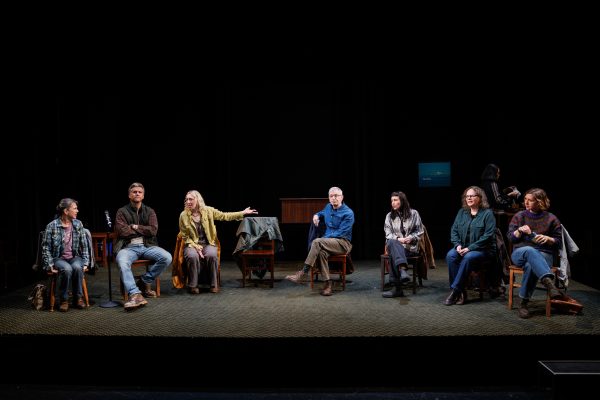
Over the course of ninety minutes, the islanders come together and break apart, trying to figure out what to do about the mess: both apparent and hidden. In between futile brainstorming sessions led by their honorary, symbolic mayor Annie (Crystal Finn), we get a glimpse of what life is like for a handful of residents. Mary (Miriam Silverman) and Chris (Armando Riesco) are working through their failing marriage. John (Arnie Burton) is trying to instill more meaning in his life by helping Homeless Gary (Ryan King), who it turns out, isn’t homeless, and in fact, asserts that he has a home. Mo and her son Alexander are rehearsing for the upcoming dance recital. Les (Jan Leslie Harding), the town’s horse groomer, is forging a relationship with a pen pal. Each story weaves and intersects, as characters are bound together in the way that all small towns are. The arguable protagonist, Ella (Maryann Plunkett), is an older woman battling cancer. Her daughter (Carmen Zilles) has returned to take care of her in the final days, as she struggles to come to terms with her own choice – dying by physician-assisted suicide. Ella is desperate to push away all thoughts of her impending end and seeks comfort in a stranger, the editor of the town’s newspaper Joy, (Mia Katigbak), though it’s debatable how much comfort anyone can provide her.

It would be tempting to call Arbus’s directing hands-off, as so much of the success comes from letting the words breathe on their own, but that would be a disservice to the intricacies that go into staging this perfectly minimal world. Just a few wooden chairs and a carpet, reminiscent of any government building, conjures up an entire island, complete with wolf-dog hybrids, lush gardens, and mom-and-pop pharmacies. Much as in the real world, the exploration of big and small exist in tandem. I was equally moved by Ella’s acceptance of her death as I was by little Alexander’s improbable hope of becoming a professional dancer. Arbus’ decision to keep the actors in view of the audience, even when off stage, contributed to an already felt sense of community; a visual reminder that simply being present is sometimes all that is needed. There were a few surprises along the way, including a particularly well-placed forest hidden deep within a closet, proving that theater magic can be done (and done well) in its simplest forms. With lights by Isabella Byrd, sound by Mikaal Sulaiman, set by dots, and costumes by Emily Rebholz, each element created a part that fed into the whole, with Arbus’s eye perpetually focused on what’s necessary.
In Deep Blue Sound, the island very well may lose its identity, its tourist draw, its quirky tidbit, and yet, it will be okay. Some islanders may go, some may stay, fall in love, fall back in love, dance, take a vacation to Spain they’ve always wanted, or relinquish their honorary title of mayor gracefully. Some will be lonely, for a while. But even with all that change, the island is there and will remain. Even with the whales gone, and a fear that they’ve forgotten us, they haven’t. They may even come back.
Leave a Reply