
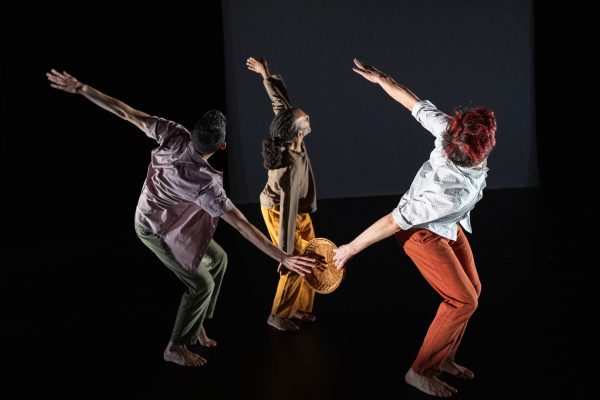

Before seeing this performance, I had never heard of gay writer and AIDS activist Paul Monette. Despite living through the AIDS crisis, choreographer Keith A. Thompson hadn’t heard of him either, until 2014, when he learned of Paul’s work. Artistic Director of the danceTactics performance company, Thompson wanted to create a dance that engaged with text and so Brendan McCall, company manager and dancer, recommended Monette’s text “Love Alone: Eighteen Elegies for Rog” (1988), which he encountered it in an NYU Performance Studies class called “The Rhetoric of AIDS”. The resulting dance was created and shown in segments over many years, culminating in the evening-long performance that recently premiered as part of the La Mama Moves! Dance festival. The dance was a multimedia masterpiece.
Now a niche figure, Paul Monette (1945-95) was well-known during his time. Coming out publicly at 33 with the publication of his very gay second book “Taking Care of Mrs. Carroll” (1978), he didn’t become a literary success and AIDS activist until his 1988 book “Borrowed Time: An AIDS Memoir,” and then a year later: “Love Alone: Eighteen Elegies for Rog”. Thompson had the difficult job of choosing which of the eighteen elegies to build on; choosing (by my count) 6 that especially captured the sensual, rageful, and heartbroken arcs of Paul’s lamentation. The effect was a successful translation of Love Alone’s message: that grief makes the afterlife of love into a “turnless page,” all the while shattering the lover’s mind through the endless work of referencing what the heart cannot forget.
Through movement, voice, and a collage of imagery, the dance brought to life Monette’s poetic account of living (and dying) in the wake of losing his beloved partner, Roger (Rog) Horowitz, to AIDS. It was intricate, political, and deeply moving. Four male dancers, two older and two younger, danced, recited, and at one point read Paul’s words. On a screen behind them, the poems appeared as text over pictures of the dancers, often nude. The images, by Robert Flynt, included an alphabet of letters paired with frozen moments, bodies seen from above surrounded by streaks of light. It was as if each letter in Paul’s alphabet corresponded to a fraction of queer embodiment: A is us laying side by side, and so on… I am sure Paul would agree with this depiction. As he said, “There was no page before I caught you”. This love was his language.

The dance opened on a stage set with two folding chairs and a large plastic table, a reminder of Paul and Rog’s quotidian reality before the brutal mythology of AIDS exploded into their lives. The first poem, Gardenias, starts with a bang: “pain is not a flower pain is a root” Paul contends. Poetry was paired with a continuous yet syncopated unfurling of small to large movements, mime but not quite. We don’t often hear dancers speak, so there was an initial awkwardness as we all got into the groove, but it soon started to flow. Ultimately, these words came from Paul’s body, out of the dance of his life. His words are a visceral poetry, so it is only right that an account of his story would engage the awkwardness of embodiment.
Also in the dance of the poem Gardenias is the earth-shattering description: “the cave of all that’s left,” situating this dance of ghosts within a reimagining of Plato’s cave allegory, wherein the grieving Paul has to make a home in the darkness, watching projections of the past. We watch as the two young dancers (Shawn Brush and Aidan Feldman) trade lines, each both Paul and Rog. They entwine as opposites, they move in unison. The dialogue, which is really Paul’s poetic monologue, finds a way to be shared. We see that Paul is talking to himself, to Rog, and to his allies and enemies wherever they may find themselves in the expanse of history.
Next we meet the dancer Clarence Brooks’ character, who Thompson describes as the embodiment of “the in between, the taboo, the monk from the poem Brother of the Mount of Olives,” an echo of the long history of queerness in hiding. This was smart, even if it required some interpretive flexibility from the audience. What was clear was that he represented something beyond the Paul-Rog dyad, a secret third energy that made their love into a prism. We also meet Brendan McCall’s character, more clearly the post-Rog Paul, who wears his loss with a sardonic posture. They each dance alone, and then Clarence and the younger pair dance with a woven basket. This was again, it seemed, an ode to the poetic tension between what death gives and what it takes.
Paul had several chapters after writing “Love Alone,” including receiving the National Book Award for his autobiography “Becoming A Man: Half a Life Story” (1992). He loved and lost several more partners before dying of AIDS at the age of 49. Already, in “Love Alone” we see him reckoning with the fragility of legacy, as he realizes his testimony on the page is as subject to degradation as some words he finds carved in stone, slowly eroding. Little did he know his story could be brought to life again. Little did he know that his community would survive AIDS and then be faced, decades later, with a fascist regime dead set on reigniting its killing power. Little did he know his words would bolster their spirits for the battle ahead.
In the documentary “The Brink of Summer’s End” (1997), we see Paul on the talk show Geraldo in 1990; “In some ways,” he says, “I feel that I am not dying of AIDS, I am dying of homophobia. We’re living with AIDS as well as we can.” And live he did, with an increasingly complicated quality of life, until the end. Keith and Brendan both spoke about how parallels were drawn between AIDS and COVID, but they affirm the difference. While both may have created mass ego-death, AIDS was a political revolution based on identity. Clarence sits in a spotlight at the corner of the stage near the audience and reads to us Paul’s Manifesto. It is just that. As Paul says in Manifesto “joy alone will not protect you.” Clarence reads Paul’s stark account of a life made political, the ghost of young Rog dancing behind him in the dark.
One of the signatures of “Love Alone” on the page is that some words are all capitalized. Brendan, as the older Paul had a chance to embody this yell; through the grief of his reflections, as he lay on his side, came a cry in the middle of a stream of sentences. This break in Monette’s composure is needed to demonstrate the stakes, shaking us out of the pleasurable lull of this endurance-dance. Thompson’s gestural abstraction rolls through more permutations of grief: the older-Paul reckoning with Clarences’ liminality and then, lastly, a return to the young pair’s duet. The dance ends with the poem No Goodbyes, Paul’s most raw remembrance of Rog’s death: “Why don’t all these kisses rouse you” he cries, caressing Rog’s hair. We all cried too.

We need catharsis right now. We need stories of love and loss that do not answer to any false hope. In “The Brink of Summer’s End” we learn about a moment in Paul’s life when he was on the brink of coming out. He describes realizing a future of normalcy would not be fulfilling. He pulls over on the side of the road, strips, and sits nude in a field begging for someone, something beyond, to find him. What found him was love, and war (“war is not all / death it turns out war is what little / thing you hold on to”), and Keith A. Thompson so many years later who brought him back to life for us to behold. The poetry of the dance reminds us that a radical love cannot be erased; so as Paul says, we must “go without hate but not without rage.”

Leave a Reply