
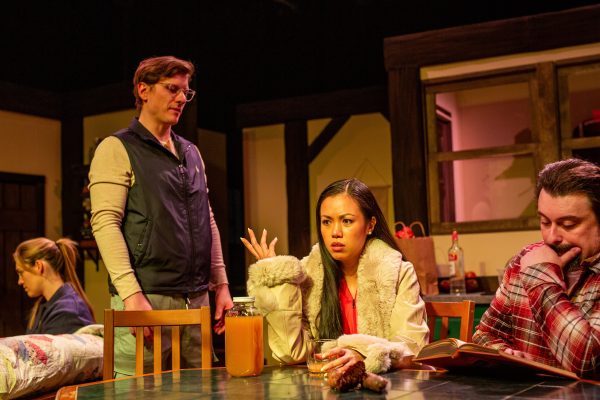

Set in the year 2000, flip phones are everywhere in Humpty Dumpty. The two central couples, Hallmark characters with high-power city jobs, spend much of the play walking around desperately waving their phones in the air in search of a signal. It’s particularly egregious, then, that none of them can act their way through the eventual calls. The play begins and ends in flat, monotone, one-sided conversations, the cast delivering their lines in rote repetition to the receiver.
It’s hard to tell if Humpty Dumpty’s problems result from the acting or writing, both of which are fantastically overblown. The script, written in 2001 by three-time Obie Award Winner and Pulitzer Prize Finalist Eric Bogosian (who you may recognize from his roles on Succession, Billions, Interviews with Vampires, and Law and Order, as well as his role in the Safdie Brother’s hit film Uncut Gems), was originally a response to the mounting technological terrors of Y2K. Its current production, its New York premiere, runs until May 3rd at the Chain Theatre, guided by the directorial hand of Ella Jane New.
The show kicks off when our city-dwelling characters on vacation in Upstate New York are terrified, beyond logic, when the power goes out. What begins as a cozy, quilts-and-Scrabble getaway soon resembles something more like the apocalypse, complete with looting and checkpoints. This, as exciting as it sounds, gives the story too much credit. In practice, the majority of the runtime is filled with lengthy expositional dialogue and monologues as tedious as a floppy disk in 2025.
The most glaring issue, perhaps, is just how inconsistent Bogosian’s stakes are. When the power first goes out, our two main protagonists – Nicole, a high-powered editor (played by Chain Theatre Development Director Christina Elise Perry), and her husband, the writer Max (Chain Theatre Artistic Director Kirk Gostkowski) – jump to the worst possible conclusions. “What if this is a terrorist attack or something?” Nicole asks immediately without provocation. When the rental’s caretaker, Nat (Brandon Hughes), comes in to explain that nothing’s wrong, there’s a sinister undertone to his explanations, as if he’s concealing the truth. It’s baffling and unprompted. In its description, Humpty Dumpty advertises how easy it is to change societal order in an instant. For this to work, Bogosian needs us to believe that a reckoning is happening. But, all we ever see, even into the second act, is the electricity going out. Since when does that mean the end of the world?
If there is a reason for their overreaction, it doesn’t translate to 2025. Bogosian was at work on Humpty Dumpty when the 9/11 terrorist attacks occurred, and the shadow of it looms large over the show. With a date already set for the premiere, he “made adjustments as best [he] could,” resulting in paranoid characters that would only make sense in the immediate aftermath. The references to a global pandemic (that could never happen now, right? one character muses ironically) are, to his credit, tinged with insightful irony. Lines about bio-terrorism, however, are bafflingly paranoid at any time other than winter 2001. Why, then, did Bogosian so explicitly set the play in 2000? Humpty Dumpty’s marketing team, as well as the various authors’ notes inserted into both the Playbill and script, make a point of telling us that this piece is more relevant than ever in today’s technologically-obsessed world. They don’t seem to see that, written as it is, it’s become a period piece.
Reviews from the original 2002 New Jersey production indicate that, amidst the overblown writing, strong performances from the cast were able to salvage the show. In 2025, it’s unfortunate that this isn’t the case. Perry, as Nicole, sets the tone in the opening moments, where it’s glaringly apparent she’s reciting someone else’s words instead of embodying them on her own. She isn’t the only one. When, in a particularly excruciating moment, ¾ of the couples are on the phone at the same time, each one agonizingly waits for the others’ lines to finish before delivering their own. Gabriel Rysdahl as Tony, their LA screenwriter friend, delivers the best performance, but only because he’s the only one who gets any characterization in the script.
At the end of the play, Bogosian tries for some kind of moral. Max, struck with inspiration, devotes himself to writing, which leads him to a dull monologue about stars. It’s strange to insert such a shoe-horned message from nowhere, but it’s downright mystifying when there were other thematic contenders actually established by the play. ‘Phones have changed society’ is not saying anything new, but it is, at least, coherent.
If we choose to accept the clumsy stakes in Humpty Dumpty, we can see what Bogosian was going for – the social order has been flipped upside down, exposing how reliant we are on postmodern luxuries. Max’s life, filled with Starbucks and Palm Pilots, isn’t legible in the natural order of things. Our characters learn how to live without, forging new lives for themselves in this post-apocalyptic world. In the end, Nicole doesn’t even want to go back to the city. What does it mean, then, that the power comes on in the final few minutes? As a body lies stiff on the floor, we’re right back where we started at the very beginning – no lessons learned, no sense that these characters will change in any way. The phone rings, and Nicole picks it up. Her ‘uh-huhs’ may sound exactly like they did in the first scene, but one imagines it’s very different from 2001.
Leave a Reply