

Asking the Brooklyn College ‘25 MFA playwrights about sci-fi, experimental theater, and something called Weasel Fest.
Weasel Fest isn’t even the official name of this legendary Brooklyn College play presentation. The full name, as established by Mac Wellman and a group of students back when he was head of the MFA playwriting program, is “Bring a Weasel and a Pint of Your Own Blood.” Even after compiling interviews with the recent alums (and after a year in the program myself), I realized that I had actually no clue as to the origin of that rodential and macabre title. Mysteriously, there are no weasels at Weasel Fest. This year, there are aliens who collect your tears, a holographic strawberry, a Contribution Committee, and a fringe movement (read: cult) called The Spiral, among many other otherworldly beings and phenomena.
At least this much I can explain: Weasel Fest, a seventeen-year-old annual tradition, celebrates the culmination of the Brooklyn College MFA playwriting program. In keeping with the scrappy and experimental ethos of the program, the upcoming alums are assigned a prompt at the start of their final year, and they have the rest of their time in the program to write and fully self-produce a staged presentation of new plays responding to that given prompt. This year, the prompt, given by department co-head Dennis A. Allen II, is “science fiction.”
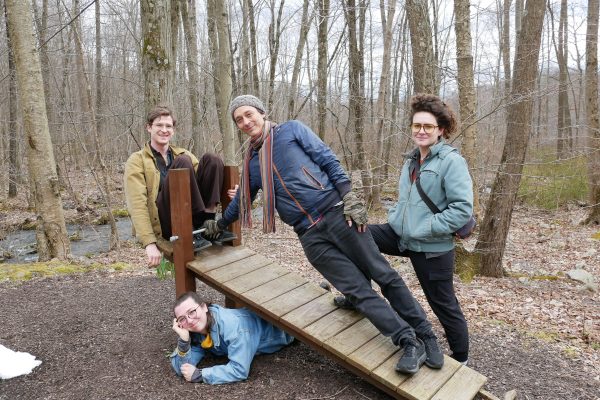
Instead of presenting their work separately, as typical for a graduation showcase, the ‘25 MFA playwrights—Ann Marie Dorr, Andrew Hardigg, Claire Greising, and Kurt Chiang—have chosen to weave their individual plays together as one big time-space-defying conglomeration called “The Booming Voice of No One,” which will be up at Life World Sept 4-7, and directed by Hanna Yurfest (Lobster).
I spoke to each playwright about their individual work, the festival at large, and how they practice and define “experimental theater.” The following interview-excerpts have been edited for length and clarity.

Helen Gallagher: The first question I have is—knowing that the prompt is totally out of your control—what was your first reaction when it was assigned? Is sci-fi something you’ve written before, or something you’ve been interested in?
Ann Marie Dorr: I had a good laugh to myself when Dennis sent the prompt to us, because Dennis and I had spent a lot of time talking about Octavia Butler. So, it might be all my fault—I fully give Dennis credit, but sci-fi was on both of our minds the spring before he gave us the prompt.
HG: Why do you think sci-fi was on your mind?
AMD: I was building my syllabus for my first composition class at Brooklyn College, and I was having a hard time coming up with a topic that I found exciting to talk about with students. I gave myself the prompt: What if I made a bunch of 18 year olds watch an episode of The X Files? I was spending a lot of time prepping for the class, trying to find good sci-fi short stories, and listening to David Bowie.
Then, during winter break, I drove from LA to Vegas, and there’s all this funny, alien-themed nonsense when you drive to Vegas. Those images and research things dovetailed into what I was already thinking about when I was writing my play in tutorial with Dennis and talking about sci-fi in theater.
HG: I found the premise of your play so interesting: that aliens are using human tears to fuel their own world. Can you talk a little bit about the idea and how you arrived at it?
AMD: I start with an image, usually. I was like, “Okay, we’re talking about sci-fi. And I think that there are tentacle creatures in my play.” The big, bad idea was: What if my play, literally, is a tank with two tiny tentacled creatures in it? What happens if they talk to each other?
The tears concept came from me personally thinking about this a lot for the past two years—I don’t cry a lot, so what does it mean? What does that fuel in our world?
HG: I was also struck by your idea that the way the aliens inflict tears is staring at people—just silently staring. What is that all about?
AMD: I think that comes from a place of teaching a lot and really thinking about how nobody likes to make eye contact. So, making eye contact and looking at people is actually this very vulnerable act. I’m experimenting in making something that people have to be present with.

HG: I’ve heard you say that sci-fi is difficult in theater. What do you mean by that?
Claire Greising: We’re getting out of it, but we were in a real realism era of playwriting for a while. Obviously, science fiction calls for something that is less naturalistic or realistic. Also, if you’re trying to create a spaceship, or an alien planet, or whatever– especially for the kind of scrappy theater we’re doing– it can be difficult if you have a low budget.
Other than that, I’m not sure why sci-fi isn’t seen more in theater. But, for whatever reason, I feel like it can be really hard to make sci-fi work on stage.
That said, I read somewhere recently that science fiction is the only writing that can respond to our current moment. I don’t think I would have written a science fiction play if Dennis hadn’t prompted us to, so it’s been an exciting challenge.
HG: I’m curious about “The Last Dive Bar in America.” What was swirling around in your mind when you started writing the play?
CG: I was interested in exploring a couple of different things. I was curious about the idea of what it means for something to be the “last” thing– as in, knowing that an interaction is a last conversation, or the last time you’ll see somebody, or having a last drink at the last dive bar in the world. That’s where I started. What does it mean for something to be the last?
I was also thinking about, what I perceive as, the narcissism of the sci-fi genre. When you write sci-fi, whether you mean to or not, you’re placing humanity in a future where maybe we do not belong. We can’t anticipate the future, and it probably just literally isn’t our business. I wanted that acknowledgement to be part of it.
There’s also exploration of addiction, especially with the closing song that I wrote. Ultimately, my part of the piece is a play about an addict and what it means to grapple with the destructive parts of yourself. You can decide to embrace the destruction and morph into something that is alien to you, or reject it and stay somewhere that might not feel comfortable.
HG: Something I’ve been asking about– because I’m curious on a personal level, too– is the lore around Brooklyn College being a place for “experimental theater” What is experimental theater? How would you define it?
CG: I think it means denying the pressures of the commercialization of theater and the things that you’re “supposed” to do. As we see all of these institutions fail because of lack of funding or lack of whatever, it’s the work that the playwright believes in and makes sure happens that will continue to exist. To me, experimental theater just means writing what you want to write, and writing a story that only you can tell. As our society becomes more fractured and strange, experimental theater is the most natural thing to create.

HG: I think of your work as being pretty naturalistic—there’s definitely an element of absurdity and oddity and something that exists a fraction above real life—but literally naturalistic in that so much of your writing engages with the natural world. So, it seems like TERRAPAX might be a departure from that. Do you feel like that’s true?
Andrew Hardigg: That’s totally true. It almost wasn’t a choice that it happened this way. The genesis for my play was an exercise to help us generate some ideas that Claire brought in when the four of us went to the Center for Fiction. It was called “the beautiful object exercise,” which prompts you to write a play about people trying to get towards a beautiful place, but there are obstacles between them and the place, with specific requirements that it shouldn’t be about the natural, organic world. It was really funny that those were the terms of the exercise because I feel like that is such a touchstone, for me, the Earth that grows without knowing how. I was like, “Okay, well, I live in a city, and there’s a lot of beauty in the city, but I think that I also do feel the most freedom in the places where I have space.” I eventually got to this idea of the world of the play, which is just a more extreme version of a feeling that I sometimes get in the city, where I feel kind of hemmed in.
HG: I really appreciated the familiarity of the feelings in your play, and that the play deals with deeply relatable human experiences– for example, what you describe as the “shunk” feeling of meeting someone and connecting with them instantly. It feels both big and small in that way.
AH: A lot of the things that I was thinking about, that I wanted to put in the play, were directed so much by a sense of experience that I really felt inside. There was one small idea of being obsessed with a place and thinking, “Man, everything’s gotta be on hold until I see that place.” Or, wondering what you contribute to society and feeling like you’re always in competition about that when you don’t want to be. Those were the kind of experiences that I wanted to be in the play. The majority of it was just thinking about things I liked seeing. There was also the challenge of thinking, “Okay, well, what would the version of these be in a world where the facts were different? What would the version of that be in the speculative world?”
HG: Weasel Fest is, in part, about nurturing what we like to call “experimental theater.” Sci-fi is also sometimes defined as “thought experiment” or “experiment.” I’ve been curious to hear from you all what that word/phrase means. What does it mean to experiment?
AH: It’s funny. I feel like a lot of stuff comes out experimental when we, or I, am just trying to be faithful to the way that I remember things, which is sometimes the only way I seem to be able to get something out.

Kurt Chiang: When the prompt came, it felt like I could write in a way that I’ve never really written before. I think the genre is supposed to be grounded in some kind of technological reality. Like, what if the technology could look like this? What if we could do this because of technology? I think the translation in my brain for theater was: what if we could do this with theater? What if we could do this with language and theater?
HG: Can you describe some of what you’re doing with language and theater?
KC: I’m really, really paying attention to fragment and form in my writing, to kind of be okay with experimenting with the gaps in train of thought and the page. I’m paying a lot more attention to where the music is, the speaking and the writing patterns, and paying attention to tempo really, really carefully. What if the characters can bleed into each other as it goes, maybe more like a film? But really do it—in a body and voice and live way. That’s what was in my head. With the prompt, it was about trying to write an impossible thing. There’s probably a lot that I think people will find demanding about watching it or listening to it, but I guess that’s the science fiction pitch that I hope people get on board with. We’re going to listen to it this way. We’re going to listen to people talking this way.
HG: I’m curious about the process of weaving these worlds together. Since all four of the pieces are so different—which makes sense, because you’re so distinct as writers—what was that like?
KC: There was an original first draft of the interwoven pieces written by Claire. We read it over, and then scheduled a time where we all got together with our physical paper and read our plays out loud, just interrupting each other when we thought that the next play should happen. That was based on a show that I did with straightforward essays called The Arrow, so I had a little bit of familiarity with that. I think a lot of it is leaving it up to chance and saying—that’s the order that we read it in, with a foundation of work and conversations we had before, so let’s see how this looks when we put it up. A lot of credit goes to our director, Hannah Yurfest, and our dramaturg, Elizagrace Madrone. They were actually the ones who worked together in the room with all the actors, including myself and Andrew. They had an eye towards making sure all the plays kind of happen on their own, or from themselves as much as from the effect of them being put into a sequence together, and being a little bit deliberate with that to make sure all the plays land their ending. I think it’s going to pan out.
HG: One more kind of cheesy question for you. I was struck by the line in your play, “I believe in everything I write. What else is there to do?” I was wondering if that’s true for you, or is it more of a challenge to yourself? Do you feel like you believe in everything you write, because if so, that’s awesome and enviable.
KC: I think, for me, it’s less of a loaded “believe in yourself,” in a self-help kind of way. I “believe in everything I write” because I see it, you know? If I wrote it, I believe that I wrote it. Also, and I guess this attaches more to the first meaning, it’s an effort to be nice to yourself, and be nice to your writing. If I don’t believe in the writing, then what do I believe in? I think it’s similar to a relationship that a lot of people have with God, or another power or energy. It’s about having faith in something.
Tickets for Weasel Festival are available on a sliding scale (from $20 – $50 plus fees) and can be reserved online at https://tinyurl.com/Weasel2025 or purchased at the door prior to each show. Life World is located at 563 Johnson Ave, Brooklyn, NY 11237.
Leave a Reply