
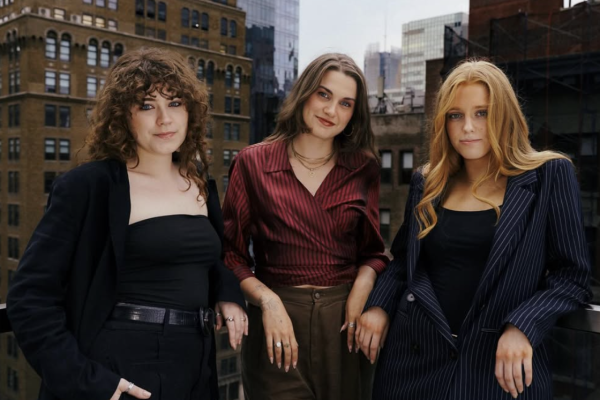

Site specific work is notoriously hard to justify. Dramaturgically, the decision to stage a play any location other than a stage can often collapse into a gimmick: a sparkly choice without much depth. This, however, was not the case with Office Party Play directed by Ghost Pocket Productions’ (a co-producer of the show along with Cardarelli’s company As We Were Productions) artistic director Shelby Gillberto and written by Maddie Cardarelli and Kyleigh McPeek: a site specific workplace drama carried out in a workspace in Midtown. Their use of the company’s office was not only satisfying to observe, but brought a hum to this pithy play about collegiality and what happens when we stretch it and parse it apart. Late last month, I spoke to Cardarelli and Gilberto about their collaboration (also with McPeek) , what they consider the larger implications of the play, and why they’re both drawn to site specific theater. I left the performance of Office Party Play in awe of the production’s self-awareness, and felt much the same way at the end of my call with this dynamic duo.
This interview has been edited for length and clarity.
Eve Bromberg: I want to start by asking you both for background: why theatre, how it started, what it looked like, where you grew up and your schooling, whatever background you want to share!

Shelby Gilberto: I am one of four children and we were all around the same age and my mom had to figure out what to do with us because she couldn’t have us at home at the same time. My mom signed me up for a class at The Cultural Arts Center in Greensboro where in five weeks, we put on a production of Junie B. Jones. I played Junie’s mom, as an eight year old. But that’s how I started in theatre; my parents signed me up by mistake to give me something to do and I decided all I ever wanted to do was act. And that led me to change schools repeatedly, sort of chasing this theatrical dream, eventually moving to Florida to go to a theatre school there. I went to Florida State for college, where I studied theatre. I accidentally started Pocket Ghost after I started directing and stopped acting during my sophomore year of college. Professionally, I worked as a stage manager for eight years until last September when I decided I needed more stability in my life. Stage management was so physically demanding and turned what was once my hobby into a job. I got a job working in weddings– which is simply theatre– through a former theatre colleague, and I am now able to make theatre on the side for fun.
EB: Shelby, what productions did you stage manage?
SG: It’s always been immersive theatre. I worked on Then She Fell by Third Rail Projects. The project closed in 2020 and I arrived in 2019 and worked on it for three months before COVID. I went on to be the Production Stage Manager on an immersive Mickey Mouse show called Mickey Mouse and Friends: An Extra Big Adventure at The Camp stores on fifth avenue and then I moved the show to their store in Dallas, and then moved on to be a part of their production team. I then worked on the immersive Great Gatsby where I started as an emergency props sub and ended up the head of props by the time the show closed. For the last year of my stage management career, I worked for Company XIV, which is a burlesque theatre company in Bushwick.
EB: Maddie, turning the stage to you! What’s your origin story in theatre?
Maddie Cardarelli: Five years before I was born, my parents founded a theatre company in Chicago– where I’m from–called Emerald City Theater in Lincoln Park, it was specifically a children’s theatre company. While I was in elementary school, I would sit in the audience of the theater while doing homework and because the shows were geared towards children, the directors would oftentimes pull me over to ask what I thought, if something was too scary, for instance.

EB: You were a dramaturg at a young age!
MC: Exactly! The company also did theatre camps, which, like Shelby’s experience, was an easy way for my parents to get me out of their hair and I ended up doing theatre in high school and got very into directing. I was very interested in the bigger picture. But then I chose to leave theatre and I actually went to school for film, and got my first full time job in film and then wound up doing theatre again about a year and a half ago! I guess it’s just in my blood!
EB: Is your first full-time job the one you have now?
MC: Yes. I’m the office manager and was the office coordinator.
EB: Maddie, do you identify as a playwright?
MC: I identify as a writer in general. I also do a lot of screenwriting; I’m developing a limited series right now, but I’m also writing another play, so I do both.
EB: Can you tell me about the incubation of this project? Where did the idea come from and where did you two meet?
MC: About a year and a half ago, I was working with another theatre company that was doing immersive theatrical events, and I suggested we do a theatrical performance in an apartment. This is such a weird memory I have, but in high school my beloved theatre director told me about seeing True West in an apartment, which sounded so cool. In the back of my mind, I always had this idea to put on a show in an apartment. Because the group I was working with was so community-focused, someone offered up their apartment to us and it became part of a series called Apartment Plays, which through the company’s writers’ group (I found a couple of playwrights) we were able to do a series of one-act shows that would move through the apartments. The second play I wrote for this series was called Subject X specifically for this bar that had a projector behind the stage. With two shows under my belt, I was wanting to do more, but didn’t necessarily have the space for it, but I got lucky because my boss at my [current] job– the head of facilities– is a huge theatre fan and asked when she could see of my shows and then offered up the offices to me. I think she recognized that the projects I do outside of work will only benefit the skills I use for this job. But then it became this thing of having this incredible opportunity and I had to figure out how to take advantage of it! Around this time I was offered the space, I met Izzy Mar, who you know Eve, because I saw her in Family and I met Shelby when I went to go see Stand Clear of The Closing Doors, which is the show Shelby worked on last summer.
SG: Maddie showed up in my life like a fucking force of nature in the best way possible. I don’t know where she came from and she’s one of the best things that’s ever happened to me. I had done this show last summer called Stand Clear of The Closing Doors, which was the third show of our first season as Pocket Ghost Productions. It was by far the most adventurous immersive piece I have ever attempted. Maddie showed up to the show, I think through April Consalo, who is in Office Party, and saw the whole thing and afterwards– it was the very first time I had gone downstairs to greet people after a show– and Maddie stopped me and for the first time ever someone was asking me how I ended up where I am, with such intentionality. Maddie followed up to plan to get coffee and also I learned we live a block from each other. Our eventual coffee lasted for six hours. It was an instant connection. I’d never met someone like Maddie and felt such kinship almost immediately. I told her to let me know if she ever needed a director and three weeks later she reached out about Office Party Play.
MC: I saw Stand Clear Of The Closing Doors, and I knew I had to meet the person who had made the show and worked with them. I may not have even brought it up during our six hour coffee, but I very much wanted to find a way to get this person involved in this project. Everything sort of took off from there. The co-writer of this play, Kyleigh McPeek, was my roommate at a theatre summer program, and we were rather artistically aligned.
EB: What was the summer program?
MC: It was Cherubs in Northwestern.
EB: Oh yes. I know it well.
MC: It’s funny because we were both there to study film. She was there for acting, she hasn’t acted in a while, but she’s a fantastic writer and I knew I wanted to work with her and the stars just sort of aligned. I was meeting this fantastic group of people who were the perfect group of people for this project.
EB: Could you speak to where the idea of this play came from and what the play conveys that is larger than the narrative itself?
MC: We were discovering it as we were going. The idea for the play’s structure came from a piece that was five unrelated one acts that took place in a succession. That’s what this play was going to be initially, but when we got into the space, we were so excited about the narrative we could create in the space– what company could be and the reason for so many things to be happening within one night.
SG: I was also interested in connecting Maddie and Kyleigh’s ideas so the play would be less stop and start and have a clear through-line. Once we started thinking along those lines, Maddie and Kyleigh suggested Sasha as the character that pushes the story forward.
MC: Kyleigh and I put the stories together by figuring out who the characters were in the space and how to create a diverse group of personalities and roles. Sasha was the least likeable character as we were writing her, but when Mary Kate read for her, we realized we totally love her. And that’s what you want, right? You want characters to be more dimensional than just someone you hate because they suck sometimes. Sasha is someone who even though she has things she needs to work through, is still sympathetic: you love her and see where she’s coming from. So we really started with the characters, but the throughline is a curiosity about working relationships and whether you can really be friends with your colleagues. I find it so interesting that work environments create barriers to human connection. The play is about what human connection looks like in a work environment and how honest people can be with each other in those settings. It was very intentional to end the play with a scene between the two caterers (Izzy Mar and April Consalo) because in food service– Shelby and I were both baristas at one point– there seems to be more openness and honesty between co-workers than there is in a corporate environment.. It’s an interesting contrast to put all of these professional and personal relationships up against each other.
SG: A big part of this show developed in realizing how queer some of the characters are. I should say, something I do at the start of all my rehearsals is I sit down with the characters and ask them rapid fire character questions. We build the characters together, so I then know how to talk to the character in the future and how to direct that person. There’s the scene between the two caterers, and there’s the scene in the library called “Cats” where a male colleagues’ game of truth and dare turns into a rather homoerotic exchange. Those were both written as such, here I’m talking about the bathroom scene between Sasha (played by Mary Kate Abner) and Carmen (Bella Duran Shedd). We were building Sasha and Carmen and talking about their past love lives, and both Bella and Mary Kate one day plainly stated that these characters were queer women and I realized the entire conflict, of that scene, is that they’re in love. We were trying to figure out what happened to get to the point of such conflict, and what we came up with was that the two of them were good friends and then a rumor started that they were involved and Sasha started to pull away, because she’s so closeted. So their argument arose from the relationship starting to alter.
EB: What was the collaboration of Kyleigh like?
MC: Kyleigh went to a performing arts high school in Colorado and grew up acting. I forced her to be in a weird experimental film that summer when we were at Northwestern together and she ended up acting in it as well. She chose not to go to college for acting, but she was still writing. She wrote a piece for Modern Love called “This Is How We Talk About Ending Things,” which is truly gorgeous. I knew I wanted to work with her because of her brain and she’s interested in the same weird stuff I’m into. From the beginning, she had a lot to say about the immersive nature of the performance because of her background in theatre. She was the one who suggested the company in the play should be a publishing house because of the library conference room in our Offices. The two of us sat down to figure out who the characters were, before I met Shelby and Izzy and knew this would be a full fledged production, which is also when I started writing The After Party scene. I made Kyleigh sit down and read the script of the scene in the office and read the script, and I think that’s what won her over and convinced her to get on board because she started getting so excited about the space and the story. So then we started building out the world and asking questions about the company and what was happening that night during the party and what was happening in what room and with which character? When we figured out which characters would be in what space, we split up who would write which scene. Kyleigh had the library and the terrace, and I had the bathroom. Even after we went off to write our individual portions, we continued to develop the work together. We wanted to make sure the work was consistent and worked together. When we were comfortable with what we had, we brought it to Shelby and our production stage manager Emma to get even further feedback. All in all, it was a rather swift writing process.
EB: Why site specific work?
MC: I’ve always had an interest in site specific work, but hadn’t seen a lot of it myself. The first production I did last February was an experiment for me during a time where I was building a lot of community. What I really love about site specific work is that you’re really entering someone else’s world and it tends to be more intimate– it feels as if you’re experiencing something with a group of people. It’s so fun to recount a performance with another audience member and realize you experienced different parts of the performance– this was certainly the case with Stand Clear of The Closing Doors. You can compare experiences, which brings people together even more so than other theatre.
SG: I feel like the best place to start is to read part of my company’s mission statement, since that’s really why I do this work.
“The way we fall in and out of love is inherently personal and yet universal. PGP aims to capture these nuances by creating atmospheric theatrical events that incorporate the audience in a way that leaves them as more than witnesses. Instead creating space in which we can see and be seen in return.
We believe that a show begins when you first hear about it and ends only when you stop thinking about it. We believe that the exploration of love through its ever changing forms is a journey worth pursuing. And we believe that we will leave you with a piece of ourselves for you to put in your pocket and take home with you.”
Pocket Ghost started in college, truly by accident. It was because I didn’t want to pay for space and at Florida State all of the fountains are certified swimming pools because you can’t keep students out of them. I staged Mary Zimmerman’s Metamorphosis in a fountain on campus while the sun was setting, as it would’ve happened in Greek theatre, and that was my initial insight into site specific work. I was raised in classical theatre, but this experience was so much more fun and interesting and the audience seemed to really feel a part of something. This developed over the course of my college career into doing things in my apartment, and my car where the space was free. I started making this theatre because it was complimentary to how my brain worked. I also studied abroad in London where site specific work happens on a much larger scale. I saw Sleep No More in 2016, which was its heyday, and it changed my life. I realized this is the type of work people want to see, especially if there’s an exploratory component where you can go back multiple times and have continuously different experiences.
EB: What projects are you looking forward to?
MC: I’m developing a site specific theatre piece to be set in a tattoo studio, which is very exciting for me as someone who loves tattoos! I have this artist I adore and I’ve hosted a reading in their studio, which had some tattooing involved, and because their studio is so interested in community building, I reached out to them again for this project. There’s so much to consider and think about. There’s a world in which there’s a more specific ticket where an audience member can get a tattoo themselves.
SG: Pocket Ghost’s next show is Hedda Gabler in collaboration with the Urbane Arts Club in Flatbush. We are doing Hedda in the house for one weekend and one weekend only. Why I said earlier it was funny that I no longer act is because Hedda is the last role I will ever play. I am performing in this piece, which is huge for me as I haven’t performed since I was 19, and it’s a role that means so much to me. Maddie is one of the associate assistant directors, so while I’m directing this show, Maddie is co-directing it so I don’t have to direct myself. She understands the vision and how I work. I have wanted to do this show for ten years and I am now Hedda’s age.
Tickets for Pocket Ghost’s two year anniversary fundraiser can be purchased here.
Leave a Reply