

Color Theories by Julio Torres is not an Off Broadway Play. It may look like a play, sound like a play, smell like a play, but Julio assures us, it’s not a play. No no no, there was a mistake made along the way in the marketing, he tells the audience, who all gathered to see what they assume to be a play. “That could not be further from the truth. Please disregard any pre-conceived notions you may have about that.” So if it’s not a play, then what is it?
Part lecture, part stand-up routine, part psychological excavation, and yes, part play (sorry Julio!), Color Theories defies neat categorization in form, yet its content clings to definition. Written and performed by Torres and currently running at Performance Space New York, this piece centers around Torres’s meditations on qualifying abstract concepts and using color as his preferred method of study. Assigning personality traits and attributions to blue, red, yellow, and so forth, this 80 minute oration is less a scientific investigation and more a lesson in intuition, impulse, and whimsy.
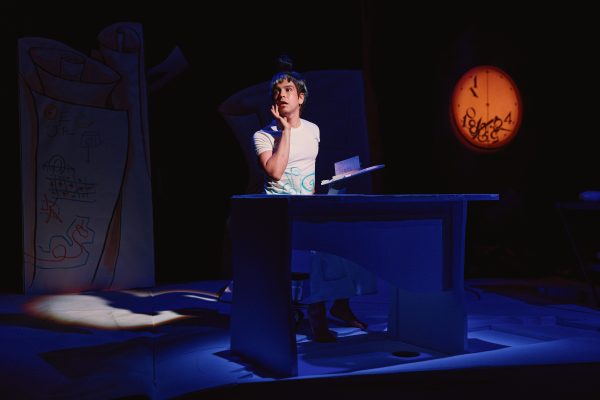
Torres plays the part of Julio Torres as the newly appointed head of Education for the city of New York, and we are actually witnessing a rehearsal for his traveling lecture series that he’ll be taking to different schools in the fall to teach students all about color. He has three handy dandy assistants to help him. There’s Spilled Wine (Drew Rollins) and Music Box (Nick Meyers), dressed exactly how they sound, with their sole purpose being to sit on stage and move some scenic elements when Julio Tores needs. Don’t feel too bad for them though, they’re NYU freshmen/nepo babies and are just really happy to be here. Bibo the Robot (voiced by Joe Rumrill) rounds out the cast, acting as time keeper. He stays nestled in a clock tower, popping out periodically to remind Torres to get a move on when he gets stuck on a color for too long. The set (designed by Tommaso Ortino) is as strange as its players, evoking a funhouse version of a low-budget theme park show. Think storybook, with all the folded pop-out illustrations, but if the story was about how capitalism destroys creative sensibilities and this is the characters’ last attempt at pushing back against commodified art.
Like any story, we start at the beginning. For Torres, the beginning is navy blue, which admittedly, is shocking. One would assume primary colors might be the introduction, but Torres is nothing if not surprising . Using “color stories”, Torres takes us on a personal journey through his interactions with said colors. Navy blue, he says, is authority. It’s the color of cops, of rules, of superheroes, of the powers that be. It’s the color that reoccurs consistently throughout the show, serving as a sort of antagonist to the others, and to Torres’s own sensibilities of loveable anarchist chaos. Navy blue is, in short, the enemy. While yellow is joy – unabashed and sometimes scary, like the lower case “e” in Ellen DeGeneres’s logo. Red is passion – unharnessed and overwhelming. Orange is a mixture of the two, the Hollywood male ideal like Dwayne “The Rock” Johnson – exciting but nonthreatening. And then there’s purple. But, well. I don’t want to give too much away.

Does any of this make sense? No, not in the slightest, and yet when delivered by Torres’s signature quiet and contemplative tone, it starts to. He walks you through his process, explains thoroughly how he ended up with his conclusions, using imagery and diagrams and props to get his point across, and even though his logic is malleable and subjective, you start to buy into this theory because of the sheer amount of consideration put behind it. He is, in this room, the authority on color personalities. He is the navy blue, if you will – Torres is clever enough to not let the irony of that go unnoticed.
As a performer, Torres is matter-of-fact but kind, exuding the essence of high school art teacher that just really cares about her craft, this comparison emphasized and expanded by Muriel Parra’s costume design: shiny silver clogs, paired with white socks, a white t shirt and jeans stenciled with blue swirls (echoing the whimsical curling of the storybook pages), a wig dotted with just enough blue to not look accidental done in the style of an angler fish – complete with an actual light shining down on his face controlled via remote on his wrist. It was clever, it was cool, it made me want to do a really good job on my still life final. There was no director, but Jack Serio was billed as its “artistic consultant” and it’s clear that the team worked in tandem to support Torres’s singular vision, which was specific enough to keep the façade of a traveling school lecture but wide enough to contain the musings on late-stage capitalism, casual fascism, and unpacking the personalities of The Real Housewives.
It doesn’t really matter if this was a play or not, just like it doesn’t matter if lilac is the color of moms and green is the sound of rain. Art is malleable , as is color theory (apparently). And yet, one cannot fault anyone for attempting to assign meaning when the world feels especially meaningless right now. As Torres put it, “To learn how to see, we must first learn we can never see it all.” We are all angler fish, swimming around with our view limited by our own understanding. Somehow color means everything and nothing at the same time.
Leave a Reply