
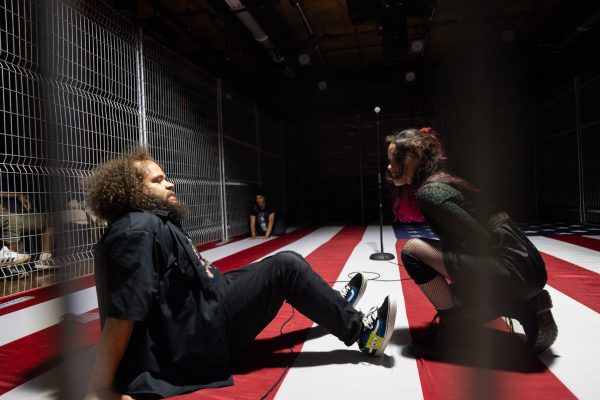

“I think she’s a fascist director” was the last statement I heard before everyone got inexplicably quiet. I’m not sure why we all got quiet. I was too busy trying to figure out who the fascist director was, (I have some guesses) but I’m sure everyone just got a sort of feeling. About a minute of silence later, a board op slid past the audience with a smirk, and mouthing something with glee to a fellow op hit the first cue. The silence allowed the performers to begin exactly as they entered, as if just waking up from a bad midday nap they routinely headed into their cage.
I mean a cage, literally. The set design, by director Alec Duffy with consultation by Mimi Lien, depicts a rugged asylum held together by the Old Glory to represent the childhood home of three half-siblings; the youngest, Alice (Izabel Mar, in a really truly triumphant performance), is a “professional listener” obsessed with media. Linus (Jonah O’Hara-David, perfectly gangly), is stuck in the middle in every way, unable to finish his screenplay or accept the death of his mother at the hands of his father, telling himself that “she’s just in space” over and over like a prayer. The oldest sibling, David (Luis Feliciano, bearing the most overt pain with a lot of grace), is multilingual with a blog written in dead languages of unspecified content. He admits his mother was ugly. He is accepting of her death, though he attempts to refute its means. The siblings are all creative in their own ways. Their mothers’ were all abused by their father and then killed by him in some way. They routinely abuse one another. They are all unemployed.
The play, written in 2013 by Celine Song, joins a long line of works of hers that contend with both a rule of threes (however, this one is probably the strangest love triangle) and the idea of fate, which my girlfriend brought up over a post-show cig right as an old friend of hers fatefully appeared from down the street. Near the middle of the piece, David informs us of the origin of the term monster, that its root is omen. Monstrosity is meant to foretell something for the monster itself and those that are victim to it. “In this way, monsters are divine lessons.” Grotesquery will always have an apological, parabolic permanence. Song emphasizes this in a way that balances modern discontent with biblical interpretation.
I’m not one to care much for content warnings, but I was surprised to see the topic of incest excluded from the list. It serves as the crux of the siblings’– trivial and the substantial– circumstances and actions. Do I think it’s a dramaturgically sound choice to not divulge? Sure. On the contrary, do I think this subject matter could be extremely triggering for someone going in blind? Probs! Still, I do think Duffy’s direction gives some level of care to the matter, but not without an edge. When Alice reveals the truth about her parentage, she slips an arm out of the cage to take the hand of an audience member. The woman chosen was already beaming towards Mar, leaning in before there was even an extension. Though we all heard it, she really only told this girl her secret. That awkward yet earnest decision to confide without trust earned—like a tween skipping class in the middle school bathroom with a girl she doesn’t know that well. Even with the understanding that she was being voyeured both within and out of the house, it didn’t feel like she was giving anything up.
Incest is a taboo most wouldn’t dare anticipate but, if discovered, lends to almost gleeful exclamations. In Georges Bataille’s 1957 Erotism, he notes “there is nothing more common today than belief in the degeneracy of the children of an incestuous union.” Said belief manifests in Alice, as she reveals her inheritance of a second face, one that her mother bore and from which she ultimately perished. Mar reveals Alice’s double nature through a physicality that first appears as a gimmick (an elderly Party City mask on the back of her head, her arms moving as if to appear facing outward, composition/sound design by Steven Leffue complementing Alice’s experiential presentation) but soon morphs into something between lifelike and the uncanny, towing a very fine line beautifully.

A majority of the elements in this production tow said line. Kate McGee’s lighting design has the same effect as a WWE grand slam, spectacular and climactic, while maintaining a level of unnerving surprise (lights flicker at random, spotlights closely follow actors.) The costuming, of unspecified origin, clearly tells us how the siblings move through the world. Alice galavants in e-girl attire (mesh long sleeve, silk dress, pinkish dye at the ends of her hair), Linus fucks the ground in a Playboy baby tee, and David itches in a boyish yet millennial get-up that includes SpongeBob sneakers. These choices are a departure from the play’s scripted staging, which suggests classic funeral dress, of an oversized nature. I feel these choices serve the piece in a way that a typical mourning dress wouldn’t have; the siblings aren’t overshadowed by their grief, but rather fueled by it, which in turn giving them more power throughout.
In moving around the space, traversing the cage, the siblings engage in rituals of play, performance, and punishment with both an awareness of an audience before their adult selves and the alienation inherent to childhood. The siblings are extremely comfortable with each, unnervingly so, but are at a visceral unease in their own skin, is exemplified through choreography by Dan Safer. His direction seems to suggest a request to enhance the character’s spoken lines through movement, an approach that often appears cliché, as is the current state of theatrical gesticulation, but works extremely well to the advantage of the performers and the text. Their maneuvers serve as a memorial of sorts for their abject loss of innocence.
Near the piece’s climax, Alice and Linus consummate their relationship. While an outcome of this nature was expected all along–Alice has the most jurisdiction of the three textually, the privilege of the narrator–the particular dyad was variable: David has entertained his sister’s provocative requests for a boyfriend, Linus comes off as the less pathetic of the two. She goes for sexier Linus. Even in the blocking, Linus is more urgent in scratching his, the, itch, even if it fills him with absolute dread. At this moment, the start of the consummating, a diverse chorus of about twelve performers enter in a cacophony of ominous sound and movement. They hold up flashlights (from phones?) to the siblings from the periphery of the home. Repeating certain words, the group vocalizes to express some feeling, adding some layer of doom. This, unfortunately, didn’t work much for me. Though I understand the meaning(s)–the flies that buzz around the house or maggots that infest the siblings’ mothers’ corpses in the crawl space both referenced throughout, the generational trauma that came before, the culture of it all, etc.–I think this was the very problem with it; its lack of specificity and sheer openness to interpretation absolved it of true meaning. If anything, this intervention was a distraction from the literal and figurative denouement happening within the home, before our own eyes.
Another distraction, a more overarching one that presented itself far earlier, was the influx of white nineteen year olds wearing ASOS in attendance using comps from their private arts colleges. A presence that currently haunts most of the downtown theatre and performance scenes. It begs conversation about who can afford, in all the senses, to be an audience member. For a piece that touches on what it is to be a non-white American with a very American, very fucked up family, such work deserves an audience that can resonate to some extend, and not just gawk.
At the play’s end, as the newly formed couple rotely exclaim about their incoming baby, David begins to match the syllables, but soon appears to be chanting something else; “burn it down”. He wants to burn the house down, that’s for sure, but does he want it to burn down because of what it represents or because he is no longer represented within it? The cycle of familial inheritance, incapable of being broken, can be either joined or left. Which is better?

Luis Feliciano, Jonah O’Hara-David, and Izabel Mar. Photo by Bronwen Sharp.
Leave a Reply