
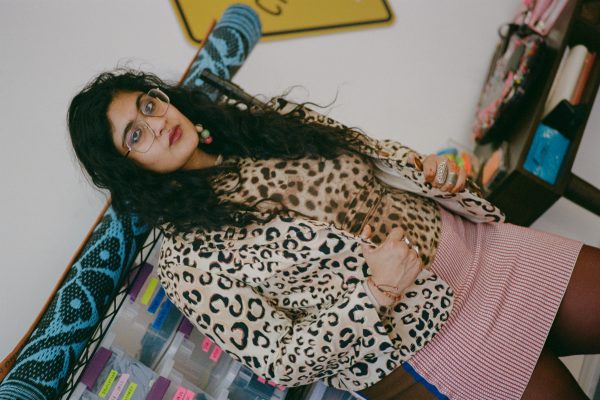
New York City is a big place, but among stormwater and land use obsessed artists, it’s a fairly small world. Sabina Sethi Unni and I are bonded together as Culture Push Climate Justice Fellow Alumni. When Sabina emailed me asking to get coffee during her fellowship in 2023, I must confess I ghosted her and we never got coffee. But, I knew that together we stood at the intersection of socially engaged art, community organizing, and extreme weather. Though we didn’t meet or speak again until I finally saw one of her performances in Jackson Heights last year, I’ve always known she is someone who I admire great. I will weather the storm with her until the end.
Sabina is from Long Island, New York, and has grown up to be both dependent on and inspired by the Long Island Rail Road. Sabina is a public theater artist, community organizer, and urban planner with a passion for infrastructure, public space, chai, and resilient adaptation in the face of climate change.
Her recent practice has manifested as Flood Sensor Aunty, a play performed outside in public space throughout the outer boroughs of New York City. These plays work to prepare people for extreme weather, and remind us that climate change is happening here and now, while maintaining that it’s cool and fun to be neighborly. Sabina’s plays always include musical interludes, nonprofit partners, and tips for extreme weather preparedness.
Now with more coordinated dances, more live instruments, and the same old leopard print Skims top that fans like myself have come to expect, this fall, Sabina is bringing civically-engaged street theater to a public space near you for the third iteration of Flood Sensor Aunty.
Cody Herrmann: As I said I’m a fan and I’ve seen iteration 1 and iteration 2 of Flood Sensor Aunty and I think you’ve just sold me on going to see iteration 3 again.
Sabina Sethi Unni: bit.ly/FloodSensorAunty.
CH: Yes, drop the link! You know, I have to be honest, I think the first time that I heard about you and your work, you were painted green. So how did that body of work, of you being green, turn into Flood Sensor Aunty?
SSU: Those were dark days. Just kidding. I think I look really, really good in green. It was pre-Wicked, of course. I’ve been told, I’m not saying who said it, but that the green painted play was a big inspiration for the big production of Wicked. I don’t know, I’m just saying there’s been talks of that.
I’m part of this Facebook page called Community Flood Watch, which is mostly a concerned citizen from Howard Beach posting National Oceanic and Atmospheric Administration (NOAA) reports. I saw a post from FloodNet sharing a call for public art proposals about flood sensors: they were installing flood sensors in neighborhoods with high risk of flooding, but people don’t know what flood sensors are, and they kind of look like security cameras, and you want to know that you’re not being monitored and surveilled, flood risk is being monitored and surveilled. So, I created Rainy Day Play, which I brought to neighborhoods where FloodNet is installing flood sensors: Edgemere Farm in Rockaway (which spoiler alert, I’m bringing Flood Sensor Aunty to tomorrow), Gowanus Dredgers Community Boathouse, and West Harlem Piers.
I wanted to do the performance during the rain—shortly as we started rehearsing I was like oh my god what a mistake, it can’t rain that would be a nightmare, and it did rain! And those were our most well-attended performances! It’s been great to iterate on this idea of how to do climate communications, (climate communications is a term I stole from Cody) around flooding in public spaces, through theater.
The best thing about Flood Sensor Aunty, of many things, has just been the really dozens, hundreds, of community partnerships that have given me feedback, both funny and tangible, that I’ve been able to incorporate into the play and make it really belong to whatever park that we’re in.
CH: As a Queens girl growing up on the edge of Long Island, there’s something about your work that feels so familiar and comfortable. I was wondering if you could talk a little bit about the greater New York City area that raised you and what opportunities you saw in your community that led you to this medium of theater and also the subject matter of climate communication.
SSU: As a parallel girl growing up on Long Island on the Queens edge, a mood board of things that I’ve found theatrically inspiring in our shared geographic scope are: (1) doing a volunteer Parks Department field biology department internship in 10th and 11th grade at Alley Pond Park and collecting water spinners between the Cross Island Expressway and Douglaston Parkway, but not wanting to put the waders on; (2) gossiping with conductors collecting tickets between the Long Island Railroad cars about their union; and (3) trying to suss-out if Ayurvedic skincare products at Butala Emporium on Hillside Avenue in Queens or Jericho Turnpike in Long Island are secretly-not-so-secretly skin whitening. I also feel very indebted to the places where I perform and the organizers I organize with, and deep responsibility for stewardship of these places on the periphery of New York City.
CH: We’ve talked before about how sometimes these neighborhoods lack the same arts and culture attention that other parts of the City get. It’s great that you bring those things here, but also that you talk about these rough subjects like climate change and flooding. Do you think these communities also need a little more help when it comes to adapting to extreme weather?
SSU: Obviously Long Island and Queens are the sexiest places for art… but because of geography and topography, Hillside Avenue and Jericho Turnpike have a higher risk of flooding because of high groundwater tables and former glacial ponds, plus subgrade housing conditions and folks that live in basement apartments, plus a lack of culturally competent disaster management. When Hurricane Ida happened, I wanted to create comedic theater about flooding as culturally competent disaster management, as a new strategy. We saw a lot of communities on the fringes of Long Island and Queens have to grapple with this lack of information, topography, and the social risk that’s constructed by housing too.
CH: So, how did we get here? How did your body of work form and evolve into Flood Sensor Aunty, and also how has each Flood Sensor Aunty run been different?
SSU: For those who live under a rock, AKA, I’m going to give you the Flood Sensor Aunty spiel, it’s a play about a flood sensor working at her aunt’s chai shop, who really wants to be a movie star. Halfway between really funny theater and culturally competent disaster prevention, this show is about how the best way to protect yourself from flooding, climate change, and despair is through knowing your neighbors. Created in partnership with New York City Emergency Management (NYCEM) and dozens, hundreds even, of other neighborhood-specific partners, audiences leave nourished with bellies full of oat milk chai, laughs, flood protection resources like flood alarms and headlamps, go bags, and calls to action.
Each round has changed and iterated, partially because I’m a perfectionist, and also partially because I’m trying to be responsive to community feedback. In the first round, we performed in South Asian Indo Caribbean enclaves in Queens and Long Island: a public park between Atlantic Avenue and Lefferts in Richmond Hill, in the backyard of a chai shop in Astoria, in the parking lot of Stewart Manor in Long Island at PYO Chai, where you can literally hear people ordering chai. In the second round we went to all five boroughs, especially Staten Island. In each round, we’ve added more Jill Cornell [New York City Emergency Management Department, NYCEM]: your favorite flood management professional’s favorite flood management professional. At first, she just provided technical assistance, now, she has a monologue.
More people have found us and wanted to be a part of Flood Sensor Aunty. Kunchok lives in Jackson Heights and was wandering through Travers Park with her cousins. It’s so hard to create consensus with your cousins when they’re just going to hang out in the park and then feel so moved to want to work with Flood Sensor Aunty and reach out to your neighbors in Queens. It is meaningful to me that we’re able to reach folks who are excited about taking care of their neighbors and looking for a launching point to do that. It’s been really great having more and more players join the band. We have a flood god uncle character. We have a live musician adding wonderful textures and layers. We have organizers with new neighborhood perspectives who can help reach more community-based organizations.
CH: So cool. Really beautiful to just hear about how all of your work has kind of culminated into this moment, Flood Sensor Aunty round three. It is also so lovely to see the people you bring into your work. How do you approach collaborations with City agencies, nonprofits, and even your performers? You really all seem like such a close knit group who share a lot of joy with one another beyond the stage, and maybe even have been painted green together?
SSU: There have definitely been some folks painted green who have stuck with me. And I think if you’ve been painted green with me, you’re going to experiment and play with me. Obviously it’s THEATER and really silly but I also see Flood Sensor Aunty as a community engagement strategy. It’s been really nice to see city agencies like New York City Emergency Management and nonprofits really embrace it as a form of community engagement. And it’s also just been really fun to watch non-profit organizers and city workers and former Pakistani soap opera stars all learn the same goofy dance that we do at the end of the play (spoiler.)
Everyone is the expert in something, so maybe you’re the expert in the place that we’re performing. Maybe you don’t know a lot about theater, but you know a lot about this park in Richmond Hill. That’s a form of expertise that is equally valuable as someone who’s really good at Laban Technique. Maybe you don’t know anything about flooding but you do know a lot about how to project in public spaces. It’s been really nice watching folks co-teach each other.
I like working with the same actors and the same community organizers and the same bureaucrats over time; we can all grow and change together and adapt to hard conditions of public space and get better at projecting and become funnier and sharper together and have good chemistry. And we all love each other.
CH: To switch gears to something that I really struggle with and I imagine you might too: people probably call you and offer you more opportunities the closer we move towards climate disaster, right? How do you deal with the fact that your popularity might correlate with how vulnerable and at risk our neighborhoods are to climate change?
SSU: I’m a chronic optimist, which is weird in a time of climate fatalism and late stage capitalism for sure. I definitely distort it to an optimistic perspective of: we’re in a really difficult time, but because of that people are more willing to take risks because we need to reach more folks. There’s definitely a Brecht quote about singing in the end days, which is relevant.
CH: I’ve also noticed that you make extreme weather disasters sexy, and fun, and popular. You really create this place where we can laugh about these things that make so many people cry, that make so many people upset. Do you think the secret is wearing the Skims x Dolce & Gabbana collab?
SSU: Well, you know my goal is to make preparedness sexy. And if you’re listening, Dolce & Gabbana or any other designer brands, Flood Sensor Aunty is open for sponsorship. By preparedness, I mean PRADA.
I’m sold on this idea that people listen to humor. When I was doing Rainy Day Play, the folks at FloodNet were like, ‘oh my god, I don’t want people to think the play is flippant about something that people have really experienced in a neighborhood where flooding is really real’ and Sandy is still raw and with the Gowanus rezoning people are thinking about it in different ways. Something that I did, and I always try to do, is balance with a little bit of earnestness so that people do know that we’re taking it seriously; so, we have these wonderful deviser monologues that talk about leaning on your neighbors. A new monologue from Jill is about (spoiler alert) organizing with Occupy Sandy. So there are moments where we kind of acknowledge the severity of flooding and these issues.
CH: I’m hung up on like the leopard Skims top that you wear for every performance, the humor is important, but the props are too, right? What kind of thought do you put into your set design, what everybody’s wearing, the costuming, that type of stuff?
SSU: The big thing that I think about is how can I make this incredibly transportable? How can I make this a set that I can bring to a public place and set this up in 35 minutes and also fit it in the back of my friend Autumn’s Toyota Camry?
I also want it to feel like the play takes place in whatever park we’re in. When we’re in Richmond Hill, the play is in Richmond Hill. We’re in Jackson Heights, the play is in Jackson Heights. So I keep it kind of minimal. I also think we’re performing in these wonderful, beautiful community gardens and chai shops and mechanical rooms and boats, and I want the space for them to shine. All the props are the smallest but dumbest things I can think of: a sock puppet, or custom council member t-shirts. I’m thinking of space and funny, the intersection of those two.
CH: Yes, of course. You’re standing at a lot of intersections, it seems.
SSU: The intersection of art and technology is the only intersection I don’t take up.
CH: Well finally, what did you hope people would take away from Flood Sensor Aunty?And are there impacts this play has had over the last couple years that you just totally didn’t anticipate?
SSU: I didn’t anticipate that Dolce and Gabbana x Skims, as you said, would be such a big part of the play and then my life. A friend who works at the Queens Borough President’s Office sent me one of their internal cabinet meetings and someone asked about flooding in the borough and someone who I’ve never met before answered, “there’s this young lady bringing a play about flood sensors to neighborhoods in Queens and we should totally reach out to her.” And it was great to see a random bureaucrat who I had never met be excited about using Flood Sensor Aunty as a form of community communications around disasters. It’s also been really nice being the reason people are having a good time and feeling good in their neighborhoods.
CH: I realized that this whole interview, I’ve just kind of been sitting here with like the dumbest smile on my face, because it’s just so great to hear you talk about this work. And all of us that are involved with socially engaged art, and standing at that intersection of climate communication and social practice with you, you know, we’re all so proud and so happy that you’re doing this and that people are paying attention. And that it’s working. It’s really great. So thank you so much for all the work that you do. And you know, I’ll give you the floor one last time to run your pitch and throw that link up.
SSU: Number one, love you. Everyone should be checking out Cody’s awesome socially engaged work. Number two, my pitch is if anyone knows how to automate Google Forms so that I don’t have to manually email the HUNDREDS of people that RSVP for a performance and also send them a calendar invite, do hit me up.
If you want to see engaging work about how the best way to protect yourself from disasters is knowing your neighbors, come see Flood Sensor Aunty. We’ll be in Elmhurst Public Library. We’ll be at Edgemere Farm. We’ll be at the South Street Seaport Museum. So probably that’s happened already, but you can definitely watch a video if you ask me nicely. And then we’re going to Boston. So we’d love you to come see these performances and also just reach out if you’re interested in getting involved in this kind of work.
CH: I see the love on stage when y’all perform. But you know, it doesn’t feel like a club. It feels like the audience is kind of right there with you, which is really it’s just so amazing. Kudos to you and all of your performers too.
SSU: It is a club, it is the hottest club, but you’re all invited. There is no cover. Everyone’s invited.
Leave a Reply