
At Abrons Arts Center, Kat Sotelo Slips Between Shades of Service

Kat Sotelo teeters like a tightrope walker, a balancing act of several roles and personas in her newest work, A Devotion to Service. It’s a bit slippery, the way she transforms herself from a sexual fantasy to a girlish ballerina in a heartbeat. But through the shifts, A Devotion to Service manages to stay grounded in Sotelo’s control. We’re always seeing her, but rarely all of her, not all at once. She makes sure of that.
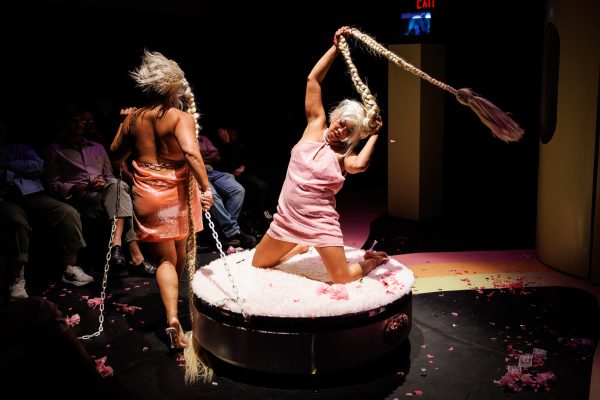
In its world premiere at Abrons Arts Center, Sotelo is joined by an effervescent Gigi del Rosario, an ever-serious Gabriella Acquaviva, and three men in theater-tech black attire with crew belts, two of which are credited in the program as a task rabbit and a Dominos pizza delivery person. The stage is bedecked in pink, orange, and green; two neon-lit peep show booths flank a white fur-covered runway, filled with Rosario and Acquaviva in tiny nightgowns, peering through the windows and into the audience during the pre-performance, grinning and waving.
It’s established early that the crew men are, ironically, in complete service to the women. As Sotelo, Rosario, and Acquaviva step onto the fur-covered runway platform in neon sequin dresses, the men eagerly jump out of their places just off stage to grab their hands and escort them. When martini glasses tumble from where they’re balanced on the women’s massive bouffants, spilling confetti onto the fur, the men dive with mini brooms and dustpans to sweep away the remnants. They stand at the ready, but remain completely in sight of the audience. Service, in all its forms, becomes the performance.
In these opening moments, the three women take on the role of the eye candy on a 60s television show, one of the many characters they take on throughout the evening. Their smiles are plasticky and expectant as they look into the audience, eyes seeming to say, ‘Look at me. Are you enjoying the show?’ The line between the performer and the audience is simultaneously blurred and stratified, especially when Sotelo gushes, “I am an emerrrrrrrrrrrging artist,” playing with the eroticism of the term she’s been coined as by the industry.

Many times Sotelo pokes fun at nature performing itself, metaphorically and physically baring herself to the audience and making moments often hidden from the audience conspicuously visible. After her sequined dress is unzipped from her body by Rosario to reveal an equally sequined bra and g-string, Sotelo calls out “5-6-7-8!” with a look so serious it becomes funny. Afterwards, she and Rosario break into a bawdy heels number, legs swinging and hips twerking with light-up acrylic stilettos on their feet. It’s a far cry from the poised, prim dancers we watched moments ago.
It’s the first of many times where the performers shift from one persona to another before our very eyes, and the transitions are not seamless. Perhaps this is intentional. Perhaps we’re meant to see the shifts, to see how much someone’s performance can change when their imagined viewer changes. Sotelo, particularly, juxtaposes different roles at breakneck speed. At one point, she’s jumping over a broomstick like a jump rope on the playground, yelping girlishly. Within a second, the broomstick becomes a pole for her to roll her hips against. Contradiction becomes the aesthetic, and it’s embodied in her movement.
Journeying through memories from her adolescence, Sotelo investigates different forms of service she’s committed herself to throughout her life. Home video footage from these milestones are projected onto screens and vintage television sets for us to see as Sotelo mimics, with absolute sincerity, the rituals of the performance. She emerges from her dressing room in a tutu and ballet shoes as waltz of the flowers begins to play, matching the choreography from her childhood dance recital taping move-for-move. Later, she comes out in a poofy white gown, and takes a turn slow dancing with each of the crewmen as scenes from her teenage debut ball play in the background.
There’s something bitingly procedural happening in these scenes. As Sotelo rolodexes through her memories, her movements are resigned, as if her body is in complete surrender to the steps she’s meant to carry out. This comes to hilt when she’s reenacting a lyrical number from her childhood recital on a loop. We see her limbs crumble under the exertion of repetition, and as the music warps, she drops to her knees, heaving. Devotion, it seems, takes its toll. She drops into a chair, leaning back with her legs splayed open, in front of one of the peep show booths. Acquaviva, inside of the booth, pushes out her ass and rolls her hips for the viewer. It feels like worlds colliding, contradiction on full display.

Not all of A Devotion to Service crystallizes quite so clearly. In some of the vignettes, ideas are brought in and washed away before anything can really land, moving onto the next act. But over the course of the evening, it becomes clear that central to Sotelo’s performance is her control over what we’re seeing. She makes sure to hide certain things, but others are flashed directly in front of our faces. When you realize this, it feels like a punchline finding its hit. On the television screens are live feeds broadcasted from monitors inside of the peep show booths, or from Sotelo’s dressing room as she changes wigs. In certain moments, the peep show booths are opened to reveal the inside, and only certain sections of the audience can get a full view of what’s happening. Sotelo plays with the eroticism of the seen and unseen, and stakes a claim over what she chooses to reveal.
That’s why the ending settles with an intentional weight. In its final moments, A Devotion to Service chooses to let us into something private, intimate. Sotelo’s father gets up from his chair in the audience to join Sotelo, Rosario, Acquaviva, and the crewmen on stage. The fur runway is transformed into a dinner table, where the performers set out Filipino dishes (Sotelo is a first-generation Filipino American). Together, they join hands in prayer, and begin to eat. There’s no bows. Instead, Sotelo and the performers ask us to join them.
A Devotion to Service shows us that service takes on a multitude of meanings; shades of being that Sotelo transgresses, mimics, and wrestles with. In its end, service to one’s community becomes the performance’s heart. Sotelo is no longer teetering off the edge into another persona. Instead, she settles into it, and invites us in with open arms.
Leave a Reply