
While waiting for the Whole of Time to begin, Frida Kahlo surveys the audience. Looking out from the center of her 1937 painting “Memory or The Heart,” her eyes are flecked with tears. She floats above the ground, flanked on either side by two sets of clothes, one for a young girl and the other for a grown woman. Where her heart should be, there is only a gaping hole and a metal rod failing to fill the void. The Organ is found elsewhere. Massive and seemingly still beating, the heart leaves a breadcrumb path of blood dripping in its wake, endeavoring to wine-darken the sea in the foreground.
Being surrounded by so many sites of rupture and removal, the artist’s lips refute the full descent into abjection. Despite her past and the seeming uncertainty of her future—how long, after all, can someone survive without their heart— she has managed to express the entirety of the pain caused by the break between tradition and modernity in this moment. Would that we were all so lucky?
What happens when a person tries to do the same? When someone tries to straddle the forking paths between the familiar and the life unlived? These quandaries are at the heart of Argentinian playwright Romina Paula’s play The Whole of Time, which played at The Brick in Williamsburg this past September. Enlisting Tennessee Williams’ The Glass Menagerie as a scaffolding, Paula explores the ways that the aforementioned inquiry challenges the assumptions and expectations of a world that doesn’t feel fully made for fractured souls.
Sadly, this question goes unanswered. The Whole of Time two-steps its way out of time, creating a staging with two theatrical left feet. Under the direction of downtown stalwart Tony Torn, Paula’s play zags at every opportunity to zig, and zigs where it ought to zag. It lumbers in one moment, only to rush headfirst into the next. The tone jags back and forth between hot and cold with such severity that the result cannot fail to be anything but tepid. Taken together, all of the attempts add up to a production whose demise stems from its own dizzying opacity.
Paula’s work loosely borrows its plot from the second act of The Glass Menagerie. An outsider enters the insular world of a singular family of three spinning out. Unlike its source material, Torn’s effort brings us into the world of the play not with a monologue, but a dance. More specifically, a dance routine. The distinction feels critical because the creation concocted by siblings Antonia (Josefina Scaro) and Lorenzo (Lucas Salvagno) feels like it’s ripped right from a series of home movies. Homespun and heartfelt, the routine unfolds like the result of a rambunctious indoor energy primed only for an acceleration of chaos.
Set to Marco Antonio Solís’ “Si no te hubieras ido,” the duo’s routine goes pound for pound with the song’s sentimentality, meeting every ounce of its forlorn feeling with an equal effort of over-the-top embellishment. In an exemplary moment, the siblings careen across the stage in a rolling chair, a shirtless Salvago, clad in a leopard-print coat. It is not fully polished, and it is not supposed to be. It’s a performance propelled by the rush of creation and the joy of making something with someone you’re close with. Eyes closed and arms outstretched, they come close to Jack and Rose on the bow of the Titanic—a comparison that feels both endearing and unsettling when placed on a brother and sister.
Antonia, in the vein of Tom Winfield, has tricks in her pockets. As the dance ends and dialogue begins, Scaro’s character quickly dives into a frenetic analysis of Solis’ song. “What’s really going on,” she confides while glued to an ancient-looking computer that serves as her home base throughout the show, “is that [his wife] is already dead. And she’s dead because he killed her, the singer-songwriter killed her.” Even after being pressed on the veracity of her statement, Antonia refuses to relent. Like the studied performer she is, though, she holds something back. The withholding is a lie. Solis never killed anyone, let alone his wife. Like many a casual critic, Antonia knows that the combination of conviction and volume creates a level of truthiness that outshines the thing itself.
The scope and scale of this lie are befuddling. Having just seen the pair sing and sync their souls with song, their mutual appreciation for the ballad is not in question. Is it to subtly flex on her sibling? A well-aimed “well, actually?” Everyone gets caught up in the heady rush of twisted facts and tall tales. The combination of higher emotive heights and lower sinister lows makes the song all the more powerful. But the question remains, why lie? It does not pass the level of Vampire Weekend logic: “Why would you lie about something dumb like that?”
In fibbing, Paula teases the connection between Antonia and her equivalent in Williams, Laura Wingfield. Laura, too, sparks the action of her play with a lie. Deceiving her family into thinking that she’s still enrolled in business college, Laura, diagnosed with an ambiguous disability, spends her days flaneuring her way through city streets. She walks. She walks through and alongside her disability. She walks, and in doing so, there is the hope that the pace of the world might pause for a second or two, allowing her to both catch her breath and catch up. Occasionally, Laura finds her way into an art museum or the zoo, spaces that offer the luxury of taking one’s time. All the while, she is waiting for the other shoe to drop. And when the truth is finally revealed, the deception only makes matters worse.
Antonia’s falsity fails to find the same poetic heights. Unlike Laura’s case, the real truth never comes to light. Instead, it is acknowledged, taken for granted, and blown past. In this way, Paula’s creation comes closer to Laura’s mother, Amanda Wingfield, than Laura herself. Amanda is a thinly veiled interpolation of William’s mother, Edwina. Connecting the two, the critic John Lahr notes in his biography of the playwright, Tennessee Williams: Mad Pilgrimage of the Flesh, that Edwina deployed a relentless avalanche of words “to keep the world at attention and at bay. Speech was a sort of confidence trick: that is, her words were intended to give confidence to both others and to herself.” Repeat a lie enough times and it becomes true. There are few things more comfortable than repetition.
In combining these two characters, something is diluted. In the act of compression, things get lost or muddled. For all the idiosyncratic energy that Scaro brings to her role, she fails to find the full capacity that the part demands. Neither Laura nor Amanda, Antonia finds herself mired in no man’s land, stuck between the competing fronts of stylized maximalism and ingrained realism. Like in many wars, no one really wins.
For all of this possible depth, the production can’t find more than a fraction of it, never pushing past surface level. All four characters we encounter, including their mother, Ursula (Ana B. Gabriel) and the gentleman caller Maximiliano (Ben Becher), feel lost within four separate worlds. There is a generous reading of this choice that views it as a commentary on the ways that we are disconnected from ourselves, even those we claim to be closest to. However, the effect falls closer to a sophomore year scene study. Over-thought and under-baked, it fails to either congeal into a compelling whole or fully commit to a fractious asymmetry.
Like many mothers, Ursula professes that she just wants her children to be happy. Like more still, she wants that happiness to contour closely with her own expectations. Seeded by some lightly discussed wealth, the family wants for nothing. Perhaps in this well-healed lack, Ursula’s frustration at her offspring develops the two-faced intensity that snakes around both Antonia and Lorenzo. In this bind, they can squirm to their hearts’ content but cannot break free. The familiarity of this pressure holds a bit of pleasure, but that feeling falls away fast. In its wake is the fight-or-flight tension of a system so dysregulated that all the crossed wires and fried nerves create a facade that appears “fine.”
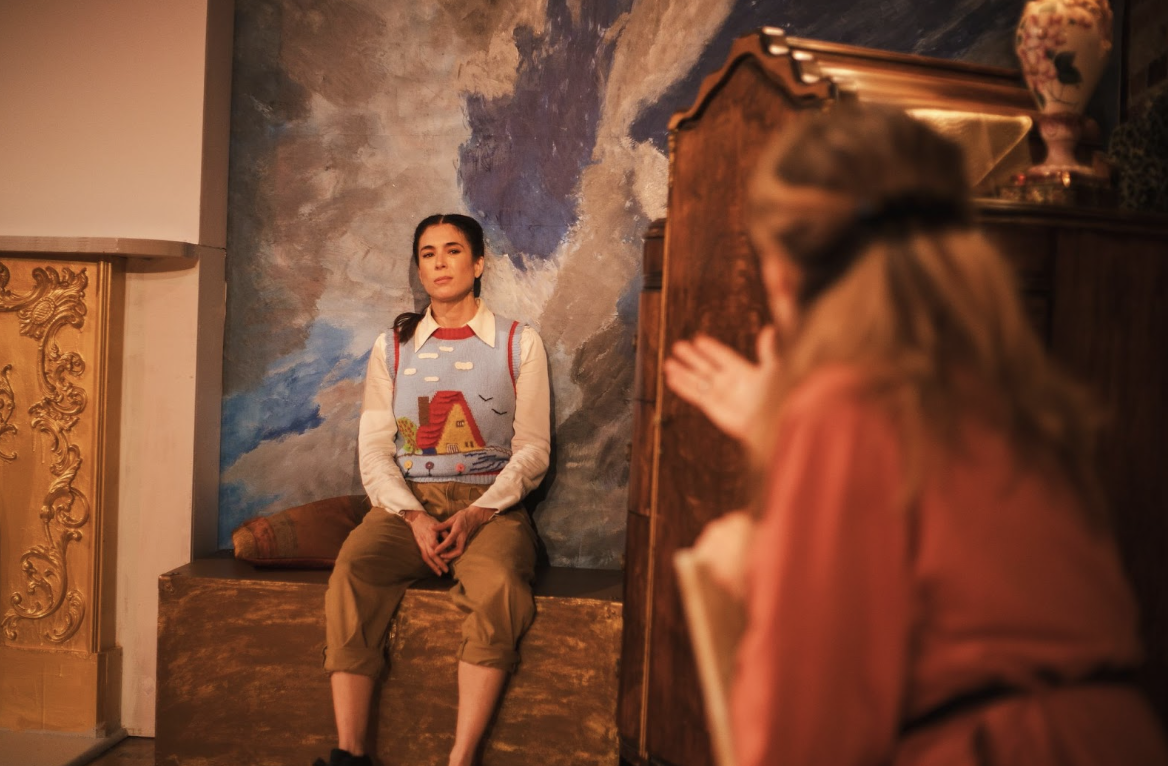
Perhaps this is why the production can’t seem to find the words to describe these feelings, falling instead into movement to communicate. After a sputtering mother-daughter exchange, Ursula coaxes her daughter into another bout of dance. Much like the opening number, there is a kind of private charm to this moment. If not these exact steps, they have moved through these motions before. They glide across the living room floor, Antonia leading, surrogating the male presence missing to varying degrees– much like in the source material– in both of their lives. However, before they can fully find each other, Scaro succumbs to the weight of this moment. She breaks away from her mother and finds her way back to the dull glow of her digital world.
In its portrayal of the online spaces, the Whole of Time shows its age. While recently translated by Jean Graham-Jones’s lean and tight translation, Paula’s play premiered in Argentina in 2010. In some respects, The Whole of Time finds a timely resonance. Call her chronically online, or hikikomori, or a femcel, whatever your preferred term is, Antonia’s attachment to her computer undoubtedly hits home with a contemporary crowd. But like many other moments in the piece, this possible point of connection in production remains frustratingly one-dimensional.
The conflict of the piece plays out most thoroughly between Antonia and Maximilliano. Eager to finish the final pages of Moby Dick, Lorenzo quickly excuses himself, leaving his sister and his friend alone together. Small talk emerges. Marble-mouthed and musclebound, sporting a leather jacket and tight jeans, Becher’s Maximiliano appears poised to cry out “STELLA” at a moment’s notice. While Williams’ Gentleman Caller dreams of bigger and better things, Paula’s character is content when he gets a consistent day off. He goes to work. He goes out to bars. Eat, sleep, repeat. Becher presents this drive with an unwavering golden retriever energy that hangs so freely off him it barely feels like acting.
Yet for all his affability, Maximiliano is troubled. He cannot wrap his mind around the puzzle of Antonia. She doesn’t work and has no desire to. She throws every one of his questions back at him, coiling her words around his head until they transfigure themselves into a cloud of cuckoos; the kind that orbit the heads of dazed cartoon characters. It’s not a fair fight, but sometimes when the world is hard, we seek out something soft, a mass that can take blows and gently find its form again, after the fury. It is the Gentleman Caller who sees Williams’ Laura the possibility of a not-so fragile future. All she needs is the right kind of support, the kind her family is incapable of comprehending and creating for her. Perhaps a similar truth rings true for Antonia. Perhaps to step forward, one must step away from a world that refuses to fully serve their needs. It is in this vein that Paula finds her deepest level of critique. When the forces of capital cannot be avoided, perhaps opting out is the most radical thing a person can do.
For the final time, though, a provocative question fizzles in the air. No satisfactory answer arrives, but in the charged space, a different kind of sparks fly. The more Antonia plays with the human Etcha-Sketch that is Maxamiliano, the more she likes it. Naturally, this play leads to a kiss, and, inevitably, more dance. More than any other, this is the moment where Paula finds the greatest overlap with Glass Menagerie. Finally moving outside of the family unit, the sequence finds a greater degree of sexual charge than earlier outings. It is an untried sexuality, stiff and uncertain in its own desires. A stiff-limbed thing threatening to fall. This support, though, does not sustain the rest of the production.
Rather than the “truth in the pleasant disguise of illusion,” that Tom Wingfield claims to present in the opening lines of the Glass Menagerie, production itself never quite reaches that standard. Instead, they stall on the previous line. Tom declares that most stage conjurers, and by association most theater, gives an audience “illusion that has the appearance of truth.” Unfortunately, all Torn and company can muster up is tarted-up truth. Fundamentally The Whole of Time is plagued by a problem of scale. An earlier iteration, staged in the home/studio of Torn’s family, received strong notices. It is possible to imagine how the play could thrive in a space like this, where a sense of home is unescapable. However, even in the intimate confines of the Brick Theater, what intangible charge propelled this earlier effort is gone. To return to the earlier image of Kahlo, the heart has stopped beating.
Photo: Josefina Scaro and Ana B. Gabriel. Photo by Catalina Recalde.
Leave a Reply