
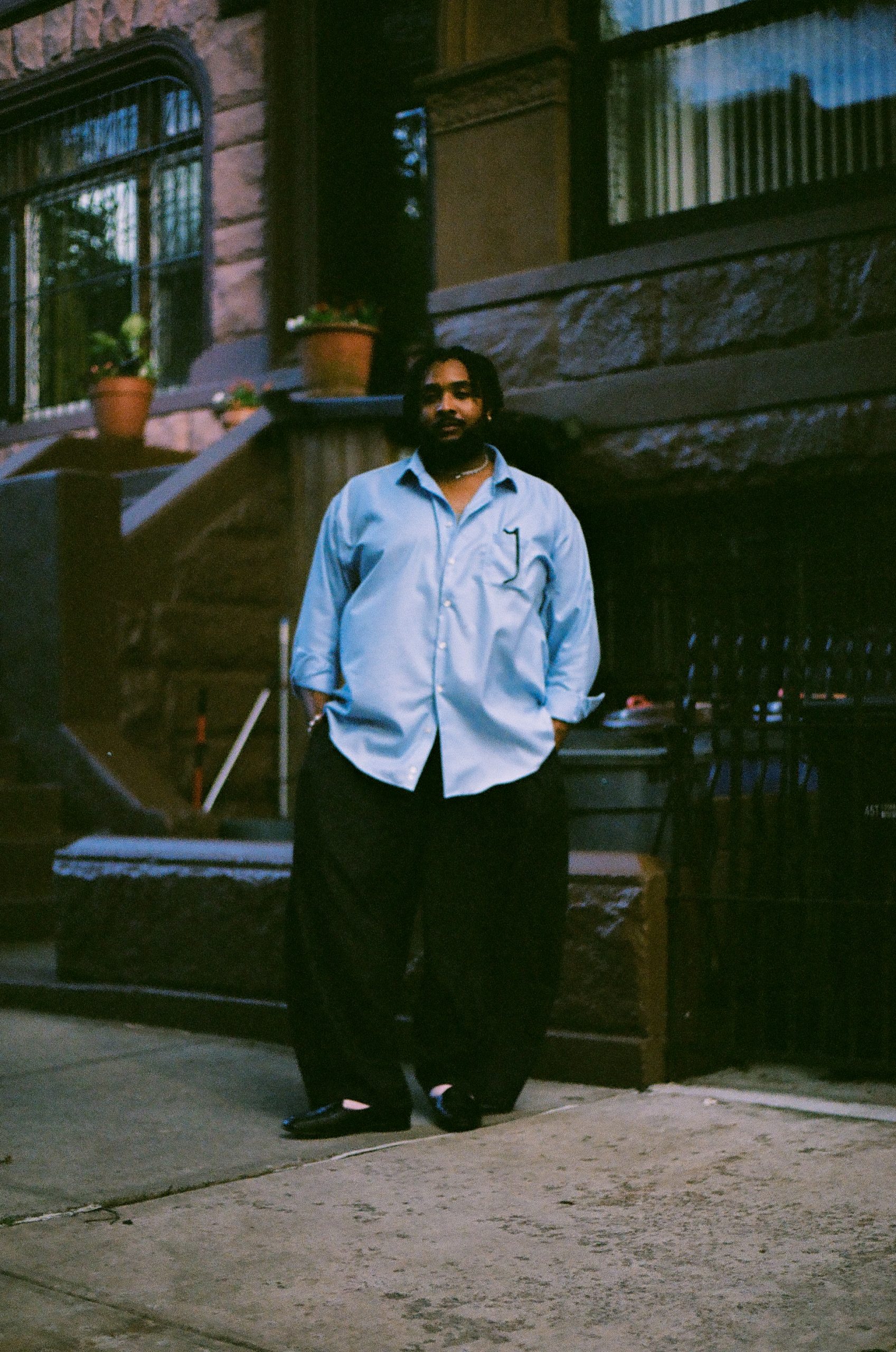
I saw Nazareth Hassan’s Bowl Ep at the Vineyard this past spring with my soon-to-be boyfriend. It was one of those dates that is only a date after you’ve officially gotten together and are telling each other the story of how the relationship came to be. I shared this with Nazareth and they seemed happy to have, in some way, facilitated our budding romance.
Months after seeing Bowl, the play’s text, imagery, and physicality, despite inevitable dissipation, still linger in my mind. I hung on to its dramatic container, an empty pool made into a skatepark by Kelly K Klarkson and Quentavius da Quitter. The pair are a rap duo, attempting to name themselves and define their connection. The empty basin that they skate, drop, and slip into acts as a sort of wishing well where the self frays and stories of becoming and unbecoming are told for us by abstracted and fragmented voices that might only come to us by way of premonitions, dreams, and trips alike.
In late October, ahead of their new play, Practice—a theatre piece that takes on the notion of performance creation—at Playwright’s Horizons premiering in November and the release of their book Slow mania December, I spoke to Nazareth about the power and fragility of theatre: its makers and players, poetry, and how language fails. At the top of our conversation, I asked Nazareth if they could remember where or how we first met. I’d seen them perform alongside Malcom-x Betts and Maxi Hawkeye Canion as part of Black Aesthetics, a performance art and dance series curated by Betts and Arien Wilkerson at Judson Memorial Church. It was after those shows, and in the audience of others, that we’d exchange warm and familiar glances, though it turned out we met at a cafe I used to work at in Bed-Stuy, presumably when I was a touch miserable and applying to grad school.
I left our conversation buzzing with the notion that, in order to straddle theatre and multi-modal performance, while traversing theatrical institutions as a writer, director, and dramaturg, one must be committed to the endlessly interrogating the relationship between content and form—what they tease out of us and what they demand from us.
Knowing that we are both dramaturgs, I couldn’t resist grounding our conversation in the ever-elusive field as a jumping off point to discuss the pangs and necessity of creation—why we do what we do and where it all fits in.
This interview has been edited for both length and clarity.
Sophia Parker: What’s your relationship to dramaturgs and dramaturgy?
Nazareth Hassan: I spent a while being a dramaturg, actually. To me, I think, the most important thing for a dramaturg to be is adaptable. I think dramaturgs really are experts at people and not, like, theory or plays. Obviously, they are, or can be, experts on those things, but I think it’s more about, when you’re working with an artist, learning how to really get to know an artist’s heart. They are the expert on their craft, and I can be there to be a talking partner about the why—their internal why and also the external why: the context and how it sits inside of the world. I can sort of be the stand-in for the audience. What it is that they’re trying to do and why and then helping them facilitate the why more than the how, you know?
Do you work with playwrights a lot, or is this dramaturgy more for performance work?
SP: I’m at school at Columbia for dramaturgy now. I’m a dancer and when I started the program I was most interested in dance dramaturgy and dance with text. That’s still what I’m the most interested in and what I’ve been working on. I had a solo show at Pageant where I performed these poems that felt monologue-y and was also trying to dance and speak at the same time, which felt like more internal dramaturgy.
I love what you say about dramaturgy being sort of a study on people more than anything. Because, before the program, I really only read Slave Play and A Streetcar Named Desire.
NH: Those two…that’s chaotic.
SP: I was like, I guess I know what a play is? So I don’t feel well-read in plays at all. But then I think I have a lot of questions about what performance does—not what it is. To your point about the why, I am after experiences and sort of capturing them—like what is felt. Like with Bowl—the sound that the skateboard was making across the space—and feeling like, oh, what is that sound doing? Or, that feels like a whisper of something.
NH: What is the material implication of the actual thing happening to you? And the social implication? I think a lot about what performance does. I had a teacher who used to say plays are a call to action—and not in the political sense—but plays are texts or manifestos that ask to be made or ask to be done.
I went to Brooklyn College, so the program I went to was very influenced by poetry and experimental theatre. And just that thesis alone about what a play is sort of expanded what I understood text and performance to be. It was no longer about drama, you know what I mean? It was about performance, text, and language operating on a physical level in addition to operating on a psychological or informational level.
It’s really good that you’re in a program, because I think theater is such a dense bubble that oftentimes the same tastes and ideas get recycled. And the way the industry is set up—only now maybe there are more performance-inspired works happening in the theater—but they’re so segregated. So I think it’s good that you’re influencing the girls. Please do.
SP: I wasn’t expecting the delineation between dance and theater to be so stark when I started. They’re not the same, but for me, they sit for me on the stage as this sort of blank map, a landscape for things to happen. That’s how I saw it, as opposed to the page being this is this thing that we all have to read, and text outranking everything.
NH: Having worked in the performance space in theater, I also see it that way. I see them as different methods of engaging and activating the stage. Whether that’s through dialogue or through movement or through straight text or music. It’s all about finding the right tool to communicate and to influence the audience, you know what I mean?
SP: Yeah. I was in a class where we were talking about theater and spoon-feeding, and working with classmates who are all navigating the same stuff. So the playwright writes, “I’m thirsty, so I grab the cup,” and then the direction is grabbing the cup. It’s that doubling of meaning-making that happens. But how do you also, within whatever’s happening on stage, give the audience the tools to understand what’s happening without this sort of doubling thing?
NH: I think that sort of representational thinking is valuable. Practice is quite representational and hyperrealistic. And I don’t normally write hyperrealism or realism in that way, but I think there’s a place for it—and there’s a very theoretical place for it. But I think the theater, at large, doesn’t engage with the theory behind realism, and, in fact, takes it for granted.
Because there is something really exciting about mimesis and attempting to replicate something that can’t be replicated. There’s something really exciting about that act—but it has to be seen as an act and not as a given. In the same way that going on stage and, you know, doing a five, six, seven, eight is also an act.
SP: For Practice, and this idea of the self rubbing against the material—how did it start, and where is it sitting with you now?
NH: Practice started just from a place of thinking about—I had just lost a show. I don’t come from wealth, and that was my main source of money. So at that time, there were a lot of things going on in my life. I have chronic illness, and I felt like in losing that show, I’d lost everything in that moment. I was really taken by the way in which this art form that I love so much could be sort of perverted, or could be used to propagate a gross sense of power.
And knowing that the tools that theater utilizes are people’s bodies, people’s minds–at the end of the day, that’s really what the medium is. I realized how fragile the work is. And it made me go into my own practice as a director and think about the kind of artist that I am and the way that I use my power.
I think the play came from me thinking about what my values are as a director and a writer, and consciously trying to pervert them. Thinking about what the worst thing that I could do–or that another director could do—with the skills that I have? And then it turned into someone actively entering the minds of their company and twisting their reality.
I think, in a lot of ways, the play is, and this might not make sense, but it’s a testament to what I love and the power of theatre. Because it’s so tender and it’s so fragile. Like, those are things that I love about theatre. I love the fact that it asks a certain vulnerability of me and my collaborators. But in the same breath, that vulnerability can be quickly misused. I was really interested in how power in this form propagates itself and is like a microcosm of how people use psychology outside of the theater to propagate power.
*
I think that’s the difficulty with performance work in general. You want a challenge. I don’t know if this resonates with you, but I know that I came into performance because of the sort of frenetic energy of those things. Because it does force you to meet yourself through the eyes of others. And it’s so painful when it’s misused, so painful.
Because when it’s good, and when it feels good, when it feels right—it’s really, really right. And when it doesn’t, it’s like… a disaster. It’s a total disaster.
SP: I wanted to ask you about poetry too. I know Slow Mania is coming out. I wrote something very cheesy the other day, that’s obviously been said before, about how dance is poetry in motion. But there’s something about poetry, where you can put it in your pocket, and isn’t that such a gift? You can’t really put theatre in your pocket. I love that about it, that it’s this fleeting thing. But I think about when poetry can exist on stage—or when it can’t? I have a lot of questions about that.
NH: I think every medium is creating its own public politic: its own space for reflection. When I’m working in different media, it’s about what politics or what methods something needs to be expressed through. Like, I think in theatre I write a lot about shame—my shame, or things that you’re not supposed to say out loud, or that we’re not supposed to do in public for whatever reason. So it can be looked at and put out in the open, and we can experience it together.
I think something that helps ease shame is togetherness. When I’ve spoken something that gave me shame and then received commiseration, or somebody responding that they agree, it automatically makes it feel ten times easier. Whereas with poetry and texts made to be read, sometimes it’s like, how can I ask people to slow down? To reconsider, and to consider over and over again a thought, an image, or a feeling. I don’t think theatre always allows this.
There’s a slowness with poetry. Because in theatre, you’re always sort of in performance; you’re always thinking about the journey. There’s a high likelihood that not everything will be caught in a play, so you’re thinking about how to frame things, how to give people a particular image or a particular thing at a particular time. Whereas with a poem, how can you write a text that someone might have to read two or three times, you know what I mean? To really feel it and get into it.
It’s the same with music. Music feels like a different sort of processing. Do you also write poetry to be published, or do you just write poetry to be performed?
SP: I think just to be performed, honestly. But I do love seeing it on the page—and then the repetition thing too. I had a professor (Vinson Cunningham) who was like, “Oh, you should start reading Frank O’Hara poems.” And they’re so observational. I hung onto a line about drinking too much coffee in the morning.
I want to make work that hangs on that line—of drinking too much coffee in the morning—but is physical and lived in. There’s the poetics of the body too. With Bowl and the eating of the banana and the fingers down the throat—all of that kind of physical intimacy—I was like, oh, I’m hanging on this, because that is this really internal, sticky, complicated thing that also just is pleasurable. And what are all the sides of this one action?
NH: I think something I really liked about Bowl is that the majority of it is a score—it’s all action. I think something I love about writing plays is being able to write action and to write choreography, whether it’s mundane or expressive. I’ve always thought about plays as the poetry of time and space in the body—and those three things sort of co-mingling in a certain way.
The way I write text on stage is more about it being felt—about it being processed physically. How do I write something that, even when it’s language or dialogue, also needs to feel physical? We need to hear and feel the consonants, or use a certain word that may have a violent reception, to get to the impact of language. Whereas with poetry, it’s more about how language fails. Does that make sense?
SP: Totally.
NH: Poetry, to me, is the failure—it’s exploiting the failure of language and trying to say the things you can’t say. And in this horrible, ugly language that is English.
SP: I always call myself a bad dramaturg because when I read, it’s really hard for me to know—depending on what the play is—to really understand what’s happening. I don’t know, because I’m not listening to it, I’m reading it. I’m really trying to teach myself how to listen to a play as I’m reading it.
NH: When you read a play, do you see it?
SP: It really depends. I think the ones that really get me excited feel like blueprints for performance. Like—oh, this is a script, but it’s really a blueprint for what this thing is going to look like—as opposed to ones where the language is really doing something. Then I kind of just get obsessed with what the language is doing and not seeing it.
NH: I try to, whenever I’m reading a play—this is my directing training—I try to draw along with the reading, just so I can imagine the space the writer wanted to be in. Because when I’m writing, I think about the kind of space I want to be in—the architecture and the size. So when I read a play, I’m like, is this something that should be in a really small black box? Or on a really large stage? How can this thing live in the actual world? What is the scale or intimacy needed to really hear it? I knew Practice was going to be a big play, and so I wrote it with that in mind. I was seeing the proscenium as I was writing it.
Leave a Reply