
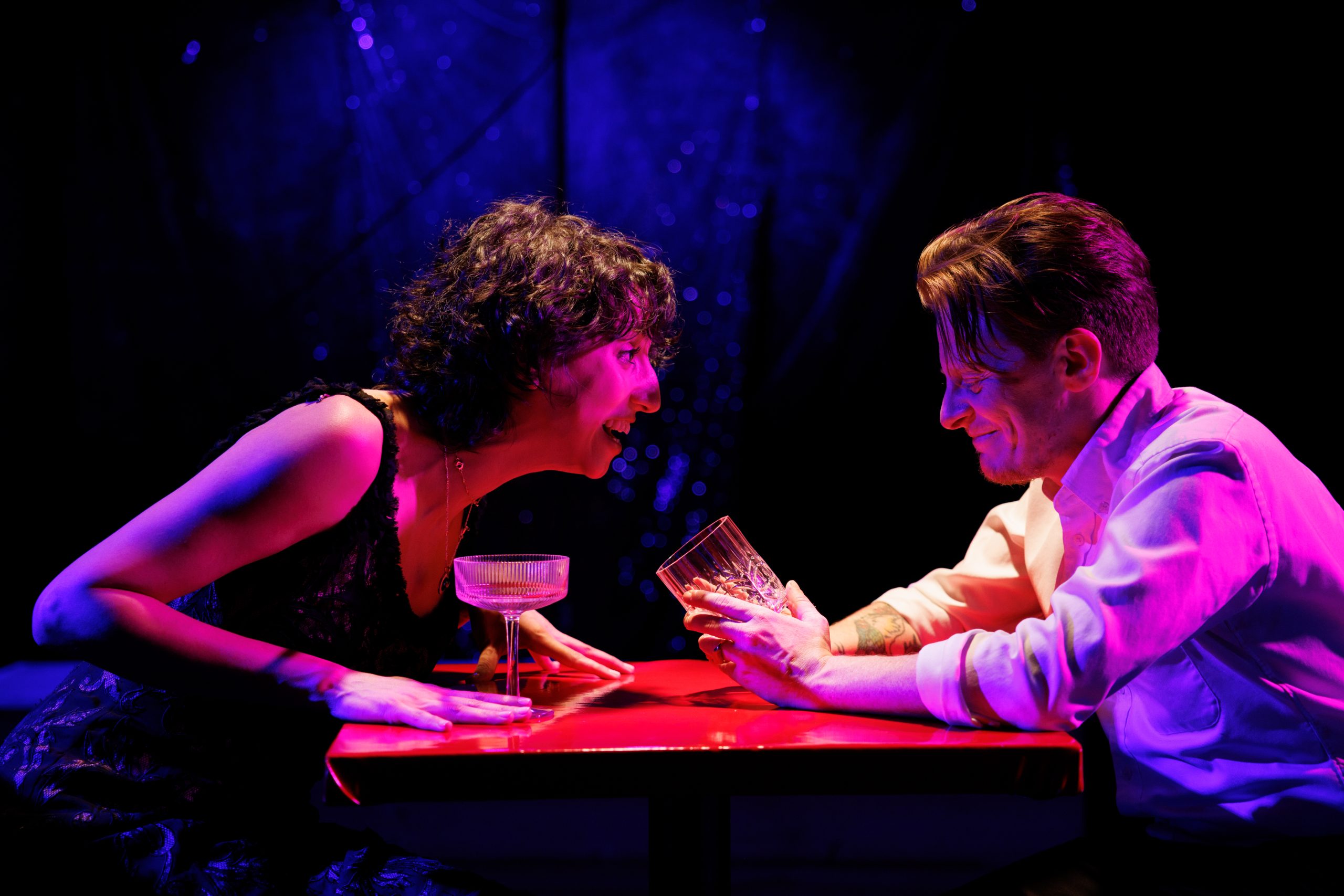

Ben Gassman’s Adult Relationships (directed by Tara Elliott) occupies a liminal space. Death brings its central characters, ex-lovers Negeen (Layla Khoshnoudi) and Noah (Jess Barbagallo), together again for a night. The two are first encountered in brief glimpses at the wake of their late friend, Haris (voiced by Greg Keller). After, the two speak for the first time in years just outside the funeral home. They share a cigarette, catch up coyly, and make attempts at closure throughout the remainder of the show. But closure is elusive.
Long before he died, Haris had been trying to get through to Noah. He’d left him voicemails. And Noah had ignored him, mostly. What becomes clear is that Noah can’t be entirely faulted for having blocked out someone like Haris. The messages he’d left hinted at who he was: brash and abrasive; sometimes obscene despite his genuine desire for closeness.
Don’t we all have a certain someone like that in our lives? If not a person, then a menacing something we’d rather not confront?
As Negeen and Noah rekindle their way through the night together, Haris regularly rifts through that narrative. His voicemail messages play loudly and without warning, causing the warm stage lighting (designed by Alejandro Fajardo) to turn cold. Scenes stop, and change. Time moves differently to the sound of his voice—onstage motion becomes slowed or chaotic or choreographed (sometimes all three at once).
But when Haris allows, Noah and Negeen seem to exist outside of time. The two attempt to bridge the gaps in familiarity, intimacy, and ideology that have divided them, first playfully and then with increasing earnestness. From the funeral home to a bar and beyond, they reflect on their past with Haris, their past together, and their respective presents: the spouses, young children, career highs (and lows) that define their current lives. I’ve said a lot about the most obvious source of the show’s tension, but there’s tenderness too. Noah and Negeen are quippy and teasing and these moments eased me toward their insular world; I escaped into it.
Still: the rifts.
Sometimes those rifts are physical. The Dancer (Lena Engelstein)—who embodies every other character besides the couple—regularly forces, or lithely lures, them away from one another: for a dance, a chat, or drugs.
In one scene, Noah and Negeen, at opposite ends of the bar and facing different directions, recite overlapping monologues as if overshooting conversational targets. Other times, some questions—posed again and again between them—are consistently evaded.
Rifts are one of Gassman’s most compelling motifs. In his earlier play Independent Study (2018) a student, GG, whose brother is killed for participating in a terrorist act, struggles to reconcile his actions with who she knew him to be. She attempts to understand his motivations: what brings a person to that point? Could she herself act in anger that way? During that confusing time of her life, she finds some relief by attending her former professor’s office hours. GG and the professor often challenge each other ideologically, but also find common ground in their genuine respect for one another’s minds, and, to a lesser extent, through the similar faith-based practices that shaped each of their seemingly opposing cultural upbringings. In Adult Relationships, Negeen and Noah mirror that dynamic in some ways. Negeen is culturally Muslim, and Noah, culturally Jewish. But Negeen is frustrated by Noah’s ambivalence as it relates to Palestinian liberation and, he, by how “binary” she is on the matter.
Negeen is staunchly anti-Israel; openly condemning. And Noah admits to “privately” standing against Zionism. Negeen is not impressed.
NOAH
People hate Jews
Negeen
NEGEEN
People hate Muslims
Noah
NOAH
Yeah. I know. You’re right. Yeah.
A strength of both Adult Relationships and Independent Study lies in their explorations of the daunting space between things: rifts in ideology; understanding; or born from avoidance; from denial. For Gassman’s characters, these themes are sources of unease at best, and at worst, fear. They were for me, too, as I anticipated how they’d close the gaps; wondered how this could be achieved in life, once I left the theater.
It’s complicated.
Sometimes confrontation is the only way. Extranarrative abrasion did the work of the ‘real’ world, even as I tried to escape into what comforted me: the moments of connection between characters, as they played out onstage. Abrasions like the “Hate Chorus” in Independent Study impose the worst elements of the digital age upon the narrative; intrude on scene with chanted –isms, incel takes, racial angst and anger, corrosive solipsism and self-pity. The “Hate Chorus” functions similarly to Haris’ voice messages in Adult Relationships, reminding the audience that vitriol, danger, even atrocity, lurk far away, but (more often) not far off enough. All of these complications we may ignore, or evade—remain impartial to—when it’s all just too much to thoroughly acknowledge.
The surrealist elements of these works of Gassman’s—the intrusion and overlaying and states of liminal limbo—make dialectics a bit easier to reconcile. Certainly easier than can be achieved in reality; in real-time. We need the surreal to close the gaps; to make sense of grief, and relationships, and convictions as ambivalent as GG’s, or Noah and Negeen’s. Sometimes the best way to make sense of confrontation, and closure, is with abstraction.
Leave a Reply