
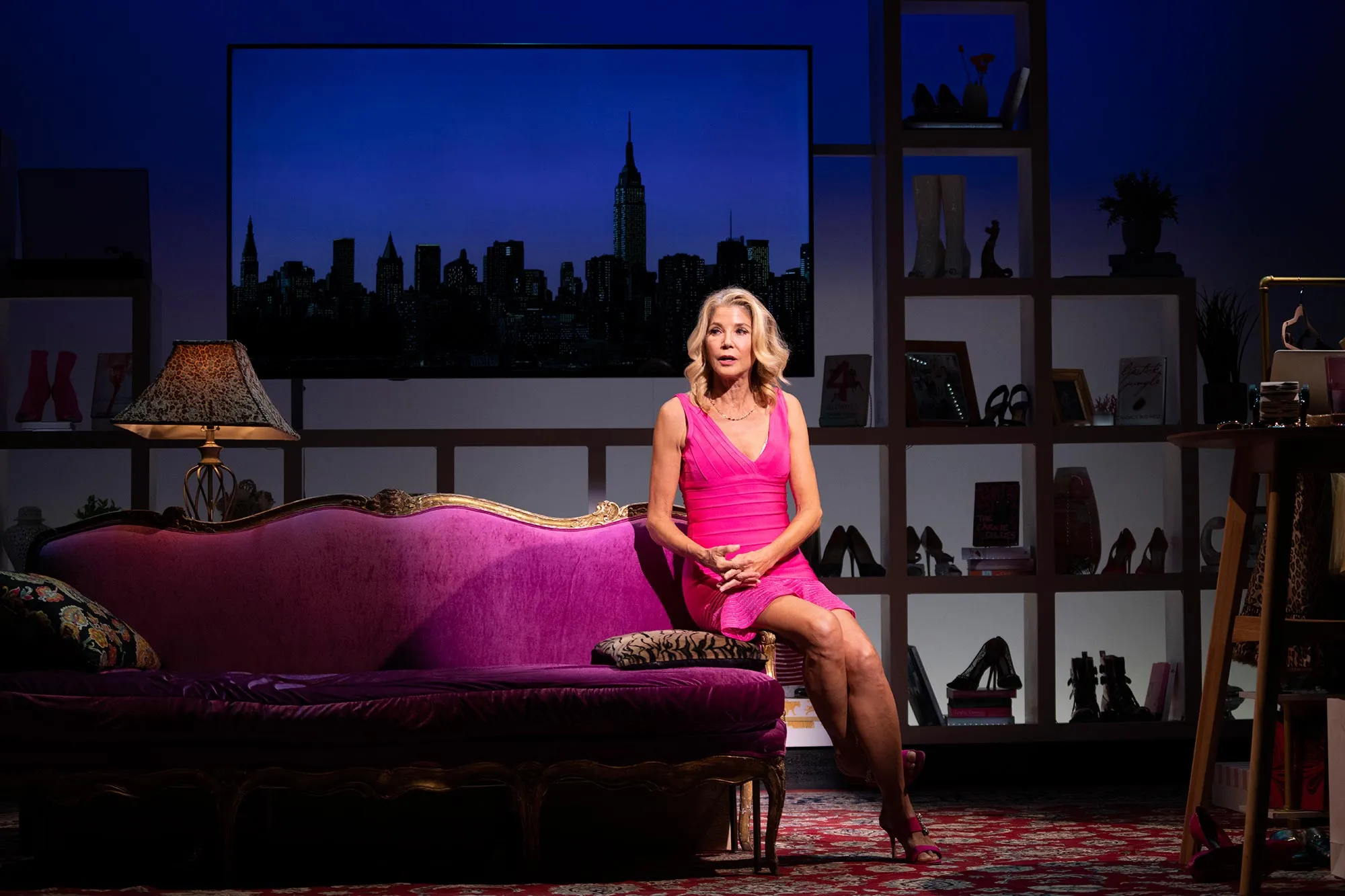
If Sarah Jessica Parker is the “President of the Girls”– declared this summer by comedian Adam Friedland– then Candace Bushnell is the Grand Dame. She is responsible for creating the character that granted SJP this status. Bushnell, whose character of Carrie Bradshaw and her whole sprawling world originated in a column in The New York Observer, has documented New York and its inhabitants for decades. Interested in dynamics of power and status, New York and relationships became Bushnell’s prisms for observation, which she recounted with an unexpected honesty. “People want fantasy,” she told me, over the phone earlier this month. We were speaking to discuss her upcoming show at Adler Hall Candace Bushnell: True Tales of Sex, Success, and Sex and the City, a one-woman show written during COVID, that tells the story of Candace’s life: her arrival to New York, the creation of Sex and The City, her own Mr. Big, and what happened after the show’s gargantuan success. Who is this woman independently of the hit she created? Candace was only involved in writing the first two seasons of the show. How has the character she crafted diverged from her own life story and her own sensibilities? She does not, she told me, resemble Katie from The Way We Were, despite the homage to the character at the end of Season 2.
What does Candace’s life in New York look like now? A New York far different from the one she encountered when she moved here, and the whole rigmarole began. When Candace first came to New York, she studied acting at HB Studio. She now sees acting as a missed opportunity, suggesting that she could’ve been given a recurring role on Law and Order. I can’t think of a better suited person for the series. To any Law and Order writers and producers out there, give Candace a call, please.
This interview has been edited for length and clarity.
Eve Bromberg: Tell me about the idea of this show! How it came about, and what the process of creating it was like?
Candace Bushnell: The show started Off Broadway at the Daryl Roth theater and was a New York Times Critic’s Pick. I’ve done it basically all, all over the world. I think I’ve done it in like 12 countries. I’ve done it at the London Palladium twice to a sold out crowd. The show is really my life story. Coming to New York mixed with the origin story of Sex in the City. How I created Sex in the City and why I invented Carrie Bradshaw and what happened to me afterward. Then I tell the real story of the real Mr. Big. I tell the story of my Charlotte, Miranda and Samantha, and how I had lots and lots of girlfriends, but on the TV show, my wide range of girlfriends turned into just four types of women– that’s a TV trope. Then there’s a game Real or Not Real that I play with the audience, because there’s so much that happened in the TV show that happened in my real life first that was either better or worse.
EB: Do you have any examples from the game?
CB: A lot of them have to do with men who Carrie dated. Also like, you know, did I walk the runway in a fashion show? Yes. But did I fall down and become fashion roadkill? No.
EB: Where did you find yourself when you decided you wanted to make this piece?
CB: Gosh, I was probably like 61. I met the manager for David Foster, Mark Johnson, and he told me that he thought I could do a one woman show. I wrote the show during the pandemic, and showed it to Mark and he loved it. He showed it to some Broadway directors and we ended up getting Lorin Latarro and developing the show at Bucks County Playhouse. Then we brought it to The Darryl Roth, and then Covid came back and everyone got Covid, and that was the end of that.
EB: For this current run, are you hoping to go off-Broadway again? Are you doing it sort of as a one off?
CB: I just do one off shows now. I’m performing at Adler Hall, and then I will go to Europe where I’ll perform in Paris and Copenhagen, and, where else am I going? Budapest, Prague, Budapest, Bucharest, Athens, Antwerp, Amsterdam, and then I’ll perform outside of LA. I want to say San Diego.
EB: Does this show denote a change in your career or career trajectory? Are you hoping to transition to performing? I read in Interview Magazine that you had studied at HB Studio when you first came to New York.
CB: Yes. I was supposed to go [to HB Studio] for six months, and I maybe lasted three or four. I thought it was, you know, I just, I didn’t understand any of it. The idea of your body being an instrument… I was like, “what the hell are they talking about?” Now, I get it. But back then, I just, I didn’t get it. But of course, now I’m like, geez, I could have pursued that. Maybe I could have been on stage. I don’t have any offers to do anything but I feel like I should, at least an arc on Law and Order.
EB: You would be fabulous on Law and Order.
CB: I really love doing the show, because I get to go all over to places that I wouldn’t normally go, like Zurich and Norway, and, you know, even going to Prague. Prague is so beautiful. It’s a lot of work, and it’s hard, but whatever.
EB: How did the idea to turn your column into a television come about, and how did the success of the show change your life?
CB: Well, first of all, the success of the show did not change my life. I was already well known in New York. I was writing precursors to Sex and The City, about money, power, sex, status, and how that affects relationships. I wrote for Vogue and had a column there. Then, I started writing for The New York Observer, where I did a lot of profiles, and the editor in chief at the time– Peter Kaplan– asked if I wanted to have my own column. So that was how it came about. And you know, I knew exactly what to do because I’d already been doing it for 15 years. The real difference was the New York Observer was a publication that a lot of men read, right, as opposed to women’s magazines, which were considered kind of a dead end because nobody, meaning men, read them. But once it was in a publication that a lot of men read, all of a sudden, it became much more important. People started faxing the column to their friends in LA and I had a lot of interest from movie companies who all wanted to buy the column. In that time, I had gotten to know Darren Star, because I’d written about him in Vogue and we became really good friends. He told me he wanted to option it. We have similar senses of humor, so I decided to go with him. ABC and HBO wanted it. We went with HBO.
EB: Do you think HBO is what allowed the show to be rawer? Would you have to tone down some of the material if you’d gone with ABC?
CB: Probably, it would have been a different show. There would have been advertisements, and you know, there were no ads in the show. It went straight through for 30 minutes.
EB: Did you expect the show to be as successful as it was?
CB: At first it had a smaller audience, because it was on HBO. People weren’t necessarily used to paying for content. Now, of course, everybody pays for it, right? Then it was on E Entertainment, and then you could purchase DVDs of each season and it ended up all over the world, this was probably in the 2000s. Now it’s on Netflix which has the biggest audience, which has allowed people to find it again. They’re, you know, young people finding the show. It’s really a perennial for young people. Even before Netflix, young people were watching the DVDs in college. Women would gather and watch it. It was a real bonding experience.
EB: You’re responsible for creating this cultural phenomenon–the character of Carrie Bradshaw and her whole world! What does that mean to you?
CB: It’s very nice, and it’s great that people come up to me and say that Sex and the City has changed their lives like, that’s probably, that’s, like, the best part about it. But I’ve had other TV shows, and I’ve had, I don’t know how many best sellers… like eight? I’ve written 11 books. So, you know, it’s a part of my life, but it’s not my whole life.
EB: You have other projects.
CB: I’ve always had other projects. Lipstick Jungle and The Carrie Diaries, and now I have this one woman show.
EB: What do you hope the audience gets from watching you perform?
CB: I’ve been told that it’s very inspirational. It’s about a woman who comes to New York and is determined to make it on her own without a man. So that’s what it’s about. It definitely has a feminist flavor. I’ve always told women to be their own Mr. Big.
EB: You not only have insight into your own experience, but so much insight into how New York City has changed. What are the largest cultural differences between what you experienced when you came here and what the culture appears to be now?
CB: Well, I would say, first of all, the biggest difference is technology… the cell phone. People used to use pay phones. When I first came to New York, the pay phone was like a dime, then it was 25 cents. I think the subway was like 25 cents. The differences here reflect, in a sense, larger shifts all over the world, like income disparity. A person from the suburbs used to be able to come to New York and afford to live in a crappy apartment. I suppose you could still do that, and “make it”, but it seems like a lot of people coming to New York are being supported by their parents. That didn’t used to be the case. I mean, of course, it was always true in some ways, but there wasn’t a preponderance, you know? I guess the city always felt really expensive, but it felt achievable. It felt like you could make enough money to survive. And, you know, it felt a little bit more intimate and a little bit more insider.
EB: Do you think there is less romance and dating and sex happening compared to what you experienced?
CB: I hear from some friends who are in their 20s and 30s that there’s definitely less sex and romance. But, you know, New York has always been a place where there are more women than men. That’s really what’s behind the friendships in Sex in the City. You really need female friends here, you really need girlfriends. And women tend to actually be pretty supportive of each other. And this is probably one of the few places in the world where women come to make it. There are really successful women here.
EB: Who is Carrie Bradshaw meant to be? Not even in how she’s portrayed in the show, but in writing her.
CB: I would always say she’s The Every Girl. There’s The Every Man, as a character type, and this is The Every Girl, trying to, you know, figure it out. Wanting to have a career while in a fairly sexist world while pushing the boundaries. Sex in the City really comes out of all of my work as a social anthropologist. Writing about people the way they really are, as opposed to the way we wish that people were. This is disturbing to a lot of people, because they want fantasy and romance. But it also comes out of being a feminist and growing up in the 60s, which was a very sexist time. Being told what women are supposed to do and be and think never resonated with me. I never thought of it in that way. And my writing was also about trying to change women and get them to think differently about their lives. It doesn’t have to be tied into being in service to a man and children, but about being the primary person in your life, as opposed to being secondary.
EB: What do you mean when you say disturbing?
CB: The audience wants fantasy and romance, as opposed to the reality of people, which is that we’re all flawed. The reality is, in a place like New York, status is pretty much everything. And that is, you know, how people date now. This idea of someone falling in love with you isn’t really what’s going to happen. It’s more about checking off enough boxes. Dating has become transactional. More so than it used to be.
EB: Do you still believe in love?
CB: Um, yeah, sure. I think people can fall in love and be in love. I don’t know. What do you think?
EB: Well, it does seem to be made harder now. Technology has created so many layers of complications. But my sister and her boyfriend are in love!
CB: I mean, somehow it can happen, yeah, if all of the things line up. But, you know, the other thing is, like, I do see stuff on social media that blames feminism and says it’s ruined men. But it isn’t true. I think it’s technology. Technology is 95 percent male, right? It’s men who are controlling technology, creating technology, and making money from technology. So technology is really by men, for men, and it’s really about extracting as much money from these poor men as possible. And how do you get money out of them? Sex and gaming. So a lot of it seems like a lot of men, their attention has been lost to pornography and gaming. I think that’s probably, you know, that’s a huge factor. Technology is designed to capture these men, and take them out of the real world happening around them.
EB: I imagine you reveal this in the show, but what happened to your Mr. Big?
CB: Oh, we broke up and he married someone else.
EB: I read somewhere that the idea of Mr. Big marrying someone else felt like a very New York story to you?
CB: I think the story of Carrie and Mr. Big is a very New York story. His marrying somebody else is a very, the kind of thing that happens in New York. I mean, Darren Star even did this homage to The Way We Were. Yes, so it’s a little bit of The Way We Were, kind of story, yes, you know, it’s like the plucky heroine, and, you know, the really attractive guy who’s, you know, wants to marry somebody from the Upper East Side.
EB: Do you feel like Katie? A Katie girl?
CB: Do I feel like a Katie girl? I don’t know what that would be.
EB: Well, I guess she yearns and is very wistful and tries very hard.
CB: Yeah, no, that’s not me.
EB: That’s good. You’ve saved yourself from a lot of suffering. Of all the outfits of the show, which is your favorite?
CB: I’ve been asked that a lot. My favorite outfit is the craziest outfit. I think it’s in the first or second season. The women go for a picnic in Central Park, and Carrie is wearing lederhosen. Only Sarah, Jessica Parker, could wear that. She can wear anything.
EB: Have you been able to maintain a connection to the show as it’s gone on? Do you have feelings about And Just Like That?
CB: I was not involved in And Just Like That, but I got a credit and paid for it. I thought it was fine. It was very big, in the way TV is now. The costumes are big, even in something like Emily In Paris, it’s so big and over the top. Even on that show Elsbeth, which is on CBS, they have her in, like, completely over the top outfits. You have to be bold to stand out. I wish they were doing another season. I was hoping they would do like six.
EB: I’m also sad they ended the show. It was so fun! Are you in touch socially with any of the cast members? Were you friends with them?
CB: I’m friendly, if I see them out somewhere, I don’t see them out a lot, but occasionally I’ll run into them. I went on Kristen Davis’s podcast. She’s great. She’s super nice. She’s really good at that podcast. I think they’re all great, but I haven’t seen Kim for a couple years at least, and I probably, like, ran into Sarah, Jessica Parker, like, last year, maybe, I don’t know.
EB: There’re many versions of Carrie’s backstory. In The Carrie Diaries, her mother dies and she’s raised by her father in Connecticut. In Sex and The City, her father left her mother when she was 4 or so– I realize this is a later season when you were no longer involved in writing the show. A google search says Carrie Bradshaw attended Brown University. What did you have in mind for her background? Something closer to your own?
CB: I never really thought about Carrie’s backstory until I wrote The Carrie Diaries. I always felt that the backstory of so many fabulous New York characters I knew in real life wasn’t really relevant because people came to New York to reinvent themselves. Then I wrote The Carrie Diaries. Unfortunately my mother had died a couple of years before of cancer, and I found that I just couldn’t write about Carrie’s mother because it reminded me too much of my own mother. We were very very close and it was just too painful. So in The Carrie Diaries Carrie’s mother passes away as well. I actually went to Rice University and then NYU, but my editor and I, when I was writing the book, decided that Brown was the perfect college for Carrie Bradshaw.
EB: I want to end our chat by discussing the current state of New York. We have a new mayor. How are you feeling about that?
CB: You know, there have been a lot of different mayors while I’ve been here, yeah, from like Ed Koch.
EB: He had a cameo on the show!
CB: Yes. New York, it always goes on. I mean, yeah, I think it’s exciting. You know, the city, the city goes on. I don’t have the feeling that anybody’s leaving. And the reality is that there are more parties and events than ever before. So in a sense, the city is thriving. They’re like all these private clubs. Who would ever think like, oh, private clubs. People are going to join them. I mean, it used to be like restaurants were like private clubs. But, yeah, I mean, there’s like, five events every night. So it feels like the city is very dynamic. You get up to a lot of things, and have lots of things to go to.
EB: Okay, actual last question, do you have any new book projects on the horizon?
CB: Well, I am working on turning One Fifth Avenue into a TV series. That’s one of the things I’m working on.
EB: I was a huge fan of Lipstick Jungle.
CB: That show should be revived, because it’s so New York now. Last night, this woman said to me, ‘oh, New York, it’s so great now, with all these women supporting other women’ I responded that that’s what Lipstick Jungle is about.
EB: I would love that. I loved the cast of that show.
Tickets for Candace’s one woman show can be purchased here.
Leave a Reply