
My family took a trip to Disney World in 2003, when I was in second grade and my sister was in third. As a late boomer, I was too short to ride anything that went upside-down, despite wearing the Payless platform sandals my mom purchased for the occasion. My most vivid memory from that vacation was a fight we all witnessed on the monorail, where two parents yelled at their children with such ferocity that they became a threat in our household for years to come–‘don’t do that, or else I’m sending you to live with the Disney Family’.
In Mikey Maus in Fantasmich!, which played at The Brick Theater this November, Hannah Kallenbach’s family does not yell on the monorail, or in EPCOT, or at the Seven Dwarfs Mine Train. In fact, “Disney was the one place we never fought,” she tells us. Hers is a Disney Family that has mastered the place. We are treated to glimpses of her mother’s detailed itineraries, with cells dictating when to walk, when to eat, when to take breaks (of 2-5 minutes), precisely engineered so that the family never once has to wait for a ride.
Once Hannah explains the frequency and dedication with which the Kallenbachs visit Disney World, we understand that it would not be overkill to call Mickey a part of their family. Nor would it be overkill to create a seventy-minute show about Hannah’s familial relationships refracted through the lens of Mickey, an approach that is both joyously batshit and sincerely sweet. And so, Mikey Maus is born.
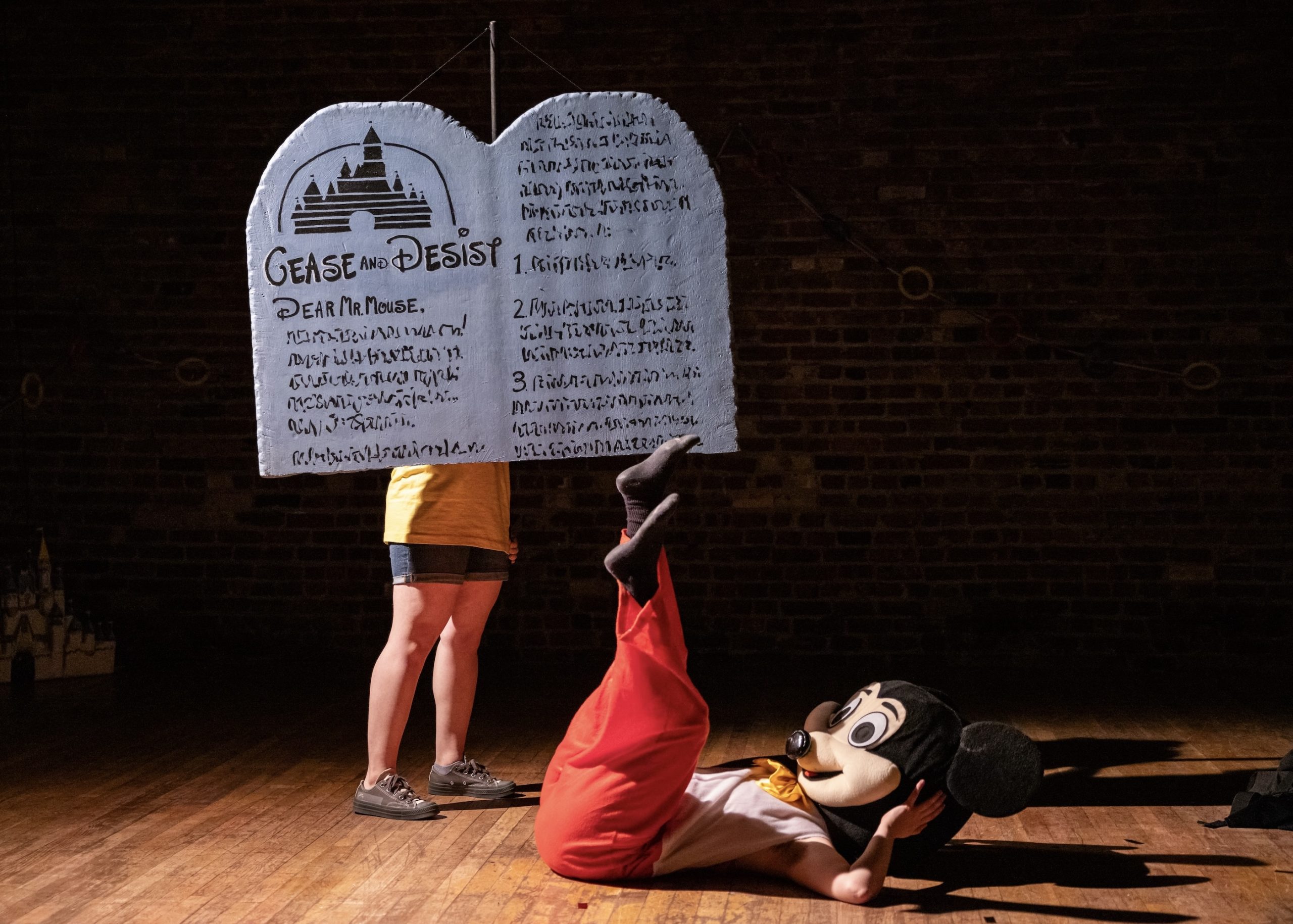
The show has two modes. In the first, Hannah plays Mikey, a coked-up German version of Mickey, who has left home to put on his own performance at alternate Disney in Brooklyn. Soon after starting the spectacle, Mikey is confronted with a cease-and-desist letter written on enormous, biblical tablets, which have been sent by his dad, Father Disney, a solely sonic presence understood to be a sort of mash-up of Walt himself and the corporate entity. Mikey has strayed from Father Disney. It’s not exactly clear how, but his foul mouth and downtrodden demeanor suggest a general departure from acceptable Disney standards. The God mic booms at him with disapproval: “You used to be such a good kid.”
The second mode is a naturalistic account where Hannah plays herself. She gives us a direct-address story about her family and love life: how she grew up in a conservative Christian household in Kansas, came to New York, began her career in the arts, and came out as queer; an announcement that led to a three-year estrangement between her and her father.
The show moves between the realistic Hannah and the surrealistic Mikey to tell the interlocking stories of her relationships—the ones she has with her parents and siblings, her romantic partners, and her imagined future child. She crafts scenes that we could consider a series of rides: there’s the thrill ride, where Mikey calls audience members onstage to participate in a pageant titled World’s Hottest Pregnant Person, handing them inflated balloons to place under their shirts; the slow-moving merry-go-round where Hannah does a bit of live drama therapy and asks two audience members about their own relationships with their fathers (point-blank: “do you have Dad Stuff?”); The Love-Boat, where she takes us through her dating history with a sense of disbelief at her own naiveté; and The Sexy Ride. I’m not going to reveal what happens in that one.
Underpinning all these rides, and this performance, is the question of the parent-child relationship.Throughout Kallenbach’s piece, I feel we always have three fathers in mind: there’s Father Disney– whose God-like power threatens to bring down the whole show on grounds of copyright infringement–, there’s Father God–the cosmic centerpiece of Hannah’s childhood recollections (in one flashback, she writes Him notes in a God Journal, signing them “your daughter, Hannah,” over and over)–, and there’s Hannah’s real, biological father, a figure that feels as foreign as the others when she tries and fails to connect with him. He’s a figure so conspicuously absent from an audience seat that’s labeled “Reserved for Hannah’s Dad.”
In one particularly moving moment, Hannah tells us that her current relationship is the first time she’s wanted someone “to put a baby in [her].” But quickly she moves from revelation to dejection and uncertainty. She is way underprepared and underfinanced, completely at a loss as to how she will bring a child into the world in a queer relationship with so little money and the burdensome memories of her own complicated upbringing. So instead, she pops on the Mikey costume head and gets on with the next scene.
It’s not quite right to call Mikey Hannah’s alter-ego; he’s not there to offer an escape or opposing perspective on her issues. He’s suffering the same relationship problems, the same “Dad Stuff” just a few octaves higher. But Mikey’s failure to reach some sort of stasis feels entirely like the point – communicating with our fathers can feel so baffling that even this fictional mouse is facing complex questions about family betrayal and forgiveness.
In the hands of a less skilled creative team, the chaos of the piece might overtake its dramatic core. But Kallenbach is so precise in her pivots from tearful to brash, proud to forgiving, tender to lacerating–one moment she ugly-cries into a mic, the next she’s whipping her face up to meet a spotlight– that she pulls it off. Kallenbach handles her family, and the audience, with care. The night I watched, one brave participant answered a question about her relationship with her father a bit too quietly for the audience to hear, and for a minute the show turned from a performance into a private conversation between two people figuring out how they might deal with family harm.
Kallenbach’s team is there to help: Sam Rodriguez and Natalia Soto, dressed in Goofy and Minnie costume heads that look like they were found washed up by the side of a creek, guide the audience through participatory moments. Zipporah Norton’s props—a sumptuous red velvet folding chair, an enormous papier-mâché turkey leg on a leash—bring primary-colored cheer with a distinct menacing undertone. Director Dan Hasse keeps the whole thing calibrated with Disney-itinerary thoughtfulness, ensuring we get our moments of respite before launching into the next ride.
This piece sits somewhere between clown show and narratively-driven performance art. As someone accustomed to seeing more traditional, text-driven theater, where an actor stays neatly within the bounds of their character, I found it refreshing to watch Kallenbach release herself onstage: sometimes this happens half-inside of a Mikey costume, sometimes half-outside of it. Regardless of the state, the sweat, tears, and burps feel entirely her own. With Mikey Maus, Kallenbach has managed to create a theme park to meet the particularly queer and untidy needs of Disney Brooklyn’s parkgoers. She has met us where we are as we encounter her. Give me the fast pass, I could watch this for days.
Photo by Walter Wlodarczyk.
Leave a Reply