
Form, that finicky and elusive notion of structure. A container, in which to organize one’s thoughts, ideas, and ramblings. It is hard to imagine form as anything but the (sometimes feeble) infrastructure needed to prevent a deluge. How filled is my mind! Determining structure and organization of a piece is what allows it to be written in full, or at all. This scaffolding, what I most seek and crave, is also what I most detest. Such reverence for, and misery by, parameters can be attributed to my ballet training: years of working within the confines of a technique to improve movement quality and expression. But in Ballet, unlike writing, structure and expectation are intrinsic. The student isn’t responsible for the creation of a world, but instead reaching a level of competence in one that already exists. One that predates the pupil by centuries. How comforting and meditative this idea can be! To this day, when I take class, standing in preparation for pliés gives a sense of calm certainty.
But what is disregarded in a world of such fixedness? In the world of ideas, are the sieves of ballet too narrow? Dance writer and writer Marina Harss explored this question– of form versus innovation–in the Fall issue of The Hudson Review: “Ballet’s emphasis on form over content is one of the things the pioneers of modern dance were fighting against with their more grounded, less immediately pleasing, less conventional way of moving, and weighty content. ‘A break from a certain rigidity, a certain glibness, a certain accent on overprivilege was needed’ wrote Martha Graham in 1941.”
This question, of content and form, the future of ballet, and the influx of freedom modern dance provided, is where we find dancer, writer, performance-maker, and scholar Emily Coates. In Tell Me Where It Comes From— a piece commissioned by Guggenheim’s Works & Process this past November– Coates, a former dancer with New York City Ballet, takes on the deified figure of George Balanchine, exploring what ballet might look like if it were cracked open, examined internally and “sideways” to use Coates’ word.
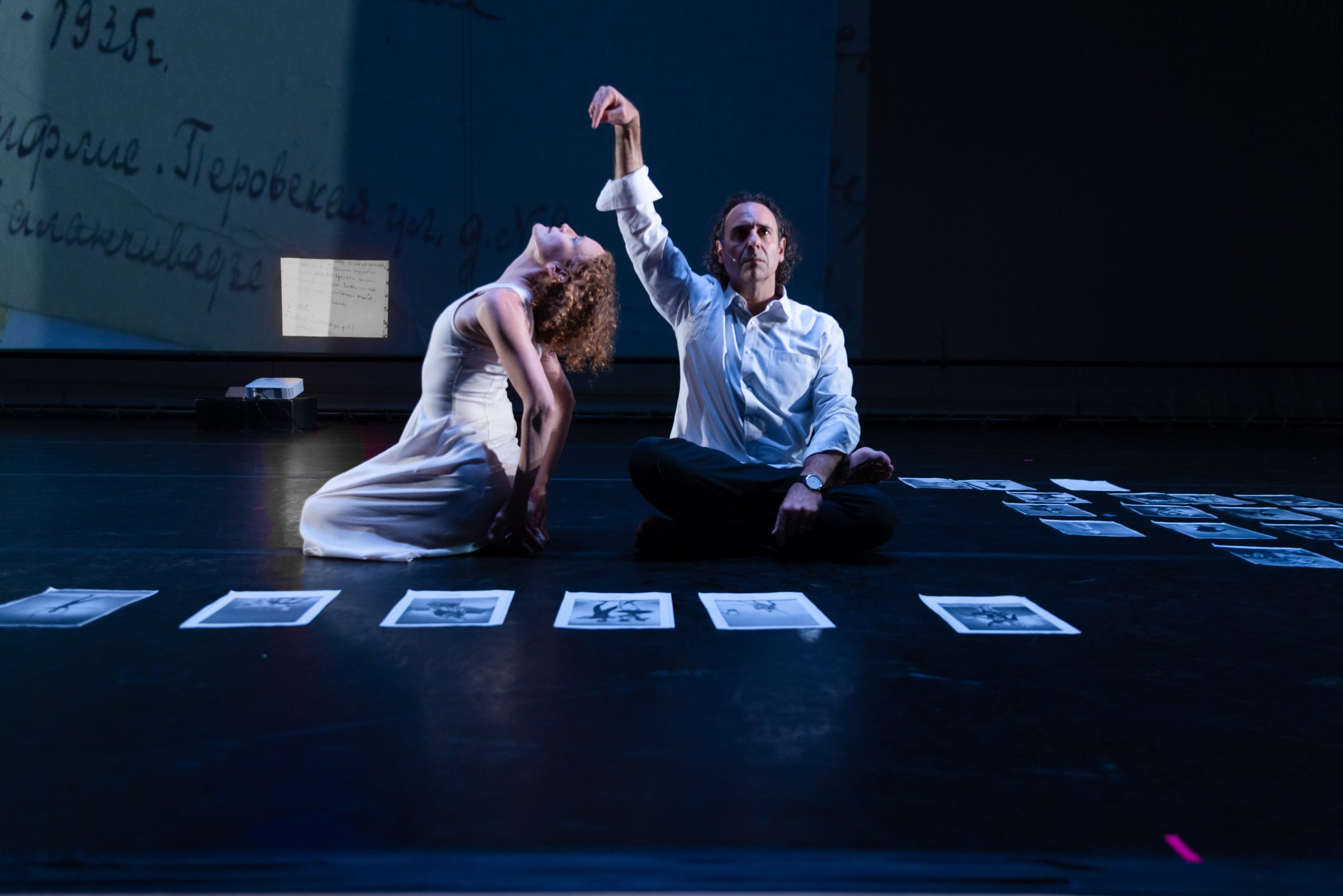
Collaborating with director Ain Gordon and co-creator and actor Derek Lucci as well as a whole host of other collaborators—composer Charlie Burnham, pianist Melvin Chen, lighting designer Krista Smith, costume designers Harriet Jung and Reid Bartelme Henry Seth, stage manager Ed Fitzgerald– Coates culls from her own trajectory from ballet into experimental and postmodern dance. Starting first with a material archive, she winds her way to towards a somatic one. After being given access to a box titled “The American Ballet Box 1933-34” from a manager at The Wadsworth Atheneum Museum of Art, whose contents laid out plans for a New York City Ballet in Hartford, Connecticut, Coates delved into an early less familiar history of Balanchine’s time in America. How might a reexamination of Mr. B’s trajectory compare to the codified biography of this legendary figure? Mixing fragments of Balanchine’s work, and ballet steps with a postmodern vernacular, Coates creates a bricolaged world where the norms of ballet are challenged and overtly dismissed; seams are purposefully on display. At the start of the piece, Lucci, an actor new to ballet, performs a ballet barre with Coates: the difference in technical familiarity on plain display. During another section the performers tape printed out photos of Balanchine ballets and dancers onto the Peter B. Lewis’ stage with blue painter’s tape. In yet another moment, Coates wears jeans over a leotard and readjusts the leotard beneath her jeans. Such moments act as examples of competing vernaculars interacting, and at times intersecting.
Tell Me Where It Comes From challenges the audience to engage deeply without the expectation of tidy comprehension. Last month, I spoke with Coates, Gordon, and Lucci over Zoom to discuss the origins of this project, as well as their collaboration in the creation of a piece that resists explanation. What is created when opposition collides and expectation is thwarted? What freedom is granted to a dancer shaped by years of training—or to one yet to train? Can expanding the scope of inquiry beyond historical codification recover material lost along the way? Coates leaves these questions to linger; posing them is the enterprise.
This interview was edited for both length and clarity.
Eve Bromberg: Let’s start by having you all explain what this piece is in both content and form.
Emily Coates: The best way to answer your question is first by telling you about a prior project we did before this one.
In 2022, I designed a split program called We with my longtime colleague Emmanuèle Phuon— who I met in while dancing in Mikhail Baryshnikov’s White Oak Dance Project—and with Yvonne Rainer. I invited Ain in to be director and dramaturg for my part of We, and he brought in Derek when we needed to replace a cast member who had fallen ill. Part of my source material for We included research I did in the papers of a nineteenth century observatory. Ain and Derek love archives as much as I do. Unexpectedly, we three all hit it off.
When We ended, I wanted to keep working with archives in performance and with Ain and Derek. I folded these impulses into a long simmering want of mine to circle back to my roots as a Balanchine dancer. I’m a former member of New York City Ballet, trained at the School of American Ballet with a career that has since been situated in experimental postmodern dance for the past twenty-five years. I joined New York City Ballet nine years after Balanchine died. While my teachers at SAB imparted his values, and dancers who had worked with him were still part of the company, Balanchine himself and as a choreographer was a ghost to me. I worked and danced directly with many choreographers: Jerome Robbins at NYCB, Baryshnikov, Twyla Tharp, and Yvonne Rainer. There is a dramatic difference between working with a choreographer personally, versus not. I patched together an impression of Balanchine through the bodies of others.
For Tell Me Where It Comes From, I wanted to reflect on Balanchine’s legacy in me as filtered through the bodies of other dancers who have moved through that school and company and then spread out into the world. Works & Process has always supported the Balanchine diaspora, and Caroline Cronson and Duke Dang found my project to be a good fit for their programming.
The Wadsworth Atheneum Museum of Art and Adam Lenz, their Public Engagement and Programs Manager, is also part of how this project came to be. Adam mentioned to me offhand that the museum had a box called “The American Ballet Box 1933-34” that had yet to be formally processed, filled with archival material related to Balanchine’s stint (one night!) in Hartford, where Lincoln Kirstein initially planned to set up a school and company for him. The Wadsworth archives launched my search, and I began to visit different libraries and holdings around the region, mapping a trail of early Balanchine ephemera that became source material for the performance.
Part of the project’s design was to share the legacy sideways. This is a phrase I like to use. We tend to look at New York City Ballet as the center of Balanchine’s work, and it is. But to me, legacy gets richer when you look at the outer edges, the hazy zone outside of a canon or branding, where forgotten features surface, and other artists (in this case outside the ballet world) can offer their perspectives.
Ain, Derek and I were later joined by musician and composer Charlie Burnham, then pianist Melvin Chen, lighting designer Krista Smith, costume designers Harriet Jung and Reid Bartelme, another former NYCB dancer Henry Seth, and Ed Fitzgerald, our stage manager. Together we could reanimate forgotten choices (mostly in fragments) that Balanchine had made with his collaborators—movement, music, lighting, costumes, props, language—always filtered through us. The piece is an alternative portrait of the choreographer, but it is primarily a portrait of transmission and interpretation. It is a depiction of our distance from the source, that is Balanchine.
Ain Gordon: As Emily said, I’m very interested in archival research as source material for live performance. I am, also, always interested in the ways in which history has been a ruthlessly editing machine that needs to retroactively make a codifiable logic out of events that were not sequenced the way that history likes to deliver it. So that’s something we share. While this may manifest in making different kinds of work, we have that impetus in common. And so, the idea of looking at Balanchine, not through his legacy but the idea of him through a lens different than the known story turned out to be in and of this project. This altered perspective was very much based in a geography that is different from the geography we associate with Balanchine [New York City versus Hartford]. That was attractive to me but also scary. It’s always scary to figure out how to make work about somebody who made great work. It’s a very big challenge to come up against. I think that was something that we all wrestled with many times over during the making.
Derek and I know each other because Derek also is a research junkie. I’ve known Derek as an actor. He’s done a lot of work with me in previous projects. As Emily said, she and I were working on the project that became We during the tail end of Covid. We were on our way to Dartmouth, where We was going to be performed, and one of our collaborators– a marvelous actor named Joan MacIntosh–was stricken with Covid and stuck in Paris. We’d been building this piece with her and it was now ten days before the premiere. We still had to make fifty percent of the piece. In that moment, I thought of Derek. He’d moved to New Hampshire, and I said to Emily, “Well, he’s not a seventy-eight-year-old woman, but I know a person, an actor, who lives in New Hampshire who loves research, who’s incredibly quick and will kind of do anything if he’s interested.” We called him from the side of the road essentially, and he arrived the next day at Dartmouth and we finished the piece with him. So, it just seemed natural and fortuitous to continue as a triplet.
Derek Lucci: I like footnotes that don’t go away. I like things that I stumble across that sort of slap me in the face and say, pay attention to this. My interest is in finding and making. I’m fascinated by the process of spelunking down into something that is going to be lost or might be lost and bringing it back to the light of day. In a performance format, this acquired or found material can be received and engaged with live. However, this work may not necessarily be understood instantaneously. I keep coming back to this piece we’re making now, which feels like jazz, or like a painting. You have to let it wash over you. That’s the level at which to engage. The piece we’re doing now doesn’t overexplain itself. That’s part of what we’re doing. We’re collaging material for a response. It’s sort of a primal approach, because the specifics of the biography [of George Balanchine] are handled in many other places, very, very well, but here, we get to focus on these minute details in these people. That has been fascinating to me.
EC: When Derek joined us at Dartmouth, he walked into the studio and I slid in front of him a list of adjectives from weather journals written between 1828 to 1834 by a young man named Ebenezer Adams Jr., who was tasked with recording the weather, one word per day, using a very limited range of adjectives: “cloudy. fair. snowy. breezy….” Ain warned me that Derek wasn’t going to be exactly like Joan, who has a mystical quality about her. But when Derek started reading, Ain and I both knew that he was the right fit. Derek can play a found text meta-theatrically: he can give you a glimpse of the human who wrote it, without becoming a character.
I’ve been gravitating toward storytelling, archives, writing for performance, and intertwining movement and language for a while. But you don’t know exactly what you need until it’s right in front of you. The found texts from Balanchine’s archives require delicate handling. I did not want this piece to be a play, or a biopic. At a certain point, we realized Derek plays Balanchine, Lincoln Kirstein [Balanchine’s greatest patron and co-founder of New York City Ballet in 1948], and Tanaquil Le Clercq [Balanchine’s last wife]—or really, conjures them, as fragments, from their writing.
Derek and I also share a movement sensibility, oddly enough, though we come from different backgrounds. We have natural aptitudes in the other’s discipline, without training–him in dance, me in theater—which helps hold the composition together. I think of Ain as a postmodernist cousin, and Derek is steeped in it too, which is why we get along. We have similar taste in performance.
EB: Emily, how did you become interested in postmodern dance? What spurred this interest given how ballet does such a good job of separating itself from a larger dialectic of performance.
EC: Mikhail Baryshnikov introduced me to postmodern dance. When I left City Ballet, I was looking to expand my horizons. He invited me to join his group, White Oak Dance Project. I performed in the new work he invited Yvonne Rainer to create in 1999, which brought her back into dance from film; and also in PastForward, White Oak’s retrospective of Judson Dance Theater. Yvonne and I stayed in touch, and I’ve danced and collaborated with her ever since. As I began to create my own work, postmodern dance’s spirit of interrogation and use of quotation and collage felt most fitting to me, and the artist I was becoming.
The movement in Tell Me Where It Comes From includes choreographic quotations—from old photographs, some film, and tiny slivers of Balanchine ballets (with approval of the Balanchine Trust)— reassembled and understood through our bodily logic. Charlie Burnham also used quotation, loosely remixing sounds from the archives in his original music.
EB: Derek, what was it like to perform a ballet barre without the training? Emily, what’s the larger significance of showing a non-trained body within this piece?
DL: Well, I think I’ve always wanted to do it on some level, and I never had an excuse to. There have been moments of doing lots of movement things throughout my career and in my training even, but the ballet barre structure was so interesting. The more I did it, the more it started to speak inside my body. That may sound a little mysterious, but it made sense. I do a lot of yoga, and barre is similar in terms of pulling the body together in a different way toward a different purpose. It’s hard, and it was, you know, in some ways painful. But what I thought was interesting was I felt like this ballet work in my body at the barre specifically could serve a function. It could serve a function for me that’s different from a body that’s been doing it for twenty years, a body that is perhaps burnt out. I’m in my 50s and found it revelatory.
At first, I was aiming at a certain amount of precision that’s in the work, but then, all of a sudden I realized that the imprecision is almost as interesting, or more interesting. The inability to do it is also something that’s interesting to put on display because it’s human. It’s more human than the mechanics of doing it. There’s something about this impulse that goes against everything in an actor’s training. An actor wants to make everything perfect, but there’s something about the human element, which is the thing that is missing from ballet training. Emily talks in the piece about how ballet doesn’t exactly admit aging.
EC: Initially, the decision to do a ballet barre was functional. During our first residency in March 2024, I contemplated where to begin. If I was going to bring Derek into my world, I needed to share some of my knowledge. And where does that world begin? That world begins at the barre. Given my training, it begins specifically with a Balanchine barre. To best prime my collaborator, and pass some knowledge over, I needed to introduce Derek to Balanchine as I was taught, through the barre. It was also fittingly thematic. This is a piece about transmission, and translation. As I was feeding into our process archival material from these different archives, we were also acknowledging my own body– through my years of training and performing professionally– as an archive. Every rehearsal that first residency began with barre. Really what I passed to Derek is my memory of my SAB teachers, passing on Balanchine.
Ain’s role, as director, is many things, but one is a set of outside eyes. Ain patiently sits and watches. He likes to watch a process unfold, and then he’ll stand up and say “that!” Ain brought a voice recorder in, and we now have hours of recordings of me teaching Derek the details of a Balanchinean ballet barre. At a certain point, it became clear that the entire piece could begin with the barre. That very much comes from our collective aesthetic backgrounds in postmodern dance and theater. Why can’t the prep for the piece be on stage as the piece? This is an inclination we all share. It resonates with the question of unpacking history through a different lens. Why would we not also unpack and display what it takes to make that world, and this piece, physically?
EB: Ain, given you have a theater background, and of course these designations are porous, how you approach directing movement? Considering who your parents [Postmodern dancers Valda Setterfield and David Gordon] were, what was your relationship to Balanchine prior to working on this piece?
AG: I didn’t have a substantial relationship to ballet or to Balanchine. My mother had been a ballerina first because that’s the kind of dancing that was available. Eventually she segued out of that, but that was the first destination possible. We went to the ballet a lot when I was a kid, and Margot Fonteyn was particularly my sort of North Star. I’m certainly conversant with ballet.
As a playwright, I am more interested in character than I am in plot. I don’t actually like plot very much, and I really don’t like it when I can see the engine of a piece turning. I’m interested in following people, whether it’s text-based or movement-based. That’s what I do. When I’m in a movement project, I’m look at it as working with a nonverbal narrative. I’m perfectly comfortable there. Sometimes I am in rehearsal shaping choreography a little bit, but a lot of times what I’m looking at is the who I’m following. What am I learning at any given moment and does it accruing in some way? I often have the job of placing the frame around moments. That’s often my task, sometimes that’s moving the frame off kilter so that a moment can spill out. In terms of the barre… I have a particular aversion to house lights to half and then out. I hate it so much. It’s dead ritual that doesn’t work. People still have their phones on. I really like shows that begin without really beginning, which is exactly what we do in the barre. It’s a slow build up into happening. You’ll notice that the house doesn’t go out for the first 15 minutes and then goes out and 20 counts very slowly. All of these decisions are impulses of mine about framing a narrative.
EB: Derek, because you are the shape shifter in this piece, could you maybe discuss who the character of G character is in relation to the idea of Balanchine or Mr. B [Balanchine’s moniker in the company]? I was quite shocked by the sexual nature of those letters you read that Balanchine had written to his second wife Vera Zorina. Balanchine was known to be such a gentleman! What did you make of that moment, in embodying that character? Is G meant to be more sexual?
DL: Early in my research, I came across this drawing that Balanchine did of himself. It’s a self-portrait that’s in Jennifer Homans’ book [Mr. B: George Balanchine’s 20th Century] right near the beginning. She writes a very beautiful description of it, but it’s a weird, weird picture. It’s this ghoul-like depiction of himself. He has this very strong profile, and his body is bent in this really crazy way, and he’s got like, eight fingers. The figure is nude, and it has a phallus. It’s extremely sexual. After finding that photo and looking through the archive and seeing the signatures of G, I came to the realization that the self-portrait is in the same shape as the g (lowercase) he uses to sign letters that’d we’d encountered from various archives .
We put the character of G in the top of the piece because it was something we were all struck by. I didn’t know how that drawing was going to fit in, and I didn’t know if we were going to try to make that G. I didn’t know what we were going to do with it, but it sneaks out. It kept showing up. It was like a nothing footnote really, but it makes a mark when you look at it, and then the mark sits there until it starts to make sense as to where it goes. We didn’t structure anything around it deliberately, but it found its way in. That’s the way the shape-shifting thing happens. This approach is indicative of how we approached the whole piece. It’s not necessarily a close reading of a photograph or a piece of archival, but a response: “what do you see here”? A lot of times I don’t know what’s happening in the picture or in the ballet, but I am intensely interested in something in the costume or in the person or in the shape of the body.
With Tanaquil Le Clercq, the letters that I’m saying towards the end of the piece, you know that that weird body shape–the position I assume while speaking–just showed up one day. I was standing there with a microphone, and I’m in this weird shape, and I’m talking for what seems like forever. Tanaquil Le Clercq ended up in a wheelchair from polio, but that wasn’t the inspiration for the position, though I maybe look like I’m emulating that while reading her postcards. The reason I was taking that shape was because I had just had surgery on my eyes. The music stand was low, and I was trying to read the printouts I had placed there. I ended up in this position and Ain told me that whatever it was I was doing, to keep doing it.
EB: Emily, I’m curious about the last part of the piece when you’re wearing jeans, the moment where Derek reads Tanny’s (Tanaquil Le Clercq) postcards. I’m sure you’ve seen The American Masters episode [Tanaquil Le Clarcq: Afternoon of a Faun] on her. In it, there’s a moment where Jacques D’Amboise [principal ballet dancer with New York City Ballet under George Balanchine] talks about how Balanchine couldn’t deal with the humanity of women. That he had a hard time living with them because it burst his illusion of feminity. This must have been trifold with Tanny because of her polio. In that final section, you kept readjusting your jeans. Were you making reference to this dynamic between Balanchine and Tanny?
EC: I like that you saw a connection. That’s the effect of juxtaposition. I was actually quoting a gesture Allegra Kent slips in between musical sections, in the filmed performance of Episodes. Allegra adjusts her leotard, which is riding up on her hips from all the partnering. She quickly pulls her leotard back down before she and Bart Cook move into the next section. It’s such a tiny moment, it’s be so easy to miss, but when you’re looking as closely as we were, you see it. So human! And nothing Balanchine ever would have choreographed in his ballet.
Ballet perhaps hasn’t figured out how to admit the whole human experience. I recently took Yvonne Rainer to see George Balanchine’s production of The Nutcracker. During the grand pas de deux–where the ballerina is dressed in a light green tutu and pink tights–Yvonne leaned over and whispered, “What does the ballerina do when she’s got a heavy menstrual flow?” Postmodern dance opened the gates to many things, including basic human impulse. Let’s see the learning. Let’s see the process. Let’s see it being figured out. Postmodern dance lets you wipe your nose if you need to. It lets you sweat. Drawing this impulse toward neoclassical ballet helped us humanize Balanchine–who has been deified, ending up at times out of reach—through the intimate archival details. And to humanize those individuals who worked with him, who are also scattered within the afterlife of this great body of work. But of course, retrospection is always in bits and pieces. Tell Me Where It Comes From remains an abstract work.
EB: Emily, what it was like to live with Allegra Kent?
EC: Genius. Allegra is a genius. Arriving in the hallowed halls of her prewar apartment on West 86th and Amsterdam as my 16-year-old self from Pittsburgh, Pennsylvania felt like entering her gorgeously eccentric, brilliant mind. There was so much attention to detail around her place. A purple alarm clock strapped to a tree branch, placed diagonally just so, to fill her picture window. Petite white satin gloves, pinned to mattresses leaning against the wall in her front hall, awaiting removal. And then there were the photographs of her dancing in Balanchine’s repertory. I reconnected with her while working on this project. She is, in my mind, the preeminent interpreter of Balanchine. La Sonnambula, The Unanswered Question, Episodes…. When he needed to dig at the edges of existence, Balanchine called on his fellow forager Allegra.
EB: Emily, does your background in ballet ever feel burdensome?
EC: I think of my ballet background as an asset, one among many languages I speak fluently. For this project, it became source material. It did take time, over many years, for me to transform the ballet that lives in my body into what I want and need it to be. My dancing is my own now—no ghosts, no other voices, me moving as me.
Photograph by Chris Randall.
Leave a Reply