
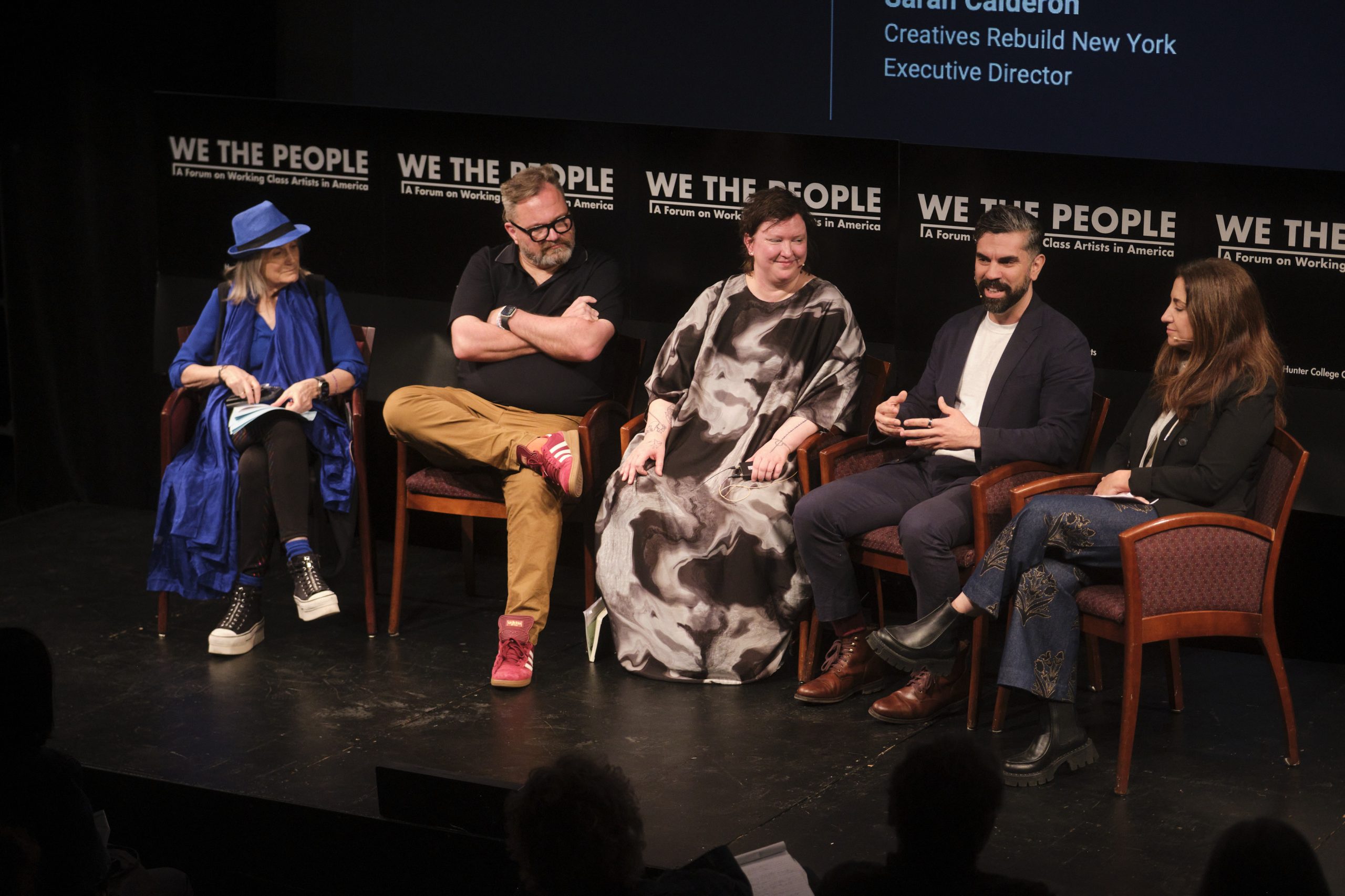

We The People: Assembly of New York Artists
at Danspace Project in St Marks Church
Monday January 26th from 4-7pm
Talia Corren: Okay! We the People Assembly of New York Artists will be hosted by the Office of the Arts at Hunter College. What is that?
Gregory Mosher: We are a college-wide program with three prongs. We try to turn on all Hunter students to the richness of the New York City art scene through cheap and free tickets and museum visits and gatherings. We also have a set of programs we work on with students who are seriously pursuing life in the arts, often with residencies and paid internships. Lastly, we try to engage the larger world of the arts in New York City. That led us to the We the People Forum on Working Class Artists last spring. And then to this event.
Talia Corren: What was the kernel of that idea? Did it emerge from other existing programs, or was it the result of conversation?
Gregory Mosher: It came out of conversations with lots of artists around town, and of course our own students. If you grew up working class, or you find yourself in a hand-to-mouth situation once you’ve graduated, you have a whole different set of problems than people who are more economically secure. Hunter students are majority immigrants and the children of immigrants. They’re majority first in their family to go to college. And these people need a voice. So we thought, well, let’s just look at this from the perspective of our students. And that led us to look at the problems of creating art in the 21st century. Through the lens of money.
Talia Corren: Framing this in the context of Hunter’s mission and Hunter’s population is actually civic work: what it means to be in New York City, in a city of profound wealth inequality, and also to be in a city that has always been driven by and guided by strivers. Immigrants, working class people, artists… What people love about New York and what people outside of New York think of when they think of New York is really at the nexus of those things – profound obstacles, profound inequality, but also this real energy of engagement, community, and mutual aid. You know, intrepid loft sharing in the Lower East Side! It feels so obvious, in a way, but it was also an incredibly revolutionary event you held in May.
Gregory Mosher: Thank you!
Talia Corren: That brings us to part two – the assembly later this month. What do you think will be different about this gathering? What are you hoping for?
Gregory Mosher: Well, let’s break that into two things, but first, thank God Theresa came on board to help us.
(Theresa waves and shrugs)
Gregory Mosher: We decided not to do Q&A at the forum in May and then we had breakout groups. For the assembly we thought, well, let’s flip the panel format on its head and just let the people talk. That was the impetus for this, and then Theresa has joined the Hunter team of Jenny Rroji, Jack Perry, and Chad Kaydo.
Talia Corren: Theresa, what would you want to add about the May forum and the path to the January assembly?
Theresa Buchheister: You know, the event in May was incredibly personal for me, having just left New York after 20 years because I could no longer figure out how to dig myself out of the financial holes that I pretty much lived in. I could do it for quite a while and then I just couldn’t anymore. So, being invited back to talk about that was like, I get emotional even now, just thinking about it. So, it was very personal and it is also about so so many people and the environment we are in – just going micro-macro-micro-macro.
So, that is the approach to how this continues – this is about individuals and this is about communities. How do we make space for individuals to be heard and communities to connect?
Talia Corren: Yeah.
Theresa Buchheister: And realize that they’re not doing this all alone. And that it is not a thing that you solve all at once. It’s an ongoing, eternal conversation. We have to remember that, amidst remembering that we were all influenced by the pandemic in a variety of ways – of bringing people together in really important ways and also isolating people in ways that we couldn’t even fully understand. So, having people be together in this iconic space on January 26th, a space of gathering for so many generations, will be really powerful.
And it’s also been a response to what has been happening since May. We had a very exciting primary, but then it was also like, don’t get too hopeful!
Talia Corren: Totally.
Theresa Buchheister: Corruption is real, you know, like, this could not go the way that all of our hearts hope that it does.
And so, when we were discussing the next steps for this, we were like, let’s see how the election goes, because that will determine how we move forward.
Talia Corren: So, how will the assembly work?
Theresa Buchheister: We decided that we’re going to flip it from panels of pushing information out there to hearing the people speak about things in front of each other and also in front of people who can help us affect change. We’ll have moderators, we’ll be in the round, we’ll have people roving with microphones, making sure that they’re catching anyone who has a glimmer of “I want to say something” in their eyes. And then folx will have 60 seconds to share their idea – a problem they perceive/that affects them, a way to address the problem.
Gregory Mosher: We want as many people as possible to speak.
Talia Corren: That’s incredible.
Gregory Mosher: The fun thing is you have time to say, “Hi, here’s who I am, here’s where I work, I’m a painter, I’m a poet, I work at such and such a theater…” And then you have 60 seconds to pitch your idea. It’s amazing how much you can say in 60 seconds.
Talia Corren: One of the things that I really respond to about this model is that as theater people we are, like, performing democracy. Being in a room and having to hear each other. It’s one of the things that, to me, was so inspiring and also just felt so profoundly different about Zohran Mamdani’s campaign – it was all about listening to people. And it feels so radical, the way that we have been socialized about what politicians are supposed to do, or what institutions are supposed to do, or what structures are supposed to be for us, that they tell us what the plan is.
And I think that shifting the expectation, changing the relationship of all of us to each other really has a radical impact on what gets said and what gets heard and what gets elevated. This is how we fight authoritarianism, fight isolation, fight those feelings of striving on your own, because once you hear 200 other voices you can’t get lost in your own experience as easily, right? That’s an exciting and challenging structure to hold.
Gregory Mosher: We’re happy about Mamdani, but you know? We would have done this if Curtis Sliwa had been elected mayor. (Theresa and Talia chuckle.) We didn’t use the word affordability once in the May Forum, but you could look back and say every panel was about affordability.
Talia Corren: Right.
Talia Corren: So, what do you hope are the outcomes from this gathering?
Gregory Mosher: First, what you were just saying – community building is essential. We know what many of the issues are. There are brilliant studies, of course. The Center for Urban Future study was published a few weeks ago. But, as you say, to be in a room and to hear it from each other and go, oh, I’m not alone. But it is just a step. We have to really think about how we make art in the city. I don’t mean the individual artists that make the work but the system in which people make art. We are using a 60-year-old model. It doesn’t work.
Talia Corren: Yeah.
Gregory Mosher: How do we turn this event into action? How do we work with EDC? How do we work with the city? How do we work with the real estate community? How do we, above all, you know, remember it’s about the artists? I think there are a couple things that we want to do. We want to literally de-Center the arts. And I mean that with a capital C. Lincoln Center, Kennedy Center, Perelman Center, Dallas Theater Center, Center Theatre Group.
Talia Corren: Hmm. Right.
Gregory Mosher: That was a great idea 60 years ago. Now we need to de-Center to realize that life and creativity happens all over the city, so that’s one goal. We also have to redefine success, which is, as you heard at the panel, it’s become all about money.
Talia Corren: Yeah.
Gregory Mosher: We didn’t talk about grosses when I started in the theater. The only number that mattered was the number of subscribers you had, which turned out to be the stupidest number possible.
Talia Corren: Yeah, not sustainable.
Gregory Mosher: We need to re-educate the funders. We need to get them to really rethink how they spend their money. I mean, God bless them for doing what they’ve done, but they need to think about it in a fresh way, in the same way that people thought about it in a fresh way in the 1960s. We need to restate clearly the dividing line between not-for-profit theater, art theater, and commercial theater.
So those are big things… Shifting the entire way we think about and support art for the first time in 60 years, really. It used to be about artists, now it’s about arts institutions.
Talia Corren: Yeah, that’s a big list, and a good list. I wonder, Theresa, what you would add?
Theresa Buchheister: Well, yeah, it is a big list, but I, you know, I tend to think about the way that individuals in small groups can make daily choices and understand actions that they can take on a regular basis that is not overwhelming to their existence, but maybe actually beneficial to their existence. Using energy in a more effective way in order to create the world that will sustain us as one person and as communities. These things will impact the larger systems, of course. Sometimes interacting with institutions feels like being at the bank or the DMV – when you say something and you’re searching for the humanity in somebody who’s only concerned with rules and it’s really hard to to find the the light in their eyes that allow them to recognize you as a person. So my hope is that people can hear us and that we can also find paths of action individualized to people’s own capabilities and interests and needs to make things better for ourselves.
Talia Corren: Yeah, I really appreciate that. I feel like, as you were just talking, Theresa and Gregory, as you were reflecting on this sort of, like, de-Centering. This image of moving from sort of, like, a hub and spoke visual to a weaving. We want people, in their way, in their own mode, to have a different kind of agency and also connectivity that is not reliant on top-down “this is what you are assigned to do” systems. Whether that’s from a funder, or whether that’s from an oversight agency. We are trying to own the how and the with whom we are making that is more sustainable, more humane, more reflective of art practices… that are not about capitalization. They are not about winning. It’s about soul work, it’s about community work, it’s about healing work, it’s about audacious dreaming work.
Like you said, Gregory, that conflict was baked in when we sort of set up this checkbox system. It is about affordability but it is also about a different kind of currency.
Gregory Mosher: That’s right.
Talia Corren: What is the currency that we actually want to value? While also needing our basic human needs met, right? Like, you can’t do that work if you can’t pay your rent… how do we nurture that? The ability for all artists to have dignity, and also for our ways of making art to be more like art, and less like hustle.
Theresa Buchheister: When you break yourself in order to try to fit into the system that doesn’t even respect you, but you’re breaking yourself in order to fit into it, you’re removing your capability to do anything else, like care for the people around you.
And so to open up the capacity of artists to be full people who are not trying to fit into the mold of something that hates them anyway is pretty exciting to think about… what opens up if that is able to happen?
Talia Corren: Yeah.Totally. New Yorkers love to be exceptional, but I do think that we are at this moment when what is possible at all levels of New York government right now feels very energizing, in part because of who will run here. I would love for there to be more artists on city council, and the possibility that if artists weren’t having to sell out certain parts of their being to fit into this structure, what incredible leadership or solutions or care might we all benefit from? If those artists have the space, the encouragement, the possibility and permission to be different kinds of stewards of our collective. That would feel thrilling.
Theresa Buchheister: And exponentially thrilling, right? Like, just like 1 person getting to experience that would have great impact.
Talia Corren: Yeah, exactly.
Theresa Buchheister: And then you make that into hundreds and thousands… it’s really exciting to think about what would be possible.
Talia Corren: What are some of the things that you would like to see changed? I mean, I think we talked a bit about structural change, But what do you imagine this change looks like?
Theresa Buchheister: For me, there’s sort of, like, two categories. One relates to the things that open up capacity for people, so, like, universal childcare! So, what are the things that are just necessary to life that open up capacity?
Talia Corren: It’s so hard.
Theresa Buchheister: So… free buses, free subways, cheaper tickets to things so that people don’t have to feel like they can’t go outside without spending a million bucks. There are all of these day-to-day needs of human beings that, if met, open up capacity.
And that also relates to how much rent is and the situations you have to engage in to be here. I mean, people are aghast at some of the environments that I’ve lived in for years, just in order to make things work. (Pause) And then category two relates to the art and how things are made. I would love for the unions to understand the needs of artists more so that, ideally, there’s less conflict between the unions and the people trying to make art. We could be more collaborative in that regard, so that the non-capitalistic things that artists are truly trying to make can be supported. I would love for there to be subsidies for people to have spaces and not just like be like – “here’s the space, go for it and fail!”
Talia Corren: Good luck. Yep.
Theresa Buchheister: So that it’s not just, like, flash paper, you know? People need support to figure out how to say – “how can I be doing this in 5 years?” They don’t necessarily even have the skills to maintain that thing in the present, so they really can’t think about the future. So creating infrastructure for people to have access to space and resources, but also a sort of generational support system for teaching people how to run space and hold space and create space for artists when they’re given those opportunities.
Talia Corren: Yeah, I think we think about that a lot at A.R.T./New York, because the gap between – “congrats, you have a space” – and – “how do I operationalize this in a way that is actually of service?”, – that feels values-aligned with why you got into this whole shenanigan in the first place. But also helps you call a plumber when something is broken, and take care of your audiences when they’re in your space, and make sure that artists have the safe and sanitary conditions that they need to do things… It sounds like a low bar. But it’s actually a huge barrier. It’s easy for us to say – “Oh, it’s so sad that another space closed.”
This is making me think about space scarcity and how space is always a challenge for artists. There is community art happening everywhere, but I don’t think that New Yorkers feel a sense of ownership or pride in their community arts in the way that I think we want and need to have in order to shift this power dynamic. That people like your brother and his wife, Theresa, can see something cool in their neighborhood instead of traveling an hour. They’re seeing a really cool cabaret that’s never been performed before, or someone’s weird puppet exploration, right? That there’s something that is interesting and valuable and unique happening in your own neighborhood, instead of it feeling like – “oooooh a cultural treat.”
Theresa Buchheister: And also, Talia, the true diversification of what would be happening would be so exciting, because so many people are applying to grants using the language of the grant organizations in order to get the money that they need to get to do whatever… but it waters down the whole affair, right? And so all these people who maybe want to do, like, experimental puppet cabarets at midnight are having to pretend that they want to do children’s educational programs so that they can get fucking money. And I’m just like – “No, people do want to do children’s education stuff AND people do want to do midnight experimental puppet cabarets.”
Talia Corren: Great.
Theresa Buchheister: And they should be able to do those things without having to pretend that they’re doing another thing in order to get money. And it would be so exciting for people to just be able to do that.
Talia Corren: So you can trust the artist, and you can also trust the audience, right? They will find the things that speak to them when they show up honestly and authentically in their own communities.
Theresa Buchheister: And it will allow people, especially artists, to realize that having a small audience is not bad. It would be amazing for the niche to be celebrated by allowing it to exist and not need to “scale up.”
Talia Corren: Right.
Theresa Buchheister: An artist would could recognize that “success” and “failure” have become such weird contortions in our society.
Making exquisite art is success. That has nothing to do with packing a venue. It’s so sad to talk to an artist who I consider to be incredibly successful, who doesn’t view themself as such, because they haven’t met certain metrics.
Talia Corren: Yeah.
Theresa Buchheister: That don’t even matter.
Gregory Mosher: So, again, it’s a question of bringing artists into the conversation.
Talia Corren: Yeah.
Theresa Buchheister: And I think that’s probably a good way to wrap it up!
Leave a Reply