
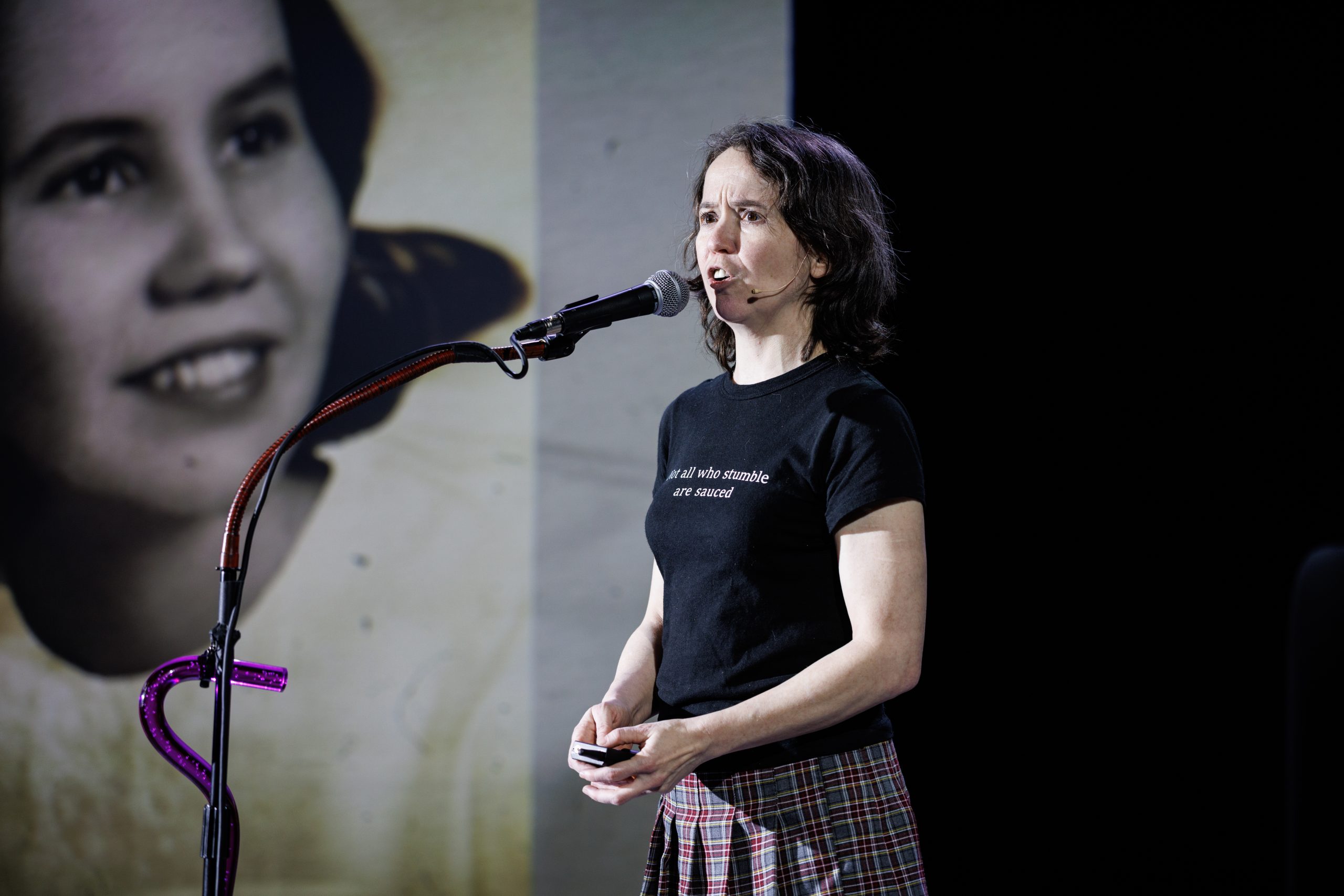
Anne Gridley is funny and warm, and she takes no bullshit. With a collection of twenty walking sticks, she calls herself “The Imelda Marcos of Mobility Aids.” The sticks have names like Dorothy Parker, Tonya Harding, and Gabagool. In her new solo show, Watch Me Walk, playing at Soho Rep through February 8 as part of the Under the Radar Festival, Anne introduces the audience to these many sticks, along with her family history of disability and what it means to live in a body like hers. Anne has Hereditary Spastic Paraplegia. It is apparent in her movement. She will fall during the show. People will want to help her. She guarantees it. “Being disabled,” Anne explains, “always includes an element of chance.” What better place to explicate her disability, then, than in live performance?
In Watch Me Walk, Anne dissects the minutiae of her diagnosis with whimsy and play. She sings! She wears costumes! Characters like Ping the Duck and Dr. Wiz discuss her medical charts while she looks on dressed as a giant purple nerve cell. The show is primarily a solo performance, though the script calls for two additional actors.
The script of Watch Me Walk suggests a whacky romp through the travails and indignities of disability– an emotional distancing via toughness and humor. When I saw the play, I was surprised by Anne’s vulnerability. The show ends with Anne dancing. She sheds the wigs and sequins of previous scenes, in favor of jeans and her dependable Doc Marten boots, and dances until she falls, gets up, and dances some more. Her gait produces a style of movement entirely her own. Her dancing is extraordinary, not in spite of her disability, but inseparable from it. After over an hour of dissecting Anne’s walk–its mechanics, its hazards, its diagnoses– she extends the type of motion the audience has witnessed and lets herself go. The dancing speaks for itself.
I spoke with Anne via Zoom in early January. We talked about inheritance, visibility, and her handsome fifteen-year-old cat, Schpeck, who spent much of the interview on Anne’s lap.
This interview has been edited for length and clarity.
Annie Rasiel: Can you tell me about the origin of Watch Me Walk?
Anne Gridley: I had the title for years because I thought it was funny. I would tell fellow downtown theater folks, “if I ever write a play, it’s going to be called Watch Me Walk, har, har, har”–but they were actually playwrights; they were actually making work. They suggested I do a residency, but I never followed through. Then two years ago, I got an email from Frank [Frank Hentschker, Executive Director of the Segal Center] about the Prelude Festival at CUNY, saying, “Annie-B [Annie-B Parson] from Big Dance said that you have a work in progress to show.” And I was like… Well, I can’t say Annie B is a liar! I had nothing written, so that really lit the fire. I wrote twenty minutes of the show for Prelude. A lot of that early work is still in the play. Eric [Eric Ting, director of Watch Me Walk and director of Soho Rep] saw it [at the festival] and commissioned me to finish the piece. It was overwhelming. I was honored and terrified and all of that. So, that’s what started the ball rolling.
AR: You were tricked!
AG: Yes! It was this joke, and then people decided to take it seriously, and I was like… Well shit!
AR: How did it feel to take something that started as a one liner and turn it into such a personal, vulnerable piece?
AG: It was exciting. I had never written a play before. I was also constantly questioning Eric, like, You really want this? You want this moron to, like, write something down? Are you sure? That’s something that I struggled a little bit with. Eric would give me prompts, and I would write. I would write well! Not to toot my own horn or anything, but I would write, like, a well written response in essay form. But it wasn’t really my voice. That was always Eric’s note. It was very polite. It was too polished, not as swear-y as I tend to be. So I started recording myself just riffing on ideas, just to get my voice, and that was more useful. I also took things from MyChart, from doctor’s notes, from random things that people say. That was helpful for me. I could take a break– I could just be like, look at all this weird language that people use. I could just steal it.
AR: Is that theft? The language belongs to you! They’re saying it about you.
AG: Right.
AR: Speaking of language that’s not yours, you open the piece with your mother’s voice, with a recorded phone call between her and Pavol Liška [co-founder of Nature Theater of Oklahoma and Anne’s frequent collaborator]. Can you talk about that choice?
AG: I work with a company a lot called Nature Theater of Oklahoma, and around 2006 Pavol, one of the directors, started recording phone calls to generate material for a play that eventually became No Dice. Pavol really enjoyed talking to my mother, because she loved talking on the phone. He called her a lot. Last spring, Eric asked if we had any unused audio, so I reached out to Kelly [Copper], another director of Nature Theater, and asked, “If you have any recordings between Pavol and my mom buried in a dusty box somewhere, I would love to hear them.” And she gave me eight hours that I had never heard before. I was terrified. I was like, am I going to have an emotional breakdown listening to Pavol talk with my dead mother? But it was so beautiful. I felt comforted. My mother had dementia at the end of her life, and these recordings are from before that. I can still hear her brightness and her curiosity and her intelligence and her joy. It was really profound.
So the piece is kind of book-ended with these two telephone calls between Pavol and my mom. The one that appears at the end was obvious. The second I heard it, I was like, this is perfect. Thank you, mom, for finishing my play.
For the first call, I have no idea. I think we picked it because she talks about me. She talks about a terrorist attack and then talks about finding me the perfect man. We thought it was funny.
AR: It is funny! From terrorism to finding you a man!
AG: That was her.
AR: That feels universal to anyone with a mother.
AG: Right?
AR: Absolutely. How do you think about the role of inheritance in the play?
AG: It’s complicated. We all inherit things from generations that we don’t even know. There’s a great mystery to that. Sometimes it’s hard for me to find the freedom within that mystery. Sometimes that mystery feels like chains. I don’t know who the first person in my family was to get this genetic disorder, but they’ve passed it down, and now here I am. But there are other things that we inherit that are wonderful. Trying to tease out how each generation coped with the genetic disorder in my family has been an interesting kind of detective work and has required some invention. I don’t know what it was like when my mom and grandmother went to NIH [National Institutes of Health, where Gridley’s mother and grandmother were studied and misdiagnosed in the 1960s]. I never met my grandmother. I just hear stories, and sometimes I don’t trust the person telling me the stories, or they conflict with another story that I heard from somebody else. You get to pick and choose a little bit. Inheritance, it’s complicated! One of the songs in the show is about this; I call genetics “the gifts you cannot see.” Sometimes it’s the shitty gift you didn’t ask for, whose value you don’t realize until later.
AR: Can you speak more about that value?
AG: In my experience, this disability is often frustrating. It’s often depressing. It’s often infuriating. But there are also moments of beauty, like friends who really step up or strangers who get it, even just the experience of slowing down. I was always very fast. I was go, go, go, go, go, go! I remember one time I was driving with my mother, and I was in my head, just whirling around. It was a stressful time. And my mom just looked out the window and said, “Oh, look at that statue in front of the bank.” She could notice these little things that I was too preoccupied to see. I think that’s happening in some ways for me too. Sometimes it’s just that I notice when the sidewalk is uneven. I notice when the other side is smooth. Noticing the little things has been a kind of beautiful fallout.
The world is full of assholes, but it’s also full of beautiful angel people, people who offer an arm. I once fell in Brooklyn, and there was a construction guy who asked if I needed help, and I said, “no, thank you.” And he said, “I’m just going to stand here with you until you get back up.” It was so kind.
AR: Wow. So perceptive too. You mention in the script about how, when you fall or if you seem to be struggling, people will rush in and try to help you in ways that can actually be quite harmful. Someone will swing open a door too fast, and you lose balance. This man let you take the lead.
AG: Sadly, I don’t think it’s intuitive to most people. In my experience, you see a problem, and you want to help. You want to fix it. If you’re a good, decent person, you probably think, “How can I help? How can I fix it?” But to actually pause and listen to the other person, to pay attention to what they really need, is beautiful.
AR: It’s a question of speeding up versus slowing down, like you were saying. We want to accomplish something. We want to be able to say, I helped! Actually listening requires patience. You have to slow down and really see the other person.
AG: Exactly. One time I was coming in from a balcony in the Netherlands, where I had gone out for a cigarette, and the door was kind of heavy. This tech guy watched me trying to open the door, and he said, “I am not going to help you unless you ask for it.” And I was like, “thank you so much, because I’m actually using the door, and I know it looks awkward or that I’m struggling, but I’ve actually got it.” I was like, he needs to teach everybody that!
AR: Wow. He’s saying that he sees you and recognizes your agency. That’s something that you instruct the audience in the show. You fall and make the audience ask if you need help.
AG: [Over the meowing] Excuse me, that’s my cat. I’m late with his lunch.
AR: That’s very cruel.
AG: I know. If you need to call the ASPCA, I get it. Oh wow, two paws on my head! Say hello, Schpeck.
AR: He’s beautiful!
AG: He’s very handsome, and he’s fifteen.
AR: He’s perfect! You start the show sitting down, which you call “pulling an FDR,” a reference to his effort to conceal his disability from the public. [Roosevelt was adamant about being photographed seated or standing with unseen supports.] But then the show goes in the opposite direction. You get deep into the minutia of how your disability functions in the brain and manifests in the body. What is the relationship between visibility and control?
AG: [Laughing] Ooh shit! Oh god. I’m certainly more physically in control when I am not moving. And unfortunately, I chose this career where I don’t get to sit most of the time. In the show, I say disability always includes an element of chance, and I think that also, at least for my body, is like a release of control, because I don’t know if I’m going to trip or stumble or fall or start shaking. In other performance contexts, there’s a part of me that hates it, that’s asking, Why is my leg shaking? Why did I trip? Why can’t I move faster? But in this show I get to release my tight little fists. If that happens, it’s okay. In fact, it’s part of the show. Ha ha ha. So I guess I am still controlling the uncontrollable potential, maybe.
AR: Live performance is never entirely in control.
AG: That’s what I love about it. You’re never going to see the same show twice. Even the Rockettes, doing their regimented thing, will always have tiny differences. I love that, because it’s human.
AR: You go into so much detail about the specifics of your diagnosis–the reflexes, the foot drop–why all the medical terminology? What do you want the audience to understand?
AG: I love the language. I want to demystify the medical language. These words, foot drop, clonus, spasticity–they’re not terrifying. Though they certainly scared the hell out of me when doctors were like, “you have Hereditary Spastic Paraplegia.” Ahh, paraplegia! Oh my god! So I guess it’s educational. I’m saying don’t be afraid–maybe to me, too, not just to the audience. If I can pick apart these specific things, if I can figure out these specific details, then that makes it less scary. The more I know, the less overwhelming it is.
And, like, hey. Maybe don’t say spaz anymore. That word describes the way I walk. . So every time you just casually say “I was spazzing out,” I want you to think of me walking back and forth stiffly across the stage.
AR: You mentioned that strangers like to guess what your disability is–which, god, I’m so sorry that happens!–but you don’t reveal the specific diagnosis until about halfway through the play, even though you discuss so much medical terminology early on. Can you talk about that decision?
AG: It’s twofold. I’m playing with the audience, letting them sit in their solitude wondering, Is it MS? It’s gotta be MS. My sister’s cousin’s brother had MS, and he walked just like that. So I want them to sit with the not knowing. I didn’t want to come out and be like, “Ta da, here it is!” Also, I didn’t know what it was for so long. I was misdiagnosed. I had to wait. There’s an element of that too. Wait, hold on–and then, boom, here’s what it is.
And ultimately, the diagnosis doesn’t really matter. What matters is how you treat somebody. What access needs do they have? It doesn’t matter if it’s a limb difference or MS or CP– what matters is whether a ramp would be helpful. Would a banister be helpful? I spend a lot of time in the show explaining my specific disorder, but in some ways it doesn’t really matter.
AR: You introduce questions from the audience throughout the play. Can you talk about where that idea came from?
AG: We had the idea at a workshop last summer. We had little note cards that said, ASK A GIMP, and people wrote things down. And I thought it was great, because it provided new material–new questions, different questions–and it gave the opportunity to ask a question anonymously, something that you might have always wanted to ask but were afraid of for whatever reason. I’m trying to take away the fear that nondisabled people have around disabled people, which is often expressed by ignoring disabled people or being just completely inappropriate. It’s like, you know what? Ask. Go ahead, ask whatever. And it keeps it fresh, in a selfish performer way. Ask me something cool, and then I can riff on it and not be bored saying the same lines every night.
AR: Are there questions that you’re sick of or questions you dread?
AG: The stage manager picks the questions, so I don’t see most of them. The time I saw the most questions was during the workshop, and they were from friends and people who knew me so there weren’t any horrifying questions.
I had a dream, a kind of nightmare, where somebody said, “Are your parents proud of you? You swear so much. Do you think your parents are happy with that?” This was before the part of the play where I say I’m an orphan, so I just responded, “you’re going to feel really uncomfortable in about 15 minutes.” But nobody’s asked that. It was just a weird flight of fancy one afternoon; I was like, what if somebody has the audacity to bring up my dead parents?
I don’t know how it would come in the form of an audience question, but I really don’t care for pity or being called inspirational. That sort of language makes me want to puke. But the stage management knows that I hate that shit, so the question wouldn’t get to me anyway.
AR: Are there any questions you hope to be asked?
AG: Yeah, I hope somebody says, “I have a huge amount of money, and I would like to donate it, but I just don’t know where,” and then I can direct them to the Spastic Paraplegia Foundation. Or something like, “I have a huge real estate portfolio, and I’ve always wanted to give a house upstate to a middle aged, disabled performing artist. Where do I send the keys?”
AR: “Do you want this beautiful estate?”
AG: Yeah, “I have this Hudson Valley estate just collecting dust. It has a sauna, and I don’t know what to do with it.”
AR: I hope someone asks that question!
AG: Me too!
AR: Are there any artists, specifically disabled artists, with whom this piece is in conversation or who inspire you?
AG: I’m still learning about all of the disabled ancestors, as Alice Wong calls them. I think about The Capitol Crawl a lot [a protest in which physically disabled activists crawled up the steps of the U.S. Capitol to demand passage of the ADA]. I love watching videos of it. It was before the ADA was passed. Everybody got out of their wheelchairs, put down their crutches and sticks, and crawled up the Capitol steps to demonstrate a need for fucking accessibility. It was brilliant. I don’t know if this piece is really in conversation with that, but it is something that I look to as a great moment in disability history. It was like, Oh, okay, you’re not gonna listen to us? Well, we will crawl up your goddamn stairs.
AR: Talk about visibility.
AG: Yeah. And I’m eager to learn more. I know this show is in conversation with others.
AR: It’s in conversation with your mother and grandmother.
AG: Yeah.
AR: You mention in the show that your grandmother refused to be photographed.
AG: That was one of the myths that I heard. Another story I heard was that she destroyed all of the photos of herself. I don’t know which one is true, probably a combination of both. That was something Eric identified very early on. My grandmother refused to be photographed. My mother wrote poetry about being disabled. And now I am on stage in front of people, very much the opposite of my grandmother. She wanted to disappear. My mom didn’t disappear, necessarily, but there was still the distance of writing, you know? I’m like, I’ve written this, and now you have to watch this old clown do it.
AR: How does it feel to dance on stage?
AG: It feels good. It can feel great, because I know that I’m going to fall, and I know that’s going to create a reaction. But also, I can’t rehearse [this scene] twice in a row. With progressive disabilities, there is a grieving process. I know I can’t dance like I used to. There’s a grief. If I fall, there’s another grief. Even though I’m okay, I have to get back up. I can do it once for the show. I can do it once for rehearsal, with a half hour break in between if we need to do it again. I have to put a boundary up. I’ll go full on, balls to the wall, no problem. But just once.
When I was teaching at Northwestern, I showed them videos of some No Dice performances. I saw myself dancing twenty years ago. It was different. I wasn’t using mobility aids. I was wearing character shoes. I could stand on one leg. It does something to my soul that is heavy and hard, and I can’t consistently pull myself out of that. But it’s the getting back up that is more important, than the falling, I think.
Photo by Maria Baranova
Leave a Reply