
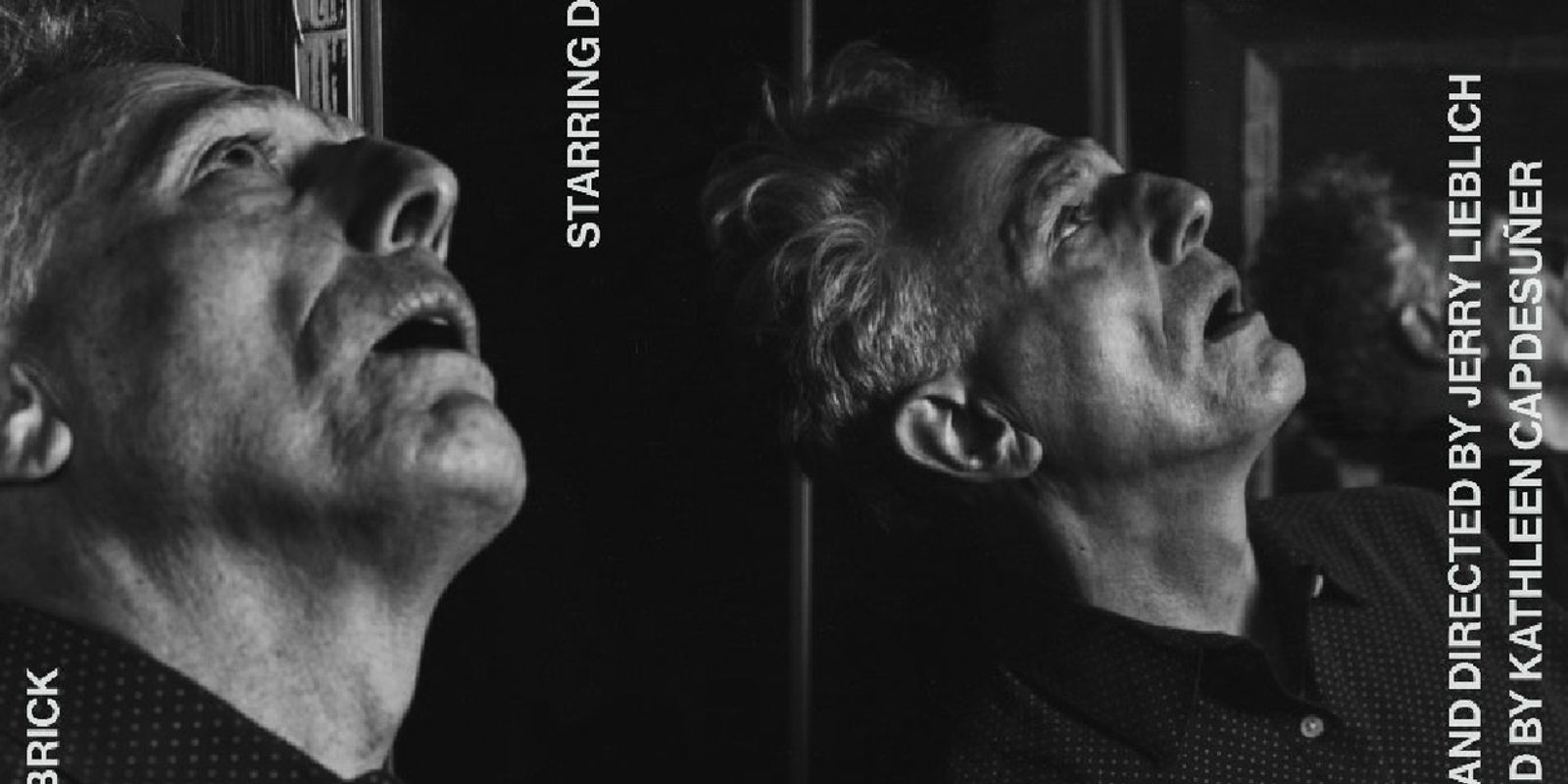
“When I think of David as a performer, I think of his nimbleness, how he makes hairpin turns between emotions, moments, intentions… I wanted to write something for him that would use that skill of feeling a through-line amidst repeated sharp turns,” says Jerry Lieblich of their new play Without Mirrors, a solo piece created for David Greenspan, the celebrated Downtown performer.
There’s something uncanny about acting. Despite efforts and best intentions, al la Yeats, it often proves difficult, -perhaps even impossible–to separate the practitioner from their craft. Even in the strongest performances, oftentimes residue of one half of this alchemy sticks to the other. For well-known actors, their personhood dots and surrounds a role, blocking the character from ever becoming full and instead existing as an expression of the actor in a specific context. For the lesser-known actor, a breakthrough role can come to mark their whole personhood. Will we ever be able to see, for instance, a performance of Timothée Chalamet as anything other than an expression of his persona? Is every performance merely a recalibration of the man himself?
David Greenspan is an actor who has come to emblematize this somewhat dizzying and delirious (yet exhilarating) nebulosity as much of his career includes solo performances portraying multiple characters. In the past few years, he’s starred in Joey Merlo’s On The Set With Theda Bara (2024, also at The Brick Theater) and Mona Pirnot’s I’m Assuming You Know David Greenspan (2025, The Atlantic Theater), both performances requiring an evening of quick, successive changes between characters. In the latter, especially, the mantle of his own person lurked at every turn. In each performance, the transitions were so swift and deft that Greenspan seemed to exist more in the spaces in between each character than in the characters themselves. The characters, in turn, became moments of rest to show off Greenspan’s highly cultivated craft, the same craft Lieblich seems to have tapped into. Watching Greenspan on stage feels like witnessing the inner workings of a mathematician’s mind.
I spoke to David in late January, ahead of Without Mirrors, by Westbeth Artist Housing, where he’s lived with his partner, William, since 1999. Asking him about his association with metatheatricality, I was struck by his nonchalance. Contrary to my piqued sensitivity to this approach, David seemed to see it as but another way to carry out a performance. Had I been too precious in my thinking, believing I’d discovered gold in an already trodden domain? Perhaps David’s ease shows off the depths of his talent: an agility so engrained that it is unremarkable to him. Either way, I left our conversation with the same amazement and wonder at the sheer capacity of his ability that I’d had when he walked into the coffee shop. Read on to learn about the origin of Without Mirrors, David’s initial experience with solo work, the limitations of set design, and the fantasy of “Broadway’s good old days.”
This interview has been edited for both length and clarity.
Eve Bromberg: How did the idea of this project, to work with Jerry Lieblich, come about?
David Greenspan: I’ve known Jerry a bit over the years. I saw their play with Steve Mellor [Mahinerator], who was in a play of mine years ago called Dead Mother at The Public. I told Jerry that I’d love to work together and to write something with me in mind. So, Jerry came to me with this solo play.
EB: So the piece was written for you!
DG: Yes! I didn’t intend for it to be a solo piece, I just said something I could act in. I say that to just about everybody I know, playwright-wise. I tell them I’d love to be in their work. I’m something of a troll.
EB: This is going to be the third performance I’ve seen of yours that’s a solo and/or multi-character work.
DG: This piece, Without Mirrors, isn’t actually multi-character. There’s only one character in the play. Sometimes the character’s mind is fragmented and there may be more than one voice. The other voice isn’t literal, but rather a voice with different intentionality. But, really, it’s one character.
EB: In the script, Jerry writes they intended this piece to be a rewrite of Richard II minus the plot and that character.
DG: Yes, and the language.
EB: Did you read, or reread, Richard II for this project?
DG: No, I did not. I was in a production of it years ago and I know the famous monologue. There’s no real direct correlation other than an ongoing meditative reflection, much like that gorgeous monologue involving the shattered mirror [in Act 4].
EB: How did you discuss the narrative of the work with Jerry? What is this story about?
DG: The play is an internal monologue of a person alone in a cave. The cave may be literal, or it may be allegorical, but it’s about someone who is trapped and trying to disidentify themself. It’s based on Jerry’s thinking about how an established identity is unsuitable. How an attempt to establish an identity leaves us searching for a new identity or an attempt to be without an identity—which in its own way would be an identity [laughs]—which is referred to in the play as a solidity. The play suggests that for people, in general, identity is not fully stabilized and the attempt to find something permanent is a fool’s errand.
EB: Do you feel you’re playing a character, or do you feel Jerry cast you to play yourself?
DG: No, it’s a character.
EB: Given its lack of clear identification, how are you differentiating the character from yourself?
DG: Well, it’s like any acting assignment. One has to try to define character and develop it based, certainly, on the writing of the text and what you learn from the playwright or director. All acting assignments require bringing something of yourself. You have to be able to identify with the character on some level. So to me, that’s the relationship. It’s definitely a character. I don’t see it in any way as my biography, but simply a matter of trying to realize the character to interpret with the playwright and director, which in this case is Jerry. I’m trying to realize the vision they have, and bringing what I can to it.
EB: From what I understand about your work, you believe in acknowledging the edifice of theater– that as audience members we’re meant to see characters onstage while acknowledging them as people. Do you find that to be something of a theatrical philosophy in your own work?
DG: Oh sure, but it’s a matter of how metatheatrical, or how much the artifice of the theater is emphasized. Some plays are emblematic of this approach and others are more grounded in a world of—I don’t like naturalism, what a meaningless term—but a world in which artifice isn’t a part. I’ve been in those kinds of plays as well. I did a play called Sex Variants Part I with The Civilians, and I did a play called Usus by T. Adamson, a wonderful play. There was no sense of acknowledging the artifice of theater in those pieces. They were plays with clear stories. When I did a solo rendition of Four Saints In Three Acts, there was a kind of understanding of the performance aspects of the text, but the metatheatricality was never directly acknowledged. There are examples of pieces I’ve been in where metatheatricality is fully put on display. In Mona Pirnot’s I’m Assuming You Know David Greenspan, there’s a rather playful use of artifice. On Set with Theda Bara, the show I did with Joey Merlo at The Brick, is very theatrical and there’s narrative, but there is also direct address to the audience. Some of the things I’ve written use artificiality. I am interested in that. I love the artificiality of theater.
I wrote about this in my play called The Myopia, and I know this from having read The Poetics, that encountering art allows for a natural separation. I think Aristotle is very right about this, that there’s a natural separation where characters are separated from audience members. This separation, according to Aristotle, is what allows for the application of reason, allowing us to encounter the piece without seeing it as mere imitation. Reality separates us from those characters, so you may cry, you might be frightened, but you’re separated from it.
EB: For I’m Assuming You Know David Greenspan, did you find yourself preparing to play yourself for that role? In acting in that role, did “David Greenspan,” become separate from you?
DG: I was never playing myself. I had to remind people, when I sent out information about the play, that it wasn’t a play about me. I’m not a character in it. It’s a play, with tremendous metatheatricality, about those four playwright characters. I never had to worry about playing myself. I never did. I was a little nervous about accepting the role, about having to say such grandiose things about myself, but there was no confusion about who I was when performing.
EB: So much of your work, your performances and perhaps your persona, symbolizes a certain type of working actor that exists in New York.
DG: What do you mean by that?
EG: Pirnot touches upon this in her play. There’s a whole generation of actors who are known in New York with these really interesting careers that seem to have grown from such an organic place of proximity to other artists creating work with fewer economic concerns. I think that is why it’s hard for me to remove your identity from your work. Your performances feel so informed by this period in New York.
DG: I have two thoughts about this. Gertrude Stein talks about her own writing career. She says none of it was intentional; it was inevitable, and anything that’s really inevitable is not intentional. It’s true to some extent. If we discover ourselves in time, we learn what we can do, what is possible. There’s an inevitability to that. There might be intention in how you study, how you apply yourself, but there are also the parameters of what you can offer. When I was coming up, I worked as a waiter. I think I worked as a waiter for at least 10 years. And then even after I’d gone to the Public Theater under Joe Papp.
EB: Where you were a director-in-residence in the same group with…
DG: Michael [Grief], George [C. Wolf], and JoAnne [Akalaitis]. They all succeeded, I was the one that fell flat. After that residency ended I had to go back to catering. I had to find another way to make money. I’m lucky in that my partner has a full time job. He’s a visual artist, but he’s supported himself now, for the last many years, as an art teacher in a public school in New Jersey.
EB: And you live in Westbeth artist housing.
DG: We do.
EB: Have you been there for many years?
DG: Since the end of ‘99. We were in Jersey City for 15 years before that. His job brings stability. We’re not millionaires, obviously, but there’s enough between the two of us to keep things going. That could change at any time, especially after he retires. But, all along he’s been painting. He has a studio in Westbeth. He actually designed and painted the sets for my early plays made from things found on the street and built in our kitchen in Jersey City. After that, he decided he wanted to go back to school to study art history. Bill has made things possible for me. I don’t know what I would’ve done without him.
The other thing I’ll say is that the notion of the good old days is so wrong. There’s an expression I’ve always loved that nostalgia is the abdication of memory. Things were always tricky. I work with a lot of young artists today and they’re doing the same things I did. They’re dedicated, determined, and crafty. When I was working with Jack Serio on Theda Bara, he was hanging lights and when the fog machine malfunctioned he was backstage controlling it manually.
I think the thing that’s really changed is real estate. Spaces, like the ones we were using in downtown Manhattan, are now in Brooklyn. When we started out, there was nothing in Brooklyn. People didn’t even live in Brooklyn. But now it’s moved to Brooklyn. I recently saw Ann Marie Dorr’s i’m going to take my pants off now, at a place called life world. It was fascinating. And I saw another piece at a theater called Loading Dock. There was a curtain between the performing space and somebody’s kitchen. So, I don’t go for this “good old days of Broadway.”
I once heard Arthur Miller speak about this when he was being honored by New Dramatists. He spoke about how people used to be able to make a living in the theater and raise families, but how it was becoming increasingly difficult. You didn’t have to work in television or movies like you do now. There are very few people in the arts who could make a living only working in the arts. I’m one of them but I happen to be in a fortunate situation where my partner has a stable income, and that I work a lot. It’s always been a struggle, probably since The Theater of Dionysus. I joke about this, and Mona put into her play, that actors were traipsing around the countryside in the 18th century with holes in their stockings.
EB: This, to me, is another hallmark of the New York actor experience: have you been on Law and Order?
DG: I was on it twice. One time I had four words, though they may have even been cut, and then I had a very small part in another episode.
EB: Were your parents in the arts? How did you come to this profession?
DG: No, we lived in Los Angeles, but my father was an aeronautical engineer. Aerospace was big on the West Coast, particularly after the Second World War.
EB: When did you realize you wanted to be an actor? Was it because you were in Los Angeles?
DG: No, it wasn’t because of Los Angeles. I would trace it back to seeing Mary Martin as Peter Pan as a kid. That was my first love, her performance. It was such a joy.
EB: Given you’re in a cave for this piece–perhaps literally, perhaps metaphorically– is there a concerted effort to make the physicality constrained?
DG: It’s not literal. I shouldn’t give away how it is physically; the only thing I can say is it’s not a literal cave. It’s internal, a place with no light, sound, sensation, no point of reference or context. There won’t be any bats flying around.
EB: You are known for your movement and your physicality. When do you think you realized you had this inclination?
DG: I don’t know that I ever did. It came naturally, I think. I took modern dance and ballet in college. I mostly stuck with ballet. I was not good; I was always on a low level, but it probably enhanced my sense of natural movement. I also picked up things from musicals and old movies, so I may have a natural sense of movement, but I’ve never been conscious of applying it. In these solo plays, where there are multiple characters, quick turns and flow are necessary to present the illusion that there is more than one person in the room. In my play The Myopia I sat in a chair, but there were head movements and small shifts to differentiate people. There is one scene called “A Smoke Filled Room,” where I reenact an infamous moment in the 1920 election where Warren G. Harding was eventually nominated. There were 17 characters in that one scene, and I played all of them by shifting my head, focus, and voice.
The Dean of Fine Arts at the University of California, Irvine, where I went to college, was very good at getting some of these New York personalities there. Anthony Tudor taught a ballet course, which was me and some lugs and football players. I used to ride the bus with them occasionally. But I think he looked at us with amusement. I couldn’t pick up steps, and I couldn’t point my feet that well, but I loved it. And then when I got to New York, I studied with a woman who was very popular with Broadway dancers Nanette Charice, related only by marriage to Cyd Charisse, who is one of my favorite performers.
EB: Her legs were insured!
DG: I can’t get enough of watching her. I watch videos of her and Fred Astaire on Youtube. I’m more of a Fred Astaire guy than a Gene Kelly guy. I recognize his brilliance, but Fred Astaire really gets me, and I like Donald O’Connor, a very fine dancer.
EB: Fred Astaire may have a bit more humility than Gene Kelly.
DG: I think so.
EB: Gene knew he was brilliant.
DG: Yes, but he wasn’t a greater dancer [than Fred]. Cyd Charice said he had a greater overall choreographic vision. Have you ever seen the gala celebrating Fred Astaire and Baryshnikov speaks and says that all classical dancers have been asked at some point, what they think of Fred Astaire. He said that the answer is very simple. That dancers hate him because he was too perfect.
EB: Where did the idea of these solo performances and multi-character pieces come from?
DG: Well, solo performances started early in my career. I worked with a choreographer early on to create these dance theater pieces, which were ] very in vogue at that time. There was dance and speaking, and I did most of the speaking, so I came to monologue that way. But also it was sort of a return to how you study acting. When you’re in school, you study monologues. I also grew up listening to music from musicals. In that kind of music, there is a natural, soliloquial form, a natural way of speaking at length, so the monologues came naturally. The multi-character work started with The Myopia, which I worked on for years, and premiered in 2010. I did one solo rendition of a play of mine called Son Of An Engineer and same with Dead Mother. I’ve always been interested in disguise in the theater. It’s very theatrical because you’re playing the part of an actor playing the role of someone playing a part. I like that. I also like when there’s no change in costumes. I’m very interested in what I called in The Myopia “the impoverished stage,” the minimalist stage. I was very influenced by Peter Brook’s The Empty Space. One of my great regrets is that I never saw his production of Midsummer.
EB: I read you were so inspired by the spinning plates as flowers.
DG: Yes, I just loved that! I was very inspired by Peter Brook’s Empty Space, that any empty space can become a stage. This idea– especially because it was connected to Thorton Wilder, whom I love– had a huge influence on me.
EB: That was an interesting thing in Mona’s play, that your costume had to represent a neutrality of personhood. It was nothing and so many things.
DG: The same was true for the Stein piece and The Patsy. I love the idea of people changing without change being perceived. I like the audience to imagine what’s changing. Sometimes language is simply too evocative to be represented by a set. I love the passage in Merchant where Lorenzo says to Jessica, “Look how the floor of heaven Is thick inlaid with patens of bright gold.” No design would ever capture that sentiment.
EB: Jerry’s work is very focused on language. How is that interest being explored in this play?
DG: The language of the piece is very thorny and disjunctive. I’ve written, in my little blurb that I sent out to my mailing list, it has what I call Steinian overtones. It’s a language which is tricky to learn because of the disjuncture. It’s not narrative, in the sense of a story, but it’s obliquely narrative in how the character thinks and in any images that come to mind. There are reflections and so many parentheticals.
EB: How are you interpreting the title of Without Mirrors?
DG: Jerry defines it two ways: literally being without the object of a mirror, or existing outside of a mirror, never being mirrored or mirroring. With both definitions, you can’t see your reflection.
EB: Do you think, if you could imagine or predict, the audience will be able to pick up Jerry’s language? Do you think they’ll be looking for a narrative?
DG: People always look for a story: in a Richard Foreman piece, in Four Saints. People pick up bits and pieces to try to create something. It is certainly my job as a performer to guide the expectations of the audience. I have to make the script as available as possible so they know how to hear it. My job is translating Jerry’s writing into a spoken text to help the audience access in whatever way possible, whatever ways that’s indicated. That’s my job. They may not find a story, but they might find what I’m rending from the script.
EB: Have you come up with a narrative to guide your performance?
DG: Not a full narrative, but I create emotional marks. It was the same way in Four Saints. Stein says she’s not interested in story and action, but instead in emotion and time. I think Jerry’s play is like that. It’s a play less interested in story and action, even though I act actions and emotional reactions. It is a play that involves thought in a direct way without a specific story to follow.
EB: What was acting for Richard Foreman like?
DG: Well, you know, he had plastic between the actors and the audience at that time. In some ways, it was like being in a Joseph Cornell box. It was challenging. We had to take breaks to write down our stage directions because it was loaded with details and constantly changing. He would say directly, “Oh that’s terrible,” sometimes after a performance because he was there all the time.
EB: Did you feel like you were a part of a great artistic project working with Foreman?
DG: It was a project. It had its challenges, but I had an awareness that I was working with somebody of tremendous passion. He was iconic, an iconic figure. It’s hard not to be aware of that.
EB: I think, like Anthony Tudor, you’re a New York character
DG: Maybe so, by way of Los Angeles.
Photo by June Buck.
Without Mirrors runs at The Brick Theater from February 12-128. Tickets can be purchased here.
Leave a Reply