
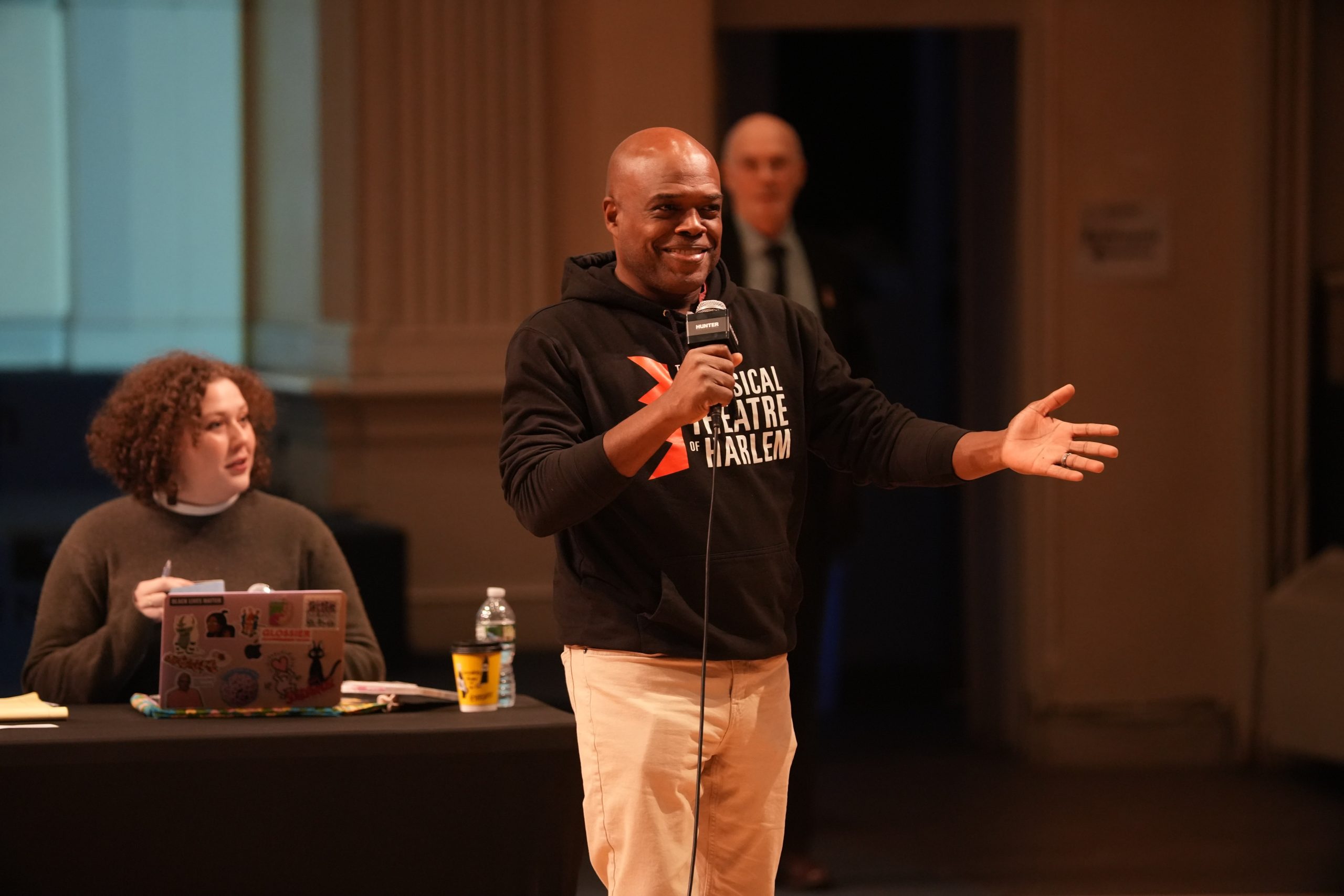

On Saturday, January 24, 529 NY artists and arts workers were signed up for We The People: Assembly of New York Artists, an event organized by The Hunter College Office of the Arts. Then came the blizzard. Remarkably, on Monday, January 26, over 200 people came together at Danspace Project in St. Mark’s Church in-the-Bowery to share their ideas for how the arts might better flourish.
Before the event, Talia Corren sat down with Office of the Arts Executive Director Gregory Mosher and one of the co-producers of the event Theresa Buchheister to talk about the goals of the event. On the other side of it all, we wanted to ask some folks that attended about their experience, as we all take our next steps forward together.
So many people were able to speak and be heard at the assembly; from lifelong New Yorkers to immigrants from all over the world to people who moved to New York City from another state; from artists who have been creating for over 60 years to artists who have been doing it for 20 and want to do it for at least 20 more to artists who are freshly out of college and even high school; from installation artists to dancers to theater artists to educators to translators to musicians to people who run organizations; from people who fit their creativity around their income-generating obligations to those whose income stems entirely from their art-making.
The coming together was moving and inspiring while also filled with anger and worry. Here are some of the observations from attendees.

RANDI BERRY
Executive Director of IndieSpace and theater-maker | What was the most resonant refrain or theme you heard on Monday?
The need for affordable spaces for living, creating and performing really stuck out as the highest need. What we’ve seen from our work, providing space has a multiplying effect. When space costs go down, payment and wages to artists go up.
Was there one suggested concrete action that stood out to you?
I feel strongly that portable benefits need to be rolled out to support the growing number of gig workers in the field. We need to prioritize affordable housing for artists who are often easily dismissed from affordable housing lotteries because of their fluctuating income and large number of 1099s and W2s. And many artists discussed the use of public spaces. I suggest the city can create a more comprehensive tool to track public spaces and available community facilities spaces, that is searchable by artists, with contact information for outreach. This would also create an avenue for the City to be sure property owners are making the public spaces available as intended.
If you could ask for one thing from the Mamdani administration to support artists thriving in NYC, what would it be?
To work together with service organizations and the real estate community to carve out new, affordable spaces for artists (and social service not for profits) in any and every new development in the city.
MARISELA GRAJEDA GONZALEZ | working class actor
What was the most resonant refrain or theme you heard on Monday?
I think my interpretation of what was said on Monday was that people want more opportunities! They want more possibility for themselves and people like them. They want opportunities to succeed, to fail, to belong. Often possibility comes in the form of money, so money and financial barriers were discussed at length. And rightly so, but I think that money is only the face of the problem and underneath money is a system that is deeply embedded; a system that has benefitted a select group and that group has a really hard time imagining another way to do things.
Was there one suggested concrete action that stood out to you?
I think the suggestion of letting artists use vacant spaces is a really good action. As well as the suggestion to create more artist housing complexes like Westbeth. Real estate is a pervasive issue in NYC and one that affects artists a great deal. If I may plug my own suggestion, which was the need for mental health support for working class artists. There are some excellent resources in NYC for affordable and sometimes free mental health care. But I think you need insurance, so that’s a barrier. There are also clinics that focus on working with artists. I think we need many more of those and we need to make sure people can access those facilities and that they know about them. I also think artistic institutions need to always take the mental health of the artists working for them into account. And they need to provide the support, the environment and the care that each artist needs to do their best work. I don’t think OSHA has ever considered mental health when evaluating an institution for its occupational safety and I think it’s time that it becomes part of the mandate for safety. I think there’s an opportunity to meld some of these ideas like having mental health care available in the artist housing that gets created. (I know I’m aiming high.)
If you could ask for one thing from the Mamdani administration to support artists thriving in NYC, what would it be?
This is a tough question to answer because there are so many things! But I think that fixing the subway would alleviate an infinite number of other issues New Yorkers face. As artists we are usually working several jobs at once, artistic and non artistic gigs, and our ability to maintain this balancing act is vital to sustaining our lives here. When we cannot reliably be where we need to be, the detrimental effects of that can snowball very quickly. Obviously it’s not great that we have to work so many gigs, but many of us have become very adept at it and we even thrive under these conditions. Please don’t mistake this as a plug for hustle culture. F$#% that. What I’m saying is sometimes we really enjoy all of the things we’re doing and as artists the stimulation of all the parts of our lives can be inspiring and sustaining. And since it’s already really obvious that we need to do something about the disgusting economic stratification in our society, I want to point to something less obvious but supremely vital; THE SUBWAY!! Fix the damn subway!!! That’s what I want to say. If you truly care about working class people, artists and non artists, FIX THE DAMN SUBWAY!!!!!!!!!!
DAVID KING | interdisciplinary artist, educator, facilitator, advocate and advisor
What was the most resonant refrain or theme you heard on Monday?
Generally speaking, what stood out is that artists are invested in New York City as their home, their muse, and place of work. Ultimately, regardless of place of origin, many folks choose this place and want to build a life here. The role of the government can truly be to make a way for a swath of hardworking, creative folks to have full lives here.
Was there one suggested concrete action that stood out to you?
There was mention from someone working at a university about ways we can democratize and open access to collegiate and vocational opportunities through mentorship, internships, and networking events. Expanding the pathway to professional opportunities for working class New Yorkers is always worth exploring.
If you could ask for one thing from the Mamdani administration to support artists thriving in NYC, what would it be?
Beyond one thing, I’d ask Mayor Mamdani to support the development of cultural venues and community centers as viable “third spaces” for youth and families in all five boroughs; on-time payment to freelance artists, arts educators, and community-based organizations enforced by municipal policies (and incentives, if necessary); inviting arts and culture workers to take part in addressing accessibility via urban planning and design throughout the city.
GAGARIN | performer, writer, mover
What was the most resonant refrain or theme you heard on Monday?
We need to resurrect an arts world that has the resources to promote collaboration over competition. I kept hearing that artists feel isolated from constantly battling with an increasing scarcity of space and time. Not having enough time to make their art because of the demands to just survive in the city; and there never being enough space for people to create in.
Was there one suggested concrete action that stood out to you?
Someone suggested repurposing the internal rooms in the empty skyscrapers that are not suitable for apartments as theatres and studio spaces. They provide an excellent amenity for residents of the building and would help immensely in addressing the need for space.
If you could ask for one thing from the Mamdani administration to support artists thriving in NYC, what would it be?
Open city run versatile performance spaces that offer free programming like The Tank; not only would they offer needed space for creatives to share their work but tickets could be sold at an accessible price to bring theatre to people at all class levels. These spaces could also sponsor residency periods focused on young career growth and collaboration to help build and establish New York’s generations of artists!
NOA WEISS | dancer and choreographer
What was the most resonant refrain or theme you heard on Monday?
Almost everyone agrees that the unsustainable cost of rent and healthcare in this city is one of the biggest obstacles to making art.
Was there one suggested concrete action that stood out to you?
I love the idea of using windowless office spaces or other corporate real estate as blackbox theaters. If those buildings can’t be re-zoned as housing, at least they can be put to use by artists who want them!
If you could ask for one thing from the Mamdani administration to support artists thriving in NYC, what would it be?
Healthcare subsidies. Not just for artists, but for everyone who is trying to make a living wage in NYC.
Here’s what I shared at the assembly:
I think the field would be better if artists were the highest paid workers at arts institutions. I’ve worked at dance non-profits for the past 5 years and I am already making more money than the professors who trained me and the artists I look up to. I don’t think an organization can say it serves artists if the Executive Director is making $800k a year while the people who perform on their stage have to choose between a career in dance or having health insurance. I want to dance, and make performances, and I want to be a dance writer and critic. But if I try to do those things full-time, I won’t be able to afford my rent or healthcare. Most full-time arts administrators don’t have to choose between their work and their wellbeing. Most full-time artists have to make that decision every day. I’m hoping we have the power to change that. With my remaining time, I’d like to say: hire a trans person before you offer the job to anyone else. You’ll have so much more fun.

Subways that work. Spaces to create. Spaces to live. Healthcare for bodies and minds. Opportunities to come together. Getting paid on time. That is not too much to ask. It is hard to ask for things from a world that seems at best to favor the rich and at worst seems to actively hate you. But there is hope because we are still finding ways to make our work despite the challenges stacked against us; because we are still finding space to gather and create despite how ephemeral these spaces turn out to be. There is possibility because we create possibility in every story, play, concert, painting, and poem. We feel it somewhere deep and know what we are capable of creating the world we need. In fact, we are doing it all the time, and we are asking you to join us.

Thank you to Susie Sainsbury and the Gilman Foundation, The Hunter College Office of the Arts, Danspace Project, ART-NY, Indie Space, Community Change Action and NYC Arts in Education Round Table for your support, in the past, present and future.
Follow We the People at @workingclassartistsforum and the Office of the Arts at @artsathunter.
Leave a Reply