
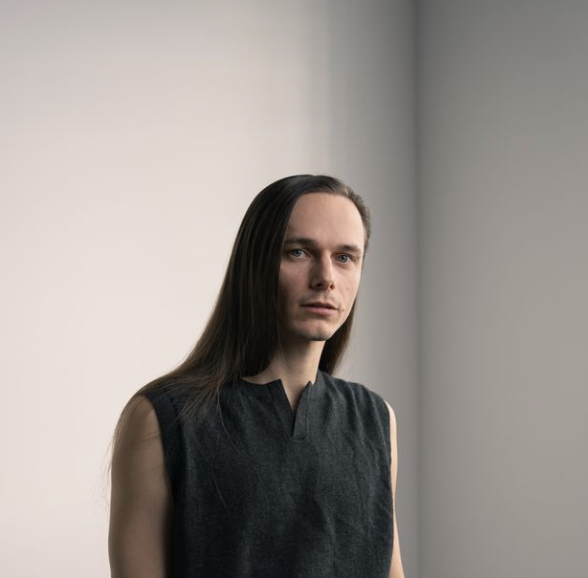
On one of the coldest days of the New Year thus far, I arrived in the warehouse-like district of East Williamsburg where Carvalho, the contemporary art gallery, is located. Standing amongst the crowd who braved the cold, I watched choreographer and contemporary dancer, Etay Axelroad perform Heron, a performance piece created in collaboration with visual artist Guillaume Linard Osorio.
I am new to writing about dance and performance. After attending CULTUREBOT’s recent conversation with Marina Harss, I felt inspired to wade into these waters. I was here at the suggestion of CULTUREBOT’S Editor, Eve Bromberg, who pointed me in the direction of Carvalho’s fourth installment of their acclaimed performance series. The gallery’s positioning of dance felt like an approachable entry point for this kind of writing. This is how I found myself at Carvalho that Friday night in early February.
After the performance, Etay and I corresponded over email about the performance and their collaboration with Osorio. Among other topics, we discussed questions around the political potential of dance, his response to Osorio’s work, and the larger political context in which this work was being witnessed.
Our conversation has been edited for both length and clarity.
Thomas Mar Wee: I want to start by acknowledging both of our contexts. When researching your piece Heron, I saw mention of your connection to Israel, both that you spent time there and were a member of the IDF. Some bios identify you as an Israeli artist. Generally, I consider myself aligned with the American left and agree with the position that the events in Gaza perpetuated by the Israeli government constitute a genocide.
I wanted to give you a sense of the context in which I encountered your piece and what I brought with me to Carvalho. At other times this aspect of your background might feel less pertinent, but these are not exactly usual times we are living in and these facts of your biography feel more salient now.
I wonder what you might say to people like me who are coming to encounter your work from a perspective like mine?
Etay Axelroad: I appreciate you naming the context you brought to the space, and I don’t take that lightly. I understand why, especially at this moment, facts of biography come sharply into focus that might otherwise recede.
My relationship to Israel, including my time living there and my compulsory military service, is part of my history, but it is not a position statement. It is something I continue to reckon with as a human, rather than seek to resolve through my work or ask an audience to reconcile on my behalf. I do not expect the work to neutralize these tensions, just as I do not expect viewers to set aside their perspectives when they enter the room.
What I can say is that Heron is not an attempt to speak about geopolitical events, nor to formalize violence or trauma. The work emerges from a long commitment to listening—to sensation, to fatigue, to restraint, to responsiveness—and to asking what it means to stay present inside complexity without collapsing the work into narrative or ideology.
I know that viewers encounter the work from their own position. I don’t ask for agreement or absolution. Instead, I invite a form of presence that resists simplification. I ask that the work be met where it lives: in the body, in time, in attention. If the work incites questions, that feels right to me, especially now.
TMW: Do you see this piece, Heron, as being a political work? Do you see Gaga, or dance more broadly, as being inherently political?
EA: On a superficial level, Heron is not political. It doesn’t address governance, policy, or specific conflicts. But if we consider politics more deeply—as the dynamics of power, force, negotiation, resistance, and coexistence—then the work inevitably enters that territory.
My movement methodology, which stands as the foundation of all my creations, investigates how forces operate: dominance and yielding, containment and expansion, agency and constraint. These are physical realities of movement, and they are also philosophical ones. These dynamics mirror how power circulates, not only between people or institutions, but within a body, a space, a moment. The work isn’t political because it makes a claim. It’s political because it stays with tension that cannot be resolved. Already that kind of attention pushes against simplified ways of understanding power.
TMW: Is this work—I found some of the movements to have an unsettling, almost alien-like quality, there were quite a lot of positions that appeared physically painful a response at all to the political/cultural/material conditions we are living in now?
EA: The qualities you identify are not designed as direct responses to current events. They come from lived experience.
In Heron, I don’t seek to aestheticize pain. I allow the body to speak from a place that knows how to exist within pressure and heightened sensitivity. The strangeness of the movement reflects how normalized these states can become—how the body adapts in order to remain present.
That experience is inseparable from the conditions created by Guillaume Linard Osorio’s sculpture installation. This structure is not a neutral backdrop; it actively and persistently shapes movement. Its scale, weight, suspension, and luminosity introduce forces that the body must negotiate rather than control. Certain positions emerge not because they are expressive choices, but because they are the most honest responses to the installation’s material reality.
The collaboration between us is built on this negotiation. The sculpture imposes constraints, but it also offers support, shelter, and resistance. My movement doesn’t illustrate the installation, and the installation doesn’t frame the dance. They meet in a shared field of forces. If the work feels unsettling, it’s not because it seeks shock, but because it refuses comfort as a default. It stays with what the body already knows when it’s asked to adapt, yield, and endure.
TMW: I want to talk a bit about your relationship with Gaga, and the choreographer Ohad Naharin. My understanding is that his influence looms large in the world of contemporary dance. Do you consider yourself in his direct lineage? Where would you say your philosophy around Gaga, and dance more broadly, align or differ?
EA: Gaga was an important influence in how I learned to listen to the body, particularly in prioritizing sensation, imagination, and internal experience over external form. It offered a framework for trusting physical intelligence rather than dictating a predetermined framing.
At the same time, my own movement methodology grew into something distinct. It is a post-contemporary vocabulary and the core of my research, creation, and educational work. I think of dance as similar to language: it’s composed of dialects that can intermingle to form complex articulations. My work actively cultivates that hybridity by synthesizing practices I have engaged with many dance forms over many years including martial arts, Feldenkrais, meditation, Gaga, classical ballet, contemporary techniques, and urban forms such as popping, krumping, and voguing. What emerges is not a style, but a relational practice.
A key distinction in my practice is the way physical work is inseparable from social and communal presence. It is not only about the flow of a class or the continuity of movement. It is frequently interrupted by conversation, reflection, and verbal exchange. We move between physical and conceptual registers—dipping in and out of modes of attention. It acknowledges that bodies do not move in isolation, and that awareness is shaped collectively as much as individually.
TMW: What can dance provide in unstable, violent times? Put another way, why dance, now?
EA: Dance remains one of the few spaces where complexity does not require resolution. We live in a moment that fuels constant positioning and instant interpretation. Dance offers something else: duration, ambiguity, and presence, all without conclusion.
To dance now is to insist on attention—not as the antithesis of distraction, but as a responsibility. It asks both performer and audience to stay with sensation and uncertainty, with states that don’t translate easily into absolutes. In unstable times, that kind of sustained presence feels essential—never indulgent. Dance trains a way of being with what is uncomfortable without turning away. That, for me, is its urgency.
TMW: In preparing for this interview I was looking you up online, to try and find your descriptions of your own practice in your own words. I found one quote on your website: “Dance is full of life, movement, music, games, it is inside of us and outside of us, you can never be wrong when dancing, it connects our mind and awareness to our bodies.” I wanted to probe this statement a bit, especially the assertion that one can “never be wrong when dancing.” To me, I interpret this as saying that dance is, at the very least, always a morally neutral act. Could you speak further about what you mean by this?
EA: When I say that you can “never be wrong when dancing,” I don’t mean that dance is morally neutral, or that anything done through the body is automatically justified.
What I mean is that sensation itself cannot be incorrect. The body does not lie about what it feels. In that sense, dance offers an encounter with truth rather than correctness. You can misrepresent, manipulate, or instrumentalize dance, but the act of listening to the body, of responding honestly to what is present, is not about being right or wrong. Inherently, dance invites responsibility. It is not an escape, but rather a way of becoming more accountable to what is happening, internally and externally, in real time.
TMW: Perhaps it is my own inclination as a writer, as a student of narrative, but I found myself creating a scaffolding of narrative in Heron. Primarily, I tracked how you moved vertically through space, on Guillaume’s suspended structure—sliding down or running up its surfaces. Is there an arc/narrative or emotional that you were conscious of in creating this piece with Guillaume?
EA: In Heron, narrative is not constructed in the traditional sense. However, there is an experiential arc. Repeated movements along and across the sculpture reflect shifts in effort, attention, and relation to gravity, and support. Those transitions track changes in state rather than story. The installation’s verticality constantly renegotiates risk and trust in the structure, in the body, in time itself. If there is an arc, it is not about arrival or resolution. It is about how perception changes as the body experiences different conditions.
TMW: Is there anything else you would like to add, in your own words, about this piece, its staging at a gallery in collaboration with a visual artist, or anything else?
EA: What feels most important to address is the nature of this collaboration itself at Carvalho. Heron is the first work in which I entered a fully equal collaboration with a visual artist—not as a commission in which disciplines are layered onto one another, but as a shared process of learning and unlearning.
The collaboration with Guillaume unfolded over two years as a deep, personal exchange. He attended my dance classes; and I spent time in his studio and institutional exhibitions, where I encountered his installations not as finished objects but as evolving propositions.
Here both choreography and installation grew in parallel, rather than by predetermined roles. The process allowed both disciplines to meet as equals—each retaining its own integrity while continuously imprinting on one another. The installation did not simply host the dance, and the dance did not animate the sculpture. Instead, they negotiated space, force, and time together, producing something that neither of us could have arrived at otherwise.
The role of the gallery is also crucial. This project could only exist within a context that genuinely understands both visual and performing practices. Gallery founder Jennifer Carvalho’s background as a ballet dancer, alongside her work as a gallerist, creates a rare curatorial intelligence—one that recognizes performance not as an event, but as a fundamental mode of inquiry. In that sense, Heron is not only a work about relation. It is the result of relation, sustained over time.
Photo credit: Quinn Wharton. Courtesy of CARVALHO New York.
Leave a Reply