
The Exponential Festival has expanded, well, exponentially since its founding in 2016 by high priest of the avant-garde Theresa Buchheister, with 24 shows happening across 9 Brooklyn venues during this year’s lineup of the monthlong festival. While no longer acting as Artistic Director of Exponential (this year’s festival was spearheaded by Co-Directors Nurit Chinn and Bailey Williams and Producing Director Nic Adams), Buchheister was still a vibrant and frequent face this festival season. By their estimation, during the time of this interview, they had seen a whopping 27 shows across the January festivals, out of a total 35 planned events. Meanwhile, within Exponential, audiences had the chance to see not one, but two performances by downtown darling Pete Simpson: as a narrator-bird-man (among other park dwellers) in Nurit Chinn’s existential meet-cute Godbird and a swimmer in Amanda Horowitz’ beguiling Fashion.
Both Simpson and Buchheister have been pillars of the downtown performance community, and in the course of our 1hr+ conversation near the end of the festival, surprising similarities emerged. Both arrived in New York City, in the words of Buchheister, “not from any of the coasts”: Simpson from Wyoming, and Buchheister from Kansas. Both speak fondly of formative early experiences with titans of experimental theatre: Buchheister moved to NYC to intern at Richard Foreman’s Ontological-Hysteric Theatre before becoming a key figure at DIY-venue Silent Barn, co-founding theatre company Title:Point and venue Vital Joint, and an Obie-winning tenure as Artistic Director of The Brick, while Simpson got his start in Richard Maxwell’s New York City Players along with a decades-long artistic home as a member of Blue Man Group (which recently ended their 34-year run in NYC). Over the course of his Obie Award-winning career (2017 Award for Sustained Excellence of Performance), Simpson has performed in pieces from just about everyone and everywhere, from Broadway to Off to Off-Off, equally at home in the works of long-running ensemble companies like Elevator Repair Service and Wooster Group to writers like Young Jean Lee and Annie Baker, to name just a few.
The above list of names does a woefully inadequate job of conveying the sheer number of hats each has worn over the years. In addition to their extensive bona fides, both have contributed ample time, energy, and resources to supporting the next generation of artists, from teaching students to running independent venues to continuously performing in works by exciting up-and-comers. Despite both of their prolific involvement in the performing arts, neither had formally met before our chat. To close out my coverage of this year’s Exponential Festival, I brought the busiest audience member and the busiest actor together on a bitterly cold February morning to talk giddiness, Richard (Foreman and Maxwell), and audacity vs. ego.
Note: The following conversation has been edited for length and clarity.
 Theresa in Blood Polaroid, a Title:Point film | Photo credit Joy Burklund
 Photo credit Matthew Stocke
Ethan Karas: From the outside, both of you seem like theater makers motivated by enthusiasm, joy, or excitement. Does that feel true to you? What gets you out of bed in the morning, what excites you about continuing? You both have worn so many different hats over decades. What continues to excite you?
Pete Simpson: Giddiness. I wanna be giddy around a particular group of people- this feeling of a potentiality that’s both dangerous and fun and all these things. I’m less likely to get morose and crazy and dark in my art, I guess? I went to see this Herman Nitsch retrospective, I was like, “Wow, I appreciate it, but I would never do this stuff, you know?” (laughs)
Theresa Buchheister: You know, I’ve never met you [Pete] for real, but I’ve seen you in plenty of shows, and I think your [Ethan] instinct for saying I should talk to the two of you is maybe rooted in a vibe that we both have. Because I’m from Kansas.
Pete: Oh, nice.
Theresa: So also like, not from like the intelligentsia of the East Coast or any of the coasts. Like, when I worked at The Strand, there was this dude, Ira, who’d always be like, “The only places that matter are Paris and New York City.” And I was like, “Fuck you, Ira.” (laughs)
Pete: You run into a wall of that. You really do.
Theresa: With my theater company, [Title:Point], our work is incredibly violent and dark, but it’s hilarious. It’s slapstick, it’s stupid. I couldn’t live in the darkness all the time. I have to be able to puncture it, make it idiotic, make it a lazzi, you know? But I think that allows it to go to darker places than some of the shows that are dramas. I wanna have a good time, and I wanna do it with people that I like. I moved here to do a Richard Foreman show, The Gods Are Pounding My Head! I didn’t know that you could audition and stuff. I had just written a letter to Foreman and asked to be an intern, but then I got to be a dwarf because he fired someone.
So that was my first year, and I was spoiled by it. I couldn’t imagine working with people that I didn’t care about or respect. I don’t wanna deal with people that I don’t care about who aren’t doing things that I’m interested in. And so that really dictated the path for me, and why I’d rather do shows at Silent Barn in a DIY music venue than try to speak a language that I don’t speak in order to get into these places that I don’t have access to.
Obligation gets me out of bed. It’s very helpful. But I like to be obligated to people I care about because that’s even more helpful. You know me, I’ll give away ideas because there are too many for me to possibly do in this lifetime. So the day that I run out of ideas, the day that I’m bored, the day that I don’t see something that surprises or inspires me, then I’ll be shocked.
Pete: I had a similar experience coming into New York. I just didn’t understand what I was getting into, and I think it made me refreshing for people. When we were touring [with Richard Maxwell], I was seated next to him on the plane. I was so intimidated, and I was talking about my angst- I wanted to make this horror film, and I felt like a silly idiot doing it, and I said I should just be focusing on theater. But he leaned over and said, “Pete, you gotta radicalize your idiosyncrasy.”
That has been my bumper sticker for everything. Like, the particularities of you, no person is born the same. You’re gonna see this world in so many twisted compartmental ways, and don’t be afraid of it. Double down on it, you know, radicalize and make it something actionable and push it out into the universe.
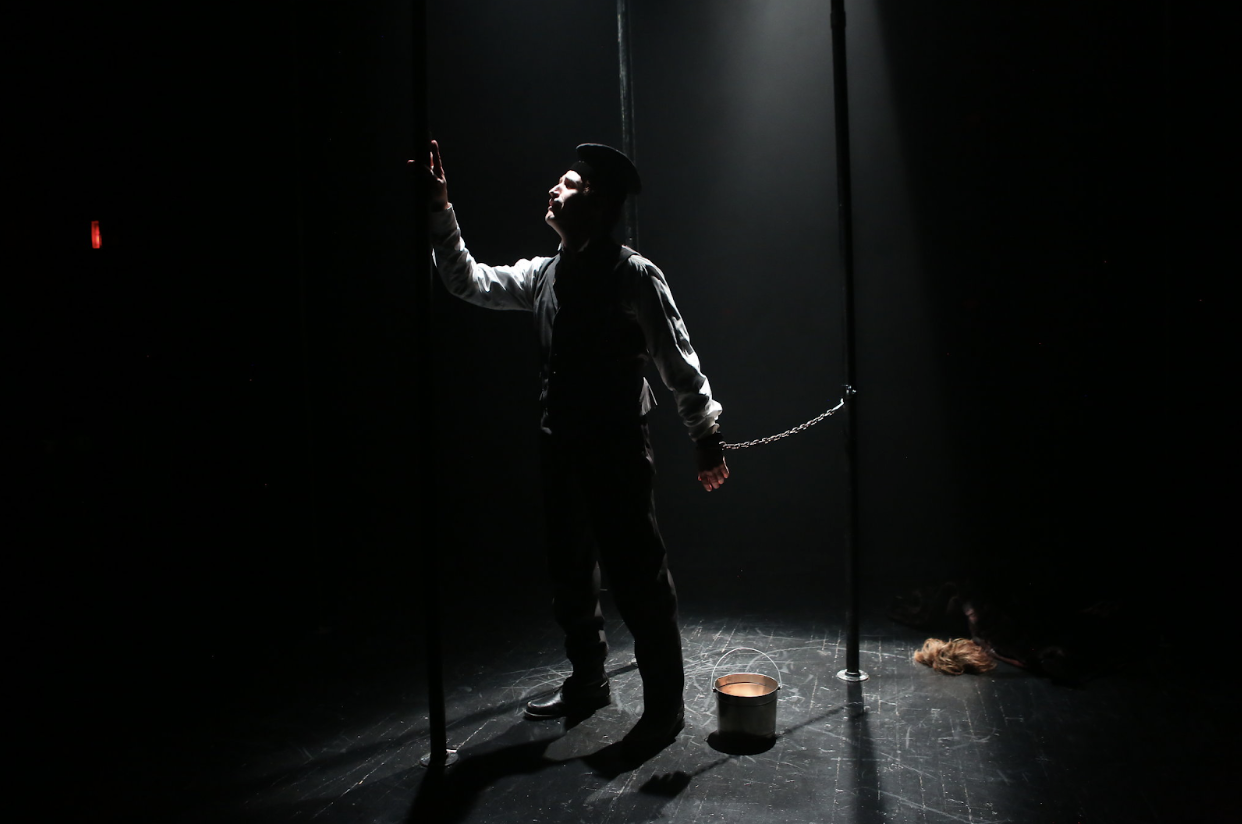
 Pete in Julia Jarcho’s The Terrifying | Photo credit Marina McClure
Ethan: You both are getting at this naivete carrying you further than you would’ve expected, especially when you’re first starting out. And I think for people who may be reading this, you both can appear as people who “have it all”: working with extremely interesting and innovative people, and you yourself being interesting and innovative people. Were there moments where you felt like your enthusiasm or your giddiness were really tested? Where do you get the spirit for that?
Theresa: Well, for me, I genuinely care about it, and I think that when I moved here, I was very competitive because I was also told as a kid growing up that my sister was the beautiful one, and I was the smart one. It was a very William Inge kind of situation, and so, to me, to be smart was everything. I had no context for the levels of intelligence I would encounter, but I was like, I need to be smart. It made me deeply competitive, and then I was also a very hurt person, so it seemed interesting to be cold and never cry, never seem affected by anything. And I think I aged out of that. I think I would’ve been really strangled by the pursuit of validation if it had continued to be a thing that mattered to me, but probably around 22, it just left. But you know, my feelings still get hurt from time to time. I think that’s also okay, ‘cause my feelings get hurt because I care, not because I’m not getting something I think I deserve.
Pete: It was almost sort of like a monastic commitment to just following the momentum of this performing energy wherever it went, at the expense of some relationships. Since settling down, I’ve actually now worked harder and more intensely since the birth of my kid. It’s ironic.
I always had this thing of like, “people perform for joy or for revenge or some combination thereof.” I mean revenge like the unresolved issues in a life, the unreconciled pains, and there’s a place to put all that. There’s plenty of that fuel for me, and that’s growing up with parents I fucking adore. They started a theater company. It’s still there. My dad’s 95. My mom’s 86. This theater company still exists. They’re still doing it. But there was a civic involvement, a codified way to be an important contributor to society, and acting was…you know, it’s not in there. So, part of me always had a shame of exhibition even as I’m ambitiously eating it, you know?
Every sort of canister in the fuel are all valid, and that’s still one of them. Less so, and that’s one wonderful thing about maturing: you don’t have to identify with all these things that propel you. You can just use the energy of them. It’s like watching a really good Rube Goldberg machine. I don’t want it to interrupt metaphysical inevitabilities and causalities. I don’t wanna sit there and go like, “no, I shouldn’t do that,” even as the energy is directly telling me the opposite. I would feel like some grand machine has been halted. I want to be a moving piece in this, I don’t wanna pull myself out disingenuously. But there are survival costs to this, especially when you have kids in tow. I’ve had my moments of, “fuck, I gotta do something different, get a full-time something or other.” But right when I’m thinking that, I get an email with a script attached. (laughs)
Ethan: Just when you think you’re out, they pull you back in! You both have been saying something similar, which is that the thing that gets you outta bed is obligation. And while obviously it’s not like being a lawyer in Wyoming, I would argue you’re both key pillars of this community of downtown theater.
Pete: You can bandy around that term community very easily. When you’re in a corporate culture, “community” can be this very disingenuous, managerial shorthand for something that doesn’t actually exist. You know it when you feel it.
Ethan: What does an actual community feel like to you, especially now when it feels like that’s scarcer?
Theresa: I can recognize hollow people and hollow words much more easily now. [Richard] Foreman would talk about “paper-thin people” and “pancake people,” these sorts of representations of things. I have a visceral reaction to the pretend version of community and the pretend version of love and admiration and care. I cry when I am around the real thing, you know? When a structure goes away, like a space or a job or even a state, and the community persists. The transactional aspect of things is removed, and there’s still something there; it’s magical. It’s not that those things have to be removed in order to test it; they just do get removed by existence, you know?
Pete: I remember sitting [with The Blue Man Group], there were only a few blue people in the world at that point. So we’re in this room with their founders, and I noticed that the founders put in their Playbill- they could have put down all their various achievements, but it just says, “Matt Goldman created Blue Man with his friends.” That’s all, one sentence.
 Theresa’s headshots they moved to NYC with circa 2004
Ethan: It feels tough to be able to have the gumption to move across the country or to make this piece of downtown theater that requires a certain amount of ego to be like, “I have something to say,” but then to balance it with humility-
Theresa: Could it be audacity instead of ego?
Ethan: What do you feel is the wedge between those things?
Theresa: Certainly, I look back at the audacity that I had as a young person, but because I was very audacious, I didn’t view it as that. I didn’t think that that’s what was going on. But I worked at the Drama Book Shop, and I could do stuff in the basement after it closed. But then I had the audacity to, on the Drama Book Shop computer, because I didn’t have a home computer, email The Living Theater’s email address and invite Judith Malina and Hanon Reznikov to the show. And within minutes, Hanon had responded being like, “yeah, come over, you can come over to the apartment, have a burrito.” And there’s no reason they should have responded to me. There’s no reason I should have thought that reaching out to them would result in anything. But I was just like, “yeah, but I’m gonna email them.” And it wasn’t ego, it was audacity, you know? And then that was a real beautiful relationship until both of them passed.
Ethan: As part of your practices, you’re both teachers and educators. Do you feel like that interaction with younger generations impacts you at all?
Theresa: I enjoy it. I will say in New York, I’ve always had community around me of all ages. I was just telling a friend who’s in their twenties, when you get to be in your forties, you get to have friends that are older than you by twenty years and younger than you by twenty years. It’s sort of fascinating. Teaching at the University of Kansas, the dynamic shifts a little bit.
I loved being in class with them. We did a lot of cool stuff. I love directing the show. But (I don’t know if this is the same way everywhere) there was no real curiosity outside of the classroom, and I was always like, “isn’t there something more though? don’t you wanna talk about stuff?” But the space is not set up for that. There’s no green room there anymore. There’s no smoking porch. You can’t even smoke on campus, which is, you know, it’s fine. (laughs) But the ability for people to engage in the in-between spaces, the third spaces of the university, didn’t really exist there for me. It really bummed me out because the conversation would just end, and then I would pick it back up every time that we were back in the room together. We did a lot of exciting work in the room, but it didn’t bleed out of the room in any ways that I could perceive, and that sort of bummed me out.
Pete: There’s so much craziness in the role reversal. Walking into a room as a de facto elder statesman, it’s a very weird feeling, but with my classes, I tend to bring the same performative commitment. It’s almost like I’m making a pitch for a core energy that I believe exists in the world. It’s a spectrum. You have to put on the right glasses to see it, and if somehow I do this class right, they’re all gonna see it, and they’ll be able to tap into it. It’ll be palpable. In some cases, there are some that already feel this bandwidth, and I’m nurturing it, and I want to enable it. And I get the great pleasure of seeing students out in the world doing it.
I always try to find an application of creative impulse and performative energy in everything you do, whatever you do. I had nine Economy majors in the last class. No one’s going to become a downtown artist or whatever. But you do feel, and I know you feel this is palpable, that their time has shifted their perspective about something. You like to flatter yourself that there’s a paradigmatic tilt in how they see stuff if you’re doing it right.
I always say at the very beginning, this is it…just impressing upon them this unrepeatable act of us being together, treat it with great value…and great sacredness.
Theresa Buchheister (they/them) is an artistic director, curator, venue operator, theater maker and voiceover artist. Theresa was in NY from 2004-2024 and during that time founded a few projects: Title:Point (experimental theater company), The Exponential Festival (January Brooklyn-based experimental art festival), Vital Joint (weird basement venue for alt comedy, music and durational performance), ?!:New Works (short form festival with different split bills every night for as many nights as possible) and SalOn! (gathering of theater people, dancers, poets, musicians, chefs, scientists, doctors, activists, lawyers, freaks and other). They also received an OBIE for their time as artistic director of The Brick Theater and Brick Aux, was a collective member of DIY venue Silent Barn, was a frequent collaborator of Jeff Stark, Night Market and Secret Parks, performed in Richard Foreman’s The Gods are Pounding My Head, was a manager at a bunch of bookstores and has directed lots of audiobooks, cartoons and podcasts.
Pete Simpson is a long time NYC-based performer/writer/educator w/ particular concentration in the experimental/avant garde theater. Pete has appeared on Broadway, Off/Off-Off Broadway, regionally and around the world in multiple principal roles w/ a wide span of companies/directors/writers/choreographers including Elevator Repair Service, the Wooster Group, Young Jean Lee, Richard Maxwell, Richard Foreman, Big Dance Theater, Half Straddle, Julia Jarcho, Will Eno, Annie Baker, Susan Marshall and others while maintaining his nearly 3-decade, 5,000 performance run with the Blue Man Group. Pete was recognized w/ a 2017 Obie Award for Sustained Excellence of Performance and currently serves as adjunct professor in devised theater and movement at NYU and Harvard University.
Leave a Reply