
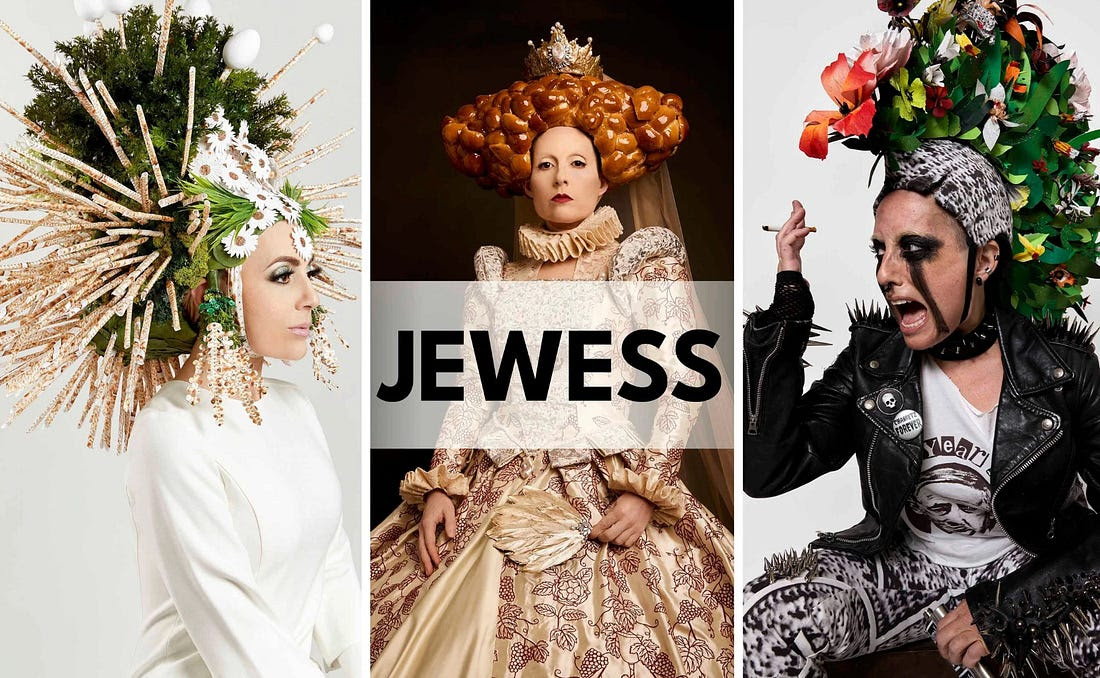
I learned of the work of Danielle Durchslag from an email sent to me by Lucien Zayan, a beloved Brooklyn fixture and the well respected gallerist behind The Invisible Dog Gallery, who happens to be the man responsible for my bat mitzvah party some fifteen (eek!) years ago. How fitting that a conversation with Durchslag’s on her exhibit Jewess, a show surrounding questions of Judaism and womanhood and her largest solo exhibit to date, should stem from a bat mitzvah. Jewess, a multi-genre exhibition spanning photography, video, and live performance, stages three female Jewish characters as costume drama and political pageant: a Sabbath Queen with monarchist hauteur, a Passover Punk as Passover’s Angel of Death, and Taylor Bonnet, a mid-century doyenne made in the image of Elizabeth Taylor. Here, Durchslag presents familiar cultural references through a Jewish lens, asking what it means to stretch and contend through reexamination and ask questions like: What counts as Jewish ritual? Who gets to define allegiance? Is laughter a means to diffuse the temperature of discourse without diminishing its stakes? Durchslag’s work asserts that glamour, grievance, dissent, and devotion are not mutually exclusive responses, but instead, materials– like a matzah-wrapped straws (see more below!)– available for use and reassembly. What emerges from our conversation is not so much a thesis as an ethos: Jewishness as argument, as play, as adornment; the gallery as a site not only of looking, but of contending. I, for one, was particularly enthralled by the character of Taylor Bonnet, whose identity, as a sight of denial and assimilation, evokes thoughts of other Jewish cultural figures like Jerome Robbins.
Durchslag and I spoke in early February about humor as an impetus for political analysis, the intricacy of creation, and the reclamation of Jewish glamour. Jewess, a co-production by La Mama Theater and The Invisible Dog– now in its second iteration as an itinerant gallery– opens March 13th.
This interview has been edited for length and clarity.
Danielle Durchslag: Besides reading your work, all I know about you is that you had your bat mitzvah at the Invisible Dog!
Eve Bromberg: [Laughs] Yes, it’s true! My family has known Lucien for years. He opened The Invisible Dog around the time of my bat mitzvah [May 22, 2010], and my mother happened to walk by one day and inquired about the space. We used the loft space on the second floor for the actual party. Because it was all one room, all of the adults complained about the music being too loud all night. Then my high school used the same space for prom years later. And even though we haven’t always been in touch over those years, he always remembers me for using that space when the gallery was just starting out. He’s such a special person.
DD: He’s so remarkable. I always referred to him as The Mayor of Bergen Street. All he had to do was stand outside, and whoever walked by he knew, or would know very soon.
EB: The other day a friend of mine referred to someone who was good at meeting people as being “sticky.” Lucien is like that. Well, I want to start, this isn’t even a question really, but, you know, I have read so many press releases, and yours is like the best written one I’ve ever read.
DD: Oh my gosh, thank you!
EB: I was amazed reading it. It really felt like a testament to how well you know your own work. I thought to myself I hope this woman is getting every grant, because I feel like this is what they want. Because you know your project so well and where it would be best suited in terms of discourse.
DD: You know, it’s a part of the job I actually love. Not every artist feels that way, and I’m not a writer. I don’t write books. I don’t think of myself as a writer first and foremost at all. But it’s a part of the process I really enjoy. Writing grant proposals and essays about the work, whatever it may be, helps me to learn and know the work as deeply as I want to. It’s a different part of your brain at work.
EB: Being able to write about or speak about your art is such a skill because you have to speak from outside of it while creating it.
DD: I always say trying to describe your work is like trying to describe a parent. No one knows your parents better than you, but you don’t know your parents outside of being parents.
EB: Before I ask where this project comes from, I wanted to start by asking what Jewess means to you? What does that term mean? Have you encountered it in your life? Why did you choose that word?
DD: Well it’s a word that, for some people, has a negative connotation. It’s considered, I would say, a kind of old fashioned term for a Jewish woman in our contemporary context. You don’t hear it bandied about, because of its negative connotations. But, one of the points of the show is to embrace discourse. Disagreement is one of my favorite aspects of Jewish life and Jewish culture, but in our present, very fraught moment, for understandable reasons, a thing that I’m proud of and embrace Jewishly has become very uncomfortable and hot to the touch. The divisions right now are so deep, and this show is really making an argument that, you know, that kind of difficult discourse is not only okay but necessary, and something to celebrate in Jewishness. And what I like about the word “Jewess” is it’s a little spicy, and a little challenging. People will have different relationships to it. It’s everything from the two leads in Broad City saying it to its various antisemitic historical references. So, much like the exhibition itself, I want this to be a place where people really consider their response to something, and also someone else’s response to the same thing. So, Jewess felt like an invitation to do that, if that makes sense.
EB: Can you tell me a bit about your background? Where did you grow up and where are you based now?
DD: I’m based in Brooklyn, but I’m speaking to you from an Airbnb in California. I’m originally from Chicago, and I grew up in a Jewish household that I could only describe lovingly as relentlessly Jewish. My mom became a rabbi in her 50s. My father owned one of the largest private collections of Haggadot in the world. The joke I tell audiences who are perhaps less Jewish-literate goes like this: There are three major forms of Jewishness: Lazy, hazy, crazy. I grew up hazy, but enthusiastically hazy. We went to a conservative shul. I come from a context very steeped in Jewishness, and I’ve been making art about this ancient, precious, demanding, at times infuriating, wonderful, tradition for many years now. The center of my art practice is about contending with Jewishness in both what I love about it and feel grateful about but also what I wish would change.
EB: What do you wish would change?
DD: I’m always advocating for a more inventive, progressive definition of allegiance in Jewish life. There’s a lot of tension, perhaps now more than most years, there’s a lot of tension around what counts. Who gets to say what counts. We, I think, can get really rigid in our camps of Jewishness. I don’t have Jewish children. I didn’t marry a Jew, but I consider myself passionately and centrally Jewish. Playing with and expanding that definition of Jewish allegiance is really central to my practice.
EB: When you say when you’re passionate about Judaism, are there like particular qualities that you find yourself repeatedly referencing?
DD: I try to make the work funny, and I do that for several reasons. One is, I honestly think that if we’re laughing, difficult discourse is just easier. That’s my experience, that laughter sort of lowers the temperature in a way very few other things do. And I consider being funny Jewishly allegiant. The Jewish relationship to joke, the Jewish relationship to humor, is so central to my work, and very inspiring to my work. You and I both know that walking into an art gallery is traditionally not associated with laughter, right? But I think there’s something about bringing, hopefully, if I do my job well, laughter into those spaces that feels to me almost anti-assimilationist. Why couldn’t this be a place where we laugh? So I’m passionate about a lot of aspects of Jewish life and Jewishness, but I will say, in my work, particularly, I’m always trying to bring in humor, because I think it’s one of the best parts about Jewish life, how committed we are to the funny,
EB: This piece explores three different experiences of or types of Judaism in the form of three characters: there’s a punk lefty, a right-wing monarch, and a mid-century Elizabeth Taylor-inspired figure. A woman who seems to distance herself from her Judaism. How would you describe the experience of playing these roles? You’re both in these roles, but also examining them at the same time in their categorization. And you may not hold these beliefs yourself. How do you explain that sort of tension? Is it present?
DD: I am a leftist, and do not identify as a Zionist, so while the show is definitely a community portrait, I can’t say I’m coming to it objectively. I ‘m coming at it from my own political values. Part of what I find so engaging about making this work is that I not only get to try on versions of Jewish political belief, but also versions of personalities. Those are my politics, what the Punk believes, but I’m not like her. I’m a nice middle-aged lady from Illinois. Playing The Sabbath Queen is me getting to embody a very right wing perspective. Part of why I make these women is because I think we can use play and fashion history to examine this discourse, not from a place of scarcity, but a place of enjoyment and abundance. That’s a big part of why I do this.
EB: In your exaggeration of all these characters, are you almost poking fun at political stridence?
DD: I don’t know if I’m poking fun at strident political stances, so much as I think every political stance can be funny, at least in theory. I think it’s more that I think each of these characters, like all of us, has her wisdom and her limitations and lives within the context of her reality. And I just find that in any character development, whether we’re writing for a screenplay or writing for this kind of project where I’m acting as these characters, one of the ways to find the funny is to go to the extreme corners of that character. So I’m doing that with all of them.
EB: Could you talk about the correlation between the specific fashion history moment and the character? What led you to make those connections?
DD: Do you mind if I step back and sort of talk about why I started making hats?
EB: Absolutely, please do.
DD: So, a friend of mine randomly, and I think it was in 2022 invited me to go to the Easter Parade. Have you ever been?
EB: No! I don’t think I’ve ever heard of it! Where is it?
DD: Right!? If I may say, as Jewish New Yorkers, the Easter Parade is not our usual space. It is a legendary parade of bonnets that occurs on Fifth Avenue. You may be familiar with the film Easter Parade, it’s a wonderful classic with Fred Astaire and Judy Garland. The phrase “I’m in my Easter bonnet” is from that movie. On paper, you would think this parade is a celebration of Christ that happens every spring, but actually, it’s this incredible showcase of creativity on people’s heads. People show up with objects on their heads that have nothing to do with religion. Their hats can explain or express their politics, identity, and playful stuff. During my first easter parade, it occurred to me that Easter and Passover almost always overlap. In the last century, I think there were only three or four times they didn’t. And here in New York, millions of people are celebrating Passover. Millions of people are celebrating Easter, but there’s no real visual or human crossover with those experiences. After the first time, I thought to myself, what if I come back here with the most Passover hat imaginable, because I knew the holidays would overlap again. I wondered if there would be space on Fifth Avenue for this sort of traditional, vaguely Christian event? I say vaguely because, as I said, it’s a lot of different forms of personal expression as headgear. And I wanted to do that in a way that was playful but also contended with some issues in Jewish life that interest me. Elizabeth Taylor immediately came to me as an inspiration. She converted when she married Eddie Fisher and while the union did not last, her Jewishness did, and she’s a famous and lauded hat wearer, known for her 1960s glamor, and ability to dazzle the room. I think about Elizabeth Taylor and these remarkable head pieces she wore, and I chose a very specific one that was made for her for the film Boom!
EB: That’s the piece with all the daisies and points sticking out?
DD: Yes, and larger than life, like she was. She’s a really interesting part of Jewish history to me. Here is someone we associate with her whiteness, beauty, glamor, and a kind of impossible perfection, especially at that heyday of her career. My Grandma Betty, of blessed memory, brought up the fact that Elizabeth Taylor and Marilyn Monroe converted to Judaism, most times I saw her growing up. There was this feeling growing up that like these glamorous women had chosen us, and I think there’s a lot there about assimilation, about whiteness, about belonging and passing, and so I thought she’s kind of the perfect vehicle to talk about those issues, but to do it in a way that’s fashion history forward, and playful. I had initially intended to just make the hat and wear it, but over the year of designing and fabricating, much to my surprise, I could just hear the voice of this woman in my head and it wasn’t my voice. I’m not an actress. I didn’t go to school for performing, but it just became clearer and clearer over the months of me bringing her to life, that this wasn’t me. I started to envision her as a sort of Upper East Side Doyen. She doesn’t define herself as political. She really steers clear of any fraught discourse in Jewish life, particularly discourse about Israel and Palestine. She’s someone who’s sort of committed to fabulousness in the way she asserts her Jewishness. I showed up to the parade really energetically, almost feeling like its host, which was an unusual approach to such a non-Jewish event. This woman in a very Jewish hat, sort of behaving as if she’s not only always belonged here, but it’s almost her domain. There was something about this impulse that felt really delicious to me. Tourists from all over the world show up to take photos of these hats, and that day I posed with dozens of people, but I also noticed there were many Jews there who were so excited to see a Jewish hat in that context. That hat has a seder plate on it, it’s not exactly subtle.
EB: The pieces that are coming out from it look like pirouette cookies made of matzah.
DD: One of the fascinating things about hat making, that I’ve learned over these years, is that a piece has to balance being visually substantial without being so heavy that it’ll break your neck. It’s a fun problem to solve! The original hat for Elizabeth Taylor is sort of like, festooned with these almost white, wiry pieces that are jutting out. And my version of that is matzah printed wrapping paper covered straws, dozens and dozens of them. Taylor’s hat inspired the first piece of Jewess. I had such an amazing time embodying her and owning Jewishness in this really unusual way. What do you think of when I say the words Jewish glamor?
EB: This isn’t even a question, but I was so amazed by this reference of Elizabeth Taylor, because I have a great affinity for the midcentury. Because I’m in theater school, and I know this is out of step with my generation, when asked who my favorite playwright is, I say Wendy Wasserstein, and oftentimes people don’t know who that is! There’s something about Judaism and the mid century in New York City. I think of people like Wendy Wasserstein or Jerome Robbins who on this– they’re not even really the same generation– quest to fit into Upper East Side patrician culture. I think it’s this tension, and wanting for difference, that is so fascinating, but I also feel like it’s not a particularly popular point of discourse, perhaps because of the apoliticality you mentioned. But there’s so much there, in the role of Jews in culture and the want to be erased.
DD: I’m always working to expand, blow up, and change what we count as Jewish history and what we count as a sacred object, right? When you think of a Jewish ritual object, most people think about Kiddush cups and menorahs, all that sort of stuff. But, could Elizabeth Taylor’s hat also be a Jewish ritual item? Why not? It’s a part. Did you happen to read Issac Mizrahi’s memoir? I love his work. He grew up in a yeshiva [traditional Jewish educational institution], and yet if you went there today, you would not know he ever existed there. There’s nothing that acknowledged him or his queerness. Something about that really injures me, that one of the great Jewish culture producers, in fashion and of all time, doesn’t get celebrated in a place where his Jewishness began. And so with Elizabeth Taylor, she’s such a symbol of American mid century sort of cinematic dominance and beauty and elegance. What does it mean to be all of those things and also a Jew? I think she belongs in that history just as much as some of the usual customers.
EB: Absolutely, that’s thrilling to think about, especially when you think the distinction between the shamata business and the fashion industry. There’s much to be said there. What is your fabrication process like? Do you have a background in fabricating? Do you have a visual art degree?
DD: My degree is in Art Education. I went to museum school after college, but I’ve been making visual art for 20-plus years. I’ve been a visual artist for a long time and have done a lot of different stuff from collage to performance work. I do not have a background in sewing. I do not have a background in dressmaking, and I do not have a background as a milliner. So I don’t sew the garments I design. I work with incredible collaborators at a place called flatiron tailors, who bring my designs to life. Outside of the creation of the base and the actual sewing, I try to do everything. So if it’s beaded, it’s hand beaded. If there is any kind of treatment to the fabric that can be done by hand, it’s done by hand. I try to do all the work by hand, because the pleasure of making these pieces is so acute for me. I love the repetitive, detailed hand work that goes into my projects. You know, each one of those straws for Taylor bonnet, to give you a sense, took me 15 minutes.
To make them I sewed clear, sort of like fishing wire through the straw in order to adhere to the paper and in a way that doesn’t add weight. I ended up using all of the straws I made.
EB: It’s like a physics experiment.
DD: For me, part of the joy of this work is it really is a more sophisticated, ambitious version of play as a kid. I know that’s a cliche where artists say, Oh, I get to play, but honestly, it is the closest I’ve come to what I used to do as a kid. I’ve always loved hats. As a kid, I would put on a big hat. There was a store in Chicago called Hats in the Belfry, and for a treat, I would go there with my mom, and they had these huge brimmed, kind of black hats. And I would put one of those on in my room and put on musical theater and dance around and pretend I was a starlet. This piece isn’t exactly that, but it has some of those elements. For Pesach Punk, for example, if you look carefully at that mohawk, it’s made of dozens of paper flowers and paper leaves as well that I’ve made by hand. I really like to take crafts associated with women’s work that aren’t necessarily associated with fine art, and put them into a fine art object. You might walk into a home and see a vase of paper flowers and think of it just as a craft, but it’s an art. That’s someone making art. As you can tell, I’m obsessed with the craft of each hat I make, and part of the joy and research is me figuring out what set of crafts or set of tools and techniques I need to learn to actually realize a piece. I had never sewn straws with matzo paper before this, for instance.
EB: Where did that idea come from?
DD: You know, I don’t know, Eve. Somewhere inside me.
EB: Quite amazing, wow. I read your essay for Lillith Magazine, and in it you discussed how your interest in hates came from your grandmother?
DD: It comes from a lot of stuff. I had two grandmas, one of whom was quite fancy, and one of whom was not, and my fancy grandma had this incredible, small collection, probably like a half dozen or so of hats by these legendary hat makers in Chicago called Bess Ben. They were a brother sister duo, and their hats are in the Chicago Historical Society. My gram wore these hats for early aviation travel. The early days of being on airplanes when you would have gloves and a formal outfit and a hat, and she called them her travel hats. These hats had embroidered swans on them and fake grass. And one was adorned with gold coins. I saw them as these portals into slightly different potential selves. My grandmother never wore them during my childhood. They just sat on a shelf. I am the lucky owner of those hats now. And I think my interest sort of started there, but I also have to say that Annie Hall, which we watched at home growing up before we knew what we know now, was also an inspiration. Seeing her wear hats so confidently was very intriguing to me. So those were some of the sources of inspiration, and I always loved the feeling of putting on a hat. At this point, I’ve studied hat history to a fairly ridiculous extent. I will tell you, and I argued this in that essay, that the act of wearing a hat for a woman, is the act of taking up more space. If you look at the history of hats, whether the fashion is very wide or very tall, you will often find misogynistic cartoons in the periodicals of the day making fun of these hats by showing a wide brim as somehow harming men. There are cartoons of men not being able to see around hats, or, evoking the period of Marie Antoinette, getting stuck in these intricate hairstyles. Innately a hat is about owning more visual space. I think there’s an argument to be had that it’s an innately feminist object. It’s not just that I love them as a wearer and viewer, but also that there’s something particular about how a hat changes our shape and the amount of space we take up in the world.
EB: How did you come to connect Elizabeth I and Zionism, or a certain sort of right wing politics?
DD: All my projects start with an idea that makes me laugh. I know from my history of Jewish culture makers, it’s a good starting place. I was looking at some portraits of Elizabeth I– I love those 16th century portraits so much– and sleeves on one of her garments reminded me of challah, the way it was, the way it was structured. Not in its color, but in the way it was shaped. Something about envisioning Elizabeth I made of challah, really made me laugh. And then I started really thinking about her, her political history, obviously, her choice to fund the beginnings of the British Empire, which ultimately had really dire consequences for Palestinians centuries later. Zionism, as we understand it, really does in some ways connect to her, even though, in the 16th century, she knew nothing of the project. She was considered a less anti-semitic European monarch because she didn’t expel the 80 or 90 Jews who were secretly living in her realm. But, it’s a time of massive hatred of Jews, so I don’t really think she deserves a ton of credit. So, there’s also something, again, delicious about sort of taking her over visually, and in my embodiment as a Jewish character, I thought about the Sabbath Queen figure who visits the Sabbath table each Friday night, with all of the finery laid out to honor her. So these two queens– The Sabbath Queen and Elizabeth I– are both very regal, very fancy. Their aesthetics are not that different. If you look at a traditional Kiddush cup, they’re often copying the aesthetics of Christian royalty, because for those European Jews, what did fancy mean? It meant the king and queen, who were not Jewish. There’s a lot of aesthetic crossover, more than you might think. The monarch, in and of itself, is not a progressive idea, so the idea of Zionism and right wing politics seemed like a natural landing place. I was also just thinking about a character who gets to be bitchy and say mean things, so I pretty quickly understood who I wanted her to be and how I wanted her to speak. She was the first character where, thanks to a Jewish Currents Magazine conference, I got to perform in her voice. I wasn’t just showing up with vibes; I really got to speak as her. I chose that venue to introduce her because it’s a very progressive leftist magazine. I knew all of those people at the conference had been hearing about leftist ideas all day. At least for me, when I’m in those contexts, I’m always aware in the back of my head of my more conservative relations and how they might respond. I thought that by embodying this type of person for everyone, we could have a type of collective release. So The Sabbath Queen gets up and she says, My beautiful children, you should all be ashamed of yourselves. Getting to do this Jewish queenly auteur character with a sort of grandeur, I think is very funny.
EB: And what about Pesach Punk? To me a Jewish influence feels very at odds to punk culture.
DD: There’s actually much more Jewish participation in punk than you might think. In the States, there are plenty of Jews we associate with punk, but Vivian Westwood’s partner actually is of partial Jewish heritage and identified as a Jew, and you know, he’s right there with her creating the Sex Pistols, creating the movement. In Jewish political history, there’s a long history of leftist, passionate rebellious Jews, and I think punk is the perfect visual embodiment of all of them. Pesach Punk is my wearable interpretation of Passover’s angel of death. And what’s more punk than the Angel of Death? It was an easy connection for me that felt particularly poignant in our current context. What do punks do? They stick a middle finger up at norms. Right now, if you’re a leftist, and if you don’t agree with what Israel’s doing– which is how I feel–it can feel like you’re sort of pushing against a really big boulder. My understanding of punk is in embracing that kind of pushback. So it seems like a natural fit, not only for the character, but also for what she’s expressing in this political moment, tonally.
EB: I want to transition a bit to the exhibit itself. Without giving anything away, asking you to give what the experience of the exhibit will be like?
DD: There’s a combination of factors. There’s going to be a lot of large-scale photographs of me portraying the characters. There’s also going to be short films of my live performances as the characters. One is a music video for Pesach Punk where I performed a new version of Dayenu, but mine is spelled Die(ayenu). It was really fun, when I posted the music video on Instagram, I was ready for the discourse about Zionism to pop up, and it did, but the larger discourse was about whether or not I have an okay voice! La Mama Gallerie is massive and we’ll have these mannequins on display that have been made in my size for the show. The shortest adult female mannequin you can find on the market is five foot eight. I am five two. In order for these garments not look like children’s attire on adult bodies, we needed to fabricate these mannequins. They will be in relationship, physically with each other on the floor. The middle of the gallery will be about these three people contending with each other. As the Sabbath Queen at The Jewish Currents Event, I was carried into the space on a large wooden palanquin, held by men wearing only yarmulkes and Speedos. La Mama Galleria is large enough that the Queen will actually be exhibited on the palanquin, with male mannequins holding her up from the floor. The space affords the space for these women deserve. I’m so grateful to La MaMa and The Invisible Dog for supporting this work. It’s not an easy time for leftist Jewish work to be supported institutionally.
EB: What was it like to work with Lucien as a curator?
DD: I originally presented the idea of doing JEWESS to Lucien over a roasted chicken dinner at my house, explaining why I thought it would be a great fit for the Invisible Dog’s program and building on Bergen Street, in Brooklyn. In response, Lucien told me his landlord had announced plans to take back the building and close it as an art center. As you can imagine, my heart sank. But, in typical Lucien fashion, he quickly flashed me a big smile and said, “Yes, let’s do it,” explaining we’d just find the right venue. For an artist, that kind of optimistic determination from a curator feels both rare and very buoying. Lucien ultimately introduced the idea of JEWESS to La MaMa. La MaMa’s long history of supporting avant-garde, radical work makes it an ideal fit for the exhibition, and Lucien and I both love the gallery space. What I admire Lucien so much about Lucien as a curator is his full commitment to you getting whatever you need to complete your expression, his focus. He is an unbelievable advocate. He is extremely collaborative, but also very clear about what he believes works best. I love that combination of directness and openness. This show is the result of a very long conversation with myself and my Jewish peers about, you know, identity and politics and all kinds of stuff. But it’s also the result of a 15-year conversation between me and Lucien about Jewishness. I really enjoy getting to do this with him.
EB: When I saw your work, I immediately thought of Cindy Sherman. What other artists do you feel you’re in conversation with?
DD: I love Cindy Sherman and her work. but I would say I do think we’re doing something quite different, though we’re both using our bodies as sort of the site of that change and alteration. Nick Cave is a large source of inspiration. I will never forget the first time I saw his sound suits many years ago; They gave me an entirely new awareness of the potential power in creating wearable art objects. The brilliance of his aesthetic, the innate playfulness of his suits, his mastery of diverse materials, and his employment of attire to deeply explore identity and politics always stay with me. I return to his work often. For research, I look at a ton of fashion design and history for these pieces, so I definitely feel in conversation with those fashion movements and makers. I think in recent years, we’ve been seeing more and more in fine art spaces, fashion and dress creation as a kind of site where identity can really be explored in a three-dimensional dynamic way. I’m always thinking about artists who do that, but I’m also thinking of these pieces as telling stories. It’s not only visual artists and fashion designers who I think about when I’m thinking about the work, but it’s also about Jewish storytelling. It’s as much Mel Brooks as it is anyone else.
EB: Is Jewss the introduction to a new phase of your career?
DD: This is the largest, most ambitious solo exhibition of my career, and the first time all my costumes and characters will be on view in one space, together, making JEWESS a very big milestone for me. I’m oddly superstitious about publicly discussing future projects, so for now I’ll just say you can count on my post-exhibition work to still be Jewy, lefty, and (hopefully) fun.
EB: For my last question, something selfish… do have opinions on The Way We Were? It’s one of my most favorite movies and a prime example of the Wasp/Jew tension!
DD: I adore that movie! Oh my God, the best. I will never forget being a young girl watching Streisand’s character in all her curly-haired, large-nosed, leftist, opinionated glory as the focus of desire for one of our most beloved WASP movie idols. So many of the films I grew up on portrayed Jewish men consumed by their desire for shiksas, who were shown as refined, beautiful, and sexy, in contrast with the uncouth and loud Jewish women on screen. The Way We Were, in contrast, asserts that Redford’s character’s inability to handle this Ashkenazi phenom of a woman reflects badly on him, not her. It presents her as the prize, not in spite of, but because of her Jewish specificity. Pretty radical for its time, when you think about it.
RSVP here to attend the free opening reception of JEWESS, co-presented by La MaMa Theatre Club and the Invisible Dog, on Friday, March 13th, from 6 to 9pm.
Leave a Reply