
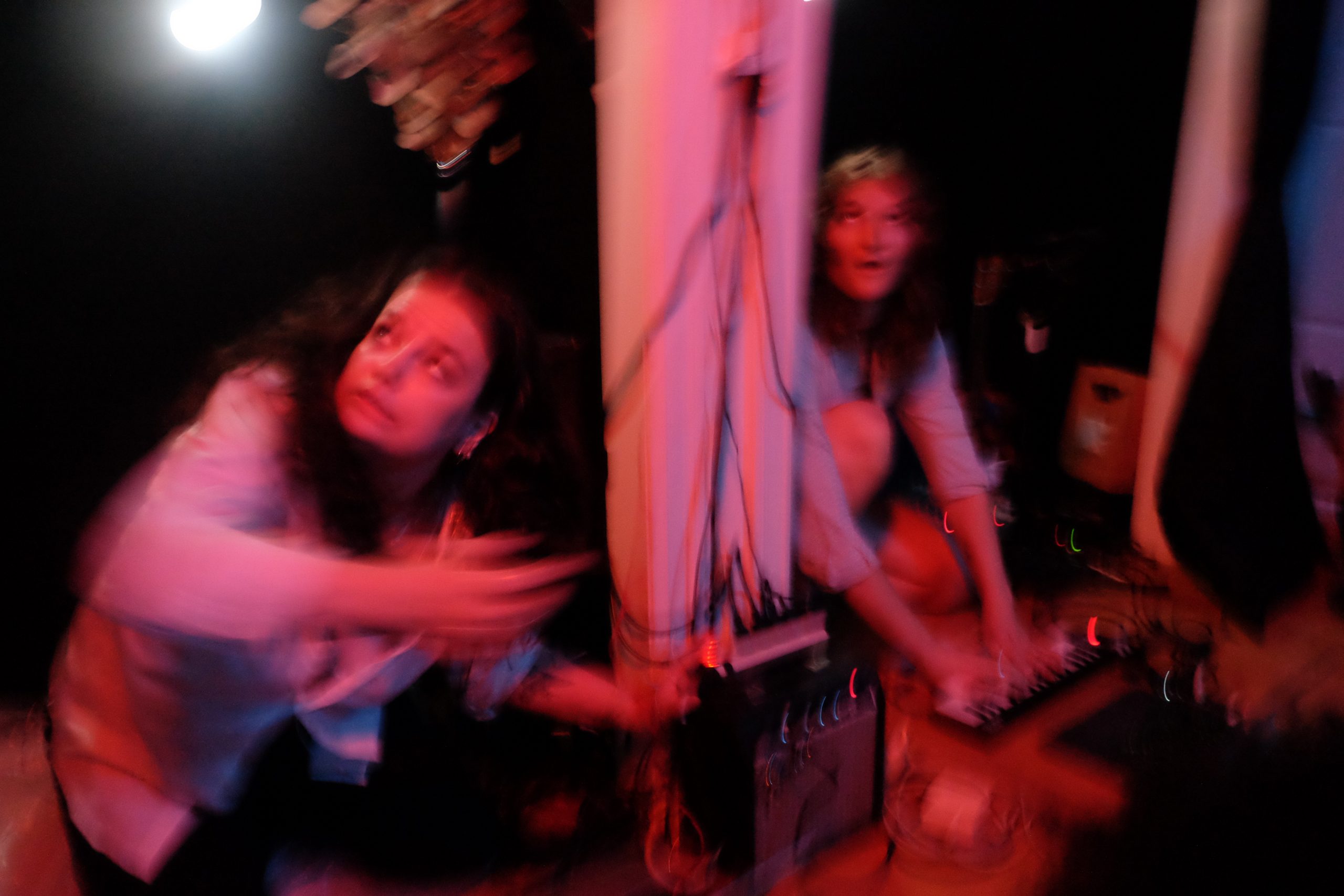
Eulàlia Comas and Leah Plante-Wiener make up the performance duo called laialeah. Their two names stand shoulder to shoulder as the two of them; friends, cousins, sisters, playwrights, directors, sound designers […] work side by side to define noise theatre on their own terms. As co-founders of box machine, they’ve made the spare bedroom in Leah’s apartment into a burgeoning DIY venue where anything is possible by way of steadfast scrappiness, a dream big mentality, and indulging the micro-gesture.
In Mobile Wash Female Locker Room, which premiered at box machine last August, laialeah occupied the bedroom’s twin closets. Never really being able to see each other they back up, overlap, and interrupt each other, with text, sound, and light. They play a game of what they call “my turn tennis”. Taking turns speaking with an intimately pragmatic patience while maintaining an unabashed will to take the talking stick. Leah then leaves her closet, naked and wrapped in a plastic tarp and tangled in string lights, to deliver a guttural cover of Sharon Van Etten’s “Jupiter 4,” anchored by Laia’s accompaniment. Leah then opens a window and lights a cigarette.
It wasn’t until Leah opened that window that I realized just how much sweat had been dripping down my back, how small the room was, how packed it was, how hot it was, and how much I love that song. Ever since Mobile Wash, I listen to “Jupiter 4” when I want to feel something. I’ve resolved that laialeah aim to haunt their audience and lend them their obsessions like a book you don’t ever have to return.
Ahead of Baby Butcher Choke For Free at The Brick, opening March 18th, we spoke about sound, noise, and the spirit of covering.
Sophia Parker: So, what can you tell me about Baby Butcher Choke For Free.
Eulàlia Comas: Well, I suppose we always struggle with this a bit. But it’s the next full length piece of the laialeah project following Mobile Wash Female Locker Room, which we did this past summer.
Leah Plante-Wiener: I think the reason why we struggle to elevator pitch this one is twofold. First, we’re addicted to not telling anyone anything. We love doing that.
EC: We actually don’t want to tell anyone anything about it.
SP: Perfect.
LPW: I don’t think it’s wrong to say that Baby Butcher Choke For Free has cannibalized much of Mobile Wash Female Locker Room. And Mobile Wash Female Locker Room cannibalized much of the previous shorter work we were doing. But what I’ve been telling people, what Laia has been telling people, is there’s surgery…
EC: Acts of surgery.
LPW: There’s acts of surgery and there’s dinner.
EC: And we have dinner by the end.
SP: I was so taken with Mobile Wash and I’ve been thinking about the site specificity of Box Machine as a venue. I think it was after coming to Mobile Wash we talked about bedroom theatre. And how bedroom pop sort of works the same way – that you can really hear where it was made. That was something that was so clear to me – and then feeling like – I’m sitting where this thing belongs. Maybe both of you said, at some point, that this show could never happen again. And you did it for seven nights-
LPW: Yeah seven nights in a row.
SP: And you could only ever do it again in twenty years?
LPW: In twenty years when we rebuild box machine completely and then we, at the age of forty, do Mobile Wash Female Locker Room in fake box machine.
EC: I think that, it’s not just that we can’t do it again, it’s that the conditions in which it occurred don’t exist anymore. For Mobile Wash specifically, the heat was such a part of it. The August heat with a room full of bodies and the one window covered in trash bags until we rip it off.
After Mobile Wash, we already knew that we had this slot at The Brick. And some people were like, are you bringing it to The Brick? We can’t because it’s March, among other reasons. And so this whole sort of component of the heat that we built the show around isn’t there.
And then likewise with Baby Butcher. So much of what we’ve been building was asking, intentionally from the start – What can we do specifically in The Brick that only The Brick can allow and enable?
LPW: There is this emotional component to the site specificity of doing it at The Brick because as the story goes, we met as interns at The Brick in January 2023. We were pretty quickly like – Wow we’ve written all the same plays, should we make art together? We have the same name, maybe we should do something about that. We kind of hit the ground running. It’s been three years.
The thing about The Brick is that it feels like going to grandma’s house. I think there is something about Baby Butcher Choke For Free – it’s kind of infused with the spirit of two cousins playing in grandma’s house.
EC: Absolutely.
LPW: And grandma is Peter Mills Weiss. And every now and then grandma comes and goes, Do you guys want a snack? Do you want anything? No? Okay. Bye.
SP: I’ve been thinking a lot about like sound not just as material or just as design but…
LPW: Sound as text.
SP: Let’s talk about that.
EC: I was listening to music in my shitty little bodega earbuds and I could hear the rattling of the speaker itself in my ear and that was such an affect of experience that was making my body feel these crazy things. I will pass it over to Leah to talk about sound as text with that haunting of the literal physicality of sound.
LPW: We’re obsessed with designing sound. Laia is a really really talented sound designer. Laia is one of the truest jack of all trades that I know and it’s a little scary.
EC: It’s scary for me too.
LPW: Our relationship to sound has multiple components. The first being that like we are the ones creating it. We don’t kind of ever work with pre-made sound, it’s all us.
EC: With the obvious exception that when we are working with music, we’re working with music that we haven’t written.
LPW: I mean like piping in audio. We never pipe in any sort of pre-recorded audio. So there’s the fact that we’re building it all from the ground using our own voices, our own instruments. We have collected an army of strange instruments that we’ve accumulated over time. Some of them are friends, some of them are ours.
Then there’s the fact that we do covers of songs. Obsessively, it’s our favorite thing to do. Laia has recently proposed that we start saying that we do interpolations of songs. But to that I say – there is still the spirit of covering a song. There is something particularly earnest, which we are, despite ourselves – we can’t help it. There is something kind of earnest and incredibly DIY about saying This is a song we really love and we can’t stop thinking about it. And it makes us think of our show and we’re going to do it in our show and we’re gonna build it a little home in our show.
That’s kind of what it feels like. It feels like we’re not rehabilitating songs, but it feels like we’re fostering them. Like if you were fostering an animal and then we release it back to whoever it is, to Mitski, John Prine, or Sharon Van Etten.
There’s also the ambient element, which is a really big part of the laialeah project and of everything we do. This ambient element is a very large component of what we call noise theatre. The thing is that the ambient component isn’t just sonic. It’s also compositional. It’s also in the video design on our Sony monitors. It’s also in the heat of Mobile Wash. And we have these unexpected, unconventional sensory elements that we’re playing with for Baby Butcher which is really fun.
Not only are we sometimes doing more ambient bouts of music. The technology that we’re working with and like the various tools that we’re using – there’s often a hum.
There’s always some sort of humming happening. There’s always some sort of technological crackle.
EC: In a lot of ways, we’re developing that component of our formula even further in this piece. In Mobile Wash Female Locker Room, the way we set up the soundscape, there were very literally overdriven frequencies coming out of the amp that were running throughout the whole thing. And there was this electrical whine that was coming from one of our synthesizers from the fact that there was an ungrounded current. And we have these 1987 Sony CRT monitors that have this little squeal.
I think now maybe in Baby Butcher Choke For Free, there are more artifacts that also accrete over the course of the show that contribute to that ambience too. In the Mobile Wash the ambience was part of a way to say – this is the space that we’re in and we don’t have control over. And now there’s a little bit more of a complicated relationship to control in terms of our work.
SP: I’m curious about the space that you’re curating and building and nurturing in box machine with your audience. The proximity is so close and so right there. How might that be similar or different at The Brick?
EC: We started box machine last summer and so each new audience is still a part of the process of creating what it actually is. And the contract is between audience and artists at box machine.
Whereas at The Brick, even though every show is bringing in its own audience, there’s also a pretty established Brick audience. And people may not know what to expect out of the work they’re gonna see at The Brick, but they know what to expect out of the people they’re gonna run into and the kind of audience they are going to be a part of. And so in some ways, we’re playing more with those expectations. Whereas, with Mobile Wash specifically, we were in the position of creating expectations.
I think that connects back a little bit to the ways in which we’re sort of obliquely reflecting on our experience of meeting each other through The Brick and the community we are a part of. Just all of the ways in which as a physical space, it holds so much community and geography. I feel very strongly that because Baby Butcher is in that space, it’s part of every show that’s in the space. And that’s part of our homecoming a little bit and we’re looking at that face on.
LPW: Laia was a production fellow at The Brick after I ended my internship and has this technical knowledge that is immense and larger beyond most peoples.
We have a relationship with The Brick but we also have a relationship to the people that run The Brick. Peter is such a huge mentor and a friend to us who really looks out for us. Robin Margolis, who is our sound designer, has been working at The Brick for so long. There’s years of earned trust and dedication and showing up. I think part of what makes Baby Butcher, Baby Butcher is not only the fact The Brick is incredibly familiar to us but that we’re allowed to let our wildest dreams come true.
SP: Thinking about selfhood and relationship, would you say the merge between character and collaborator is a part of noise theatre?
LPW: What is built into what we do as laialeah is our relationship as friends and collaborators. The question of character is a really curious one because it feels like what we do is just present our heightened selves. That’s what we bring to the table and what’s included in that is the spirit of collaboration, the technicalities of collaboration. The literal process of two people working together is often reflected in our work. I would say that kind of fits into the larger noise theatre project.
In Baby Butcher, for the first time, we have this really major element in the show that feels fictional in a way that nothing we’ve ever done before has.
EC: We’ve unintentionally invited narrative into what we’re doing.
LPW: We’ve created this device that requires a degree of suspension of disbelief and projection of imagination from the audience. Whereas previously, what noise theatre developed into was – these are two girls making experimental theatre together, who are making sound together and you are watching that happen in real time. And now we’ve placed this piece of storytelling that is not of the laialeah world, that is not even of the noise theatre world as we’ve understood it.
We’re a Rorschach test. laialeah is the Rorschach test. Noise theatre is a Rorschach test. It’s about what you’re picking up and what you’re projecting onto it.
EC: I think that that’s a really good metaphor for it because it’s a nondescript thing. This idea of projection and of dramatic projection - regardless of how you’re interacting with it or regardless of what we do as creators, somebody else is going to project their own thing onto it – in the process of meeting it as material in the world.
SP: I find that when you’re dealing with amplified self or heightened self, that it can definitely invite projection. Me and Sacha Vega have been talking about aboutness in performance and this problem of aboutness in theatre. And a play having to be about something as opposed to this play is doing or asking something.
LPW: Doing is what we give a shit about.
EC: Yeah. We had a moment in rehearsal the other day where we were like, Wait, we’re acting right now and that’s not –
LPW: We’re acting too much, we’re acting too much!
EC: We’re supposed to be doing.
One of the deeply satisfying things that I get from watching live music is watching the artists not just create the music, but interact with the tools required to make music. Outside of the music itself. And the tension between – I’m playing my guitar and also in this moment, I need to direct my attention to the pedal board and smash a pedal. And this splitting of imaginative faculties. And that’s noise too. There is this interference. There’s these different signals that are traveling together and they’re fucking with each other. I hope that we make that interference very visibly plain.
LPW: Aboutness really reminded me of when Annie Baker zoomed into my playwriting class at Columbia. She said, the second you start talking about a playing being about anything you run into trouble. And I was like – wow, yes.
So when people ask us Baby Butcher Choke For Free, I immediately kind of default – after the initial struggle of I feel like I have to say what it’s about. I kind of default to what we’re , literally, technically doing. Because, the doing is the everything. The doing is the Rorschach test and what people project onto. And obviously we’re comprising very specific images. We’re all about a tableau. We’re all about a perfectly salient pairing of light and sound. But that’s the doing – it’s storytelling through craft. It’s storytelling through effort. And it’s storytelling through the pre-existing relationship that the work is imbued with.
EC: I worked on thirteen or fourteen productions in a single year. I’ve stage managed several productions. I’ve designed several productions. I’ve worked as a tech director and production manager. And the moments that were the most satisfying to me as an artist and when I learned the most and when I felt the most engaged with my body were when I was engaged with the totality of this space.
And was sitting in the booth and it was just me on the mixer and the lighting console and the laptop running and sound and projections and whatever. And I gave all of those different go buttons and maybe I also have to use a walkie talkie and run down and do this thing and that thing and reset. And at a certain point I was like, this whole building is literally an instrument.
In the sense that an organ, in a church or a cathedral, is an instrument that works because the entire space is part of that resonating chamber. And I started to have that experience at The Brick where I was like, I’m playing a theatrical organ and that was so titillating to me.
Photo by Marcellus Louise.
Leave a Reply