
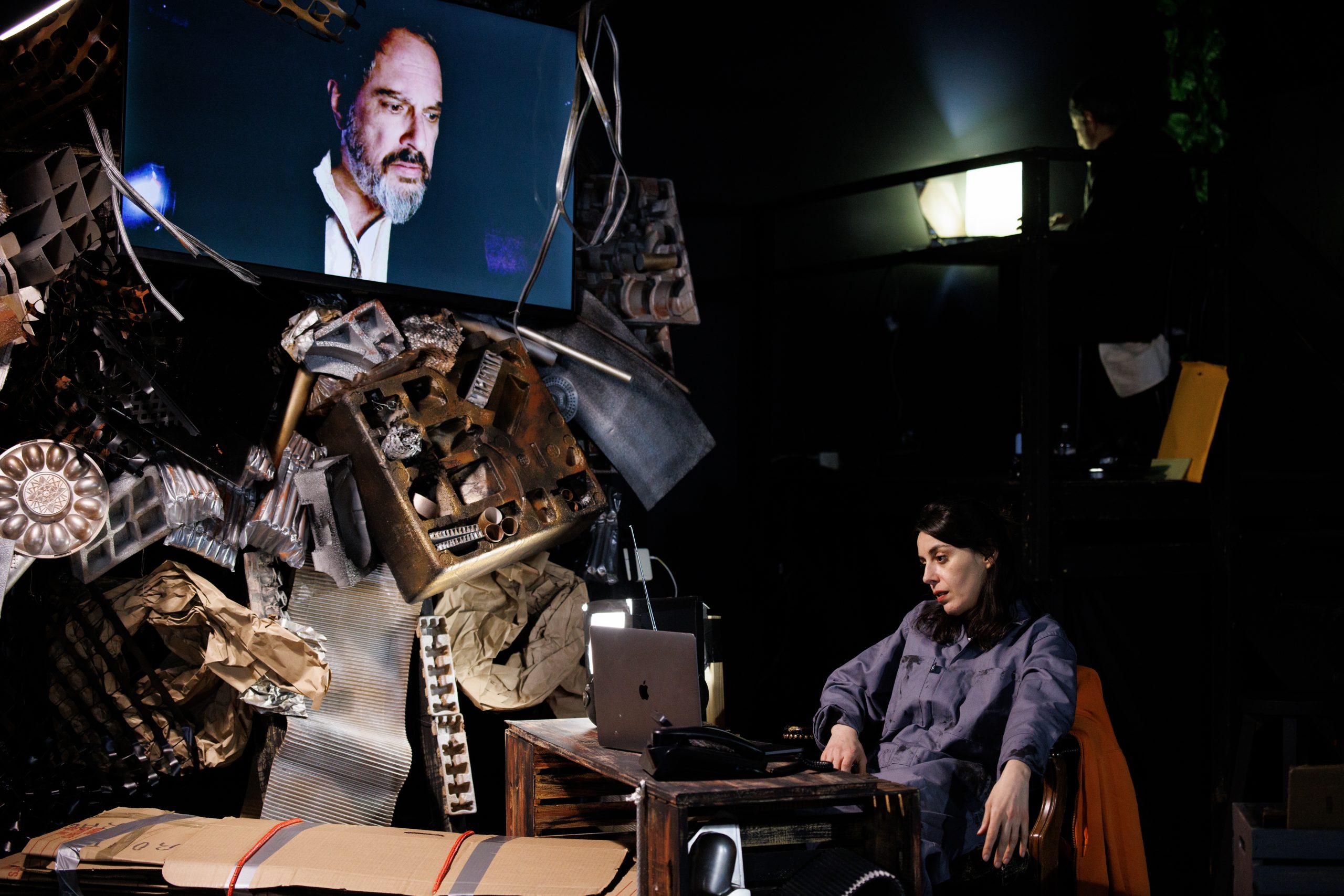
In the midst of reading Christina Masciotti’s new play, Liberty Scrap, now up at Culture Lab in LIC, some news popped about St John’s University’s unilateral decision to stop recognizing their 56-year-old faculty unions. In a letter to faculty, the president (a Dominican friar) and the lay provost, jointly explained that the entanglements of collective bargaining no longer allowed the university “the flexibility required to fulfill its Catholic-centered mission.” This is a mission apparently undisturbed by Rick Pitino, the men’s basketball coach at St. John’s, taking home 3.3 million a year. In a separate statement to National Catholic Reporter, university spokesman Brian Bowne, added that ending bargaining with faculty unions, “will allow St. John’s the flexibility required to innovate while continuing to support our faculty and, most importantly, deliver on our promise to our students.”
Shortly after meeting Katya, the protagonist of Liberty Scrap, or maybe we could call her the moving portrait at the center of the play, we learn that she went to St. John’s. Briefly. In the wake of Sept. 11, 2001. Two weeks into her studies she secures a meeting with the university’s president. She is worried about some blanks she left on forms for her job at the law library. “I think I’m undocumented,” Katya tells him. “My visa expired and my country collapsed.”
The president was so kind. He shook her hand.
Flexibility. Catholic commitment. Promise to students.
Three days later she lost her job in the library and then her scholarship.
Katya didn’t have the exact language for her status then, because she’s not just undocumented in the United States, she’s undocumented everywhere. She’s stateless.
When a friend disclosed that she was stateless to Masciotti a few years ago, the language was likewise new to her. “I was struck that I’d never heard the term before,” Masciotti recalls, “and stunned the more I learned about it.”
Masciotti’s friend introduced her to United Stateless, a humanitarian organization led by stateless people, whose vision is “a world in which everyone’s human right to Nationality is respected and upheld.”
At the time they were looking for volunteer writers, primarily journalists, who could amplify the condition of statelessness in direct and practical ways to rally attention and legislation.
Masciotti, whose work is driven by a uniquely high-frequency sensitivity to the battle-scarred inner lives of people pushing through the clogged pipes of gunked-up systems, volunteered an alternative idea: “to write an in-depth character study in the form of a play.”
Enter, slowly, Katya. Slowly, because Katya is imagined composite, based on two years of interviews and research done by Masciotti. In Katya’s story, in her bearing, her talents, her preoccupations, there is detailed deference to the lived experience of stateless people who shared their stories with the playwright, tempered by a very careful respect for the precarity of their situations and the preservation of their anonymity.
A tough, sensitive, artist in her early 30s, living in Astoria, Queens, Katya has figured out how to make money in a way that keeps her close to the material with which she makes exquisite miniature sculptures: junk. She scavenges scrap metal and sells it to Maxine, who owns the titular Liberty Scrap.
Like roughly half the people around her in Astoria, Katya was born outside the United States. Like many of the people she interacts with daily, she does not have legal documentation to live and work in the United States. However, unlike the majority of her neighbors in this proximate position, she has no documentation attesting to existence by way of national belonging anywhere else either.
Katya was born in Tashkent, Uzbekistan, USSR. In 1982. It is 2015. There is no USSR.
When the Soviet Union collapsed, independent nation states were breaking free of Moscow, individual opportunities for cultural exchange were proliferating, and in the summer of 1994, at 12 years old, Katya came to the United States for a girl scout summer camp—on her Soviet passport. By the end of that summer, the fortifications of new Uzbek national self-determination were sharpening, the new currency was collapsing, the Russian language—her primary language, not out of identitarian purpose, just as a result of being born into a Russian system—was being scrubbed out of education and public life, and crime was rampant. Katya’s parents prevailed upon her host family to try to get her a visa for one more year. They succeeded. Some opportunities. A missed consular deadline in her late teenage years.
Twenty-one years later, when we meet Katya in Masciotti’s world, she has not returned home, nor seen her parents in person. As far as we in the audience can see, she only communicates with her father over video calls. For more than a decade, since being discarded by St. John’s after two weeks, Katya seems to have scraped by entirely outside of institutional frameworks.
Of that landmark indignity, she reflects on how her basketball star-classmates got to stay at school despite “struggling to read with words.”
“That basketball team was my first introduction to the real world,” she tells Maxine.
“The real world” and the portrait of the human individual falling through its cracks is Christina’s dramatic turf. Particularly the blunt force of policy dropped on the heads of individuals living on the urban peripheries of the richest country in the history of the world. Put like that, the real-world sounds sort of mythic. In Christina’s plays, it is. Her plays operate in precisely located naturalism. And they operate in the space of an allegorical quest unfolding in the overactive brain of somebody with no time, no center, no safety, as they come up against everything.
The first Christina Masciotti play I saw was Social Security at the Bushwick Starr in that strange hopeful moment of 2015 when Liberty Scrap is set.1 June, the elderly protagonist, is mostly homebound and reliant on social service agencies, her landlord, and a neighbor. There’s a lot of gaslighting. June speaks an Eastern Pennsylvania working class vernacular. But her own version. She talks obsessively about who is “hanging up” with who. The young actor assumed her June costume and came out of it in front of us. We were let in on the spectacle. I’d never encountered in performance an American play that combined ear-perfect spoken language with such bold and precise accenting on the tremors of challenged human subjectivity.
What I think of as “The June Play” was unlike any play I’d previously encountered with working class people doing real talk. It was not what I’d come to think of derisively as a well-made play.2 It was more than the sum of vernacular precision and a gift-wrapped message. But it didn’t shy from story or hard-hit social messaging. Aesthetically and socially, it was intentional, determined, in every way. I didn’t know a playwright could fashion something successful salvaged from the Aristotelian and the avant-garde aimed at a better world. All the while staying committed to character study and not tripping over into agit-prop. I was obsessed.
“What’s exceptional about Christina’s plays,” reflects T. Ryder Smith, the director of Liberty Scrap, who played the landlord in Social Security, “is the way the language and situations are simultaneously realistic and dream-like. On the immediate level they deal with small crises in working-class lives, often those of immigrants, played naturalistically,” Smith points out. “But,” he goes on, “they also play on another level close to that of myth, or fable, a kind of slow hallucination which lifts you out of time.”
This dualism is at the center of Liberty Scrap. Katya’s traffic in the throwaway stuff of the modern world—she is pricing metal frames from George’s shuttered screen-printing shop when the play opens—lands simultaneously as social realism and as heightened allegory. This helps set the tone for the play to operate as both character study and narrative with stakes.
A recurrence of her father’s cancer ignites a narrative urgency, prompting Katya to decide she needs to figure out a path back to Tashkent. Stat.
At the Uzbek consulate in Washington D.C, Katya is given a meeting with an inflexible Plexiglass window. The plexiglass window is droll, full of cold, yet funny, bureaucratic clarity. Katya is given some ear-tight word puzzles. She is not given an Uzbek passport.
“I don’t have time to throw all the pasta on the wall,” Katya tells a lawyer after, in exasperation.
Masciotti’s second or third language crossover shots at idiom are ear perfect. They are also often moving, and sometimes strangely mystical. As if they join dimensions. During a video call, Hidayat, Katya’s distant father, on realizing the screen has frozen, utters, “Everything frost.” A reasonable stab at past participle, but, also, the way everything might appear when you haven’t embraced your child in over two decades.
Hidayat, on video phone again, to Katya: You’re my saver.
Screen goes dark. No screen saver even.
When people fumble in language they are improvising, crossing. Systems are so inflexible. We’ve made them and yet we make crossing so impossible, then blame them, the systems, instead of us, their executors. Katya’s tiny sculptures, Christina’s chiseled speech accidents, these are records of individual ingenuity breaking normative, inherited—go back far enough and you see they are as human made as they are human guarded—systems, bending regulations and reshaping borders.
Systems and power. Systems fuck up people’s shit individually. But the only way to structurally alter a corroded system is collectively. This conundrum is always there in Christina’s plays. They live in the tension between the incoherent individual subject flailing and the collective insurgency forming.
What differentiates Liberty Scrap from any Masciotti play I’ve seen so far is that the individual at the center finds solidarity for herself inside the play. It is not left to the audience to recognize implicitly that she is both individual and representative. Here, Katya’s Sisyphean struggle to get back to her father becomes a collective struggle to get documentation. A chorus of the stateless emerges from heaps of scrap metal. And yet, even these characters whose struggles we can only glimpse, Masciotti sends forth with such percolating particularity. Fatima, one character from the chorus, has my favorite line in the play. “I was raised to believe most of politicians are psychopaths and it’s not curable.” While no one is reified, neither is anyone stripped of all humor, reduced to an abject example. Christina listens to individuals, uses their voices in stories that she imagines purposefully to feature something of their psyches: the ways systems have damaged their psyches, and the ways individual subjects salvage their dignity, their spirit, and their strange, discreet personhood. Nobody that infuses a Masciotti play becomes an object. Nobody becomes a file. Her real world subjects can watch themselves being applied to larger social purposes and feel many things in sometimes harmonious and sometimes disjunctive collectivity with every other audience member. But they also have the thrill of uniquely recognizing their own strange, bracket-proof, watermarks in the midst of that spectating collectivity.
I keep coming back to the place of St. John’s University in Liberty Scrap because of its concatenation with my own shit. I’m in a new contract faculty union. My day job employer doesn’t have a Catholic mission, but they do share the Catholic church’s commitment to an impressive New York City real estate portfolio. Fed by the shapes of Christina’s vision, I can make strange faces at the deans and provosts on the management side of the table at bargaining sessions, thinking: plexiglass windows. I’d like to send them to Liberty Scrap and remind them they are also humans with choices. They aren’t system infrastructure. They only benefit from it more than we do. Just subjects at guard posts in a system driven by a tired, rickety framework.
Any one of us could get a stateless slot; any one of us could become a plexiglass window.
Photograph by Maria Baranova.
FOOTNOTES
1 Obama was killing people extrajudicially with drones in Yemen, but saying gorgeously democratic things to the world. And in the wake of the Senate’s failure to pass the DREAM Act, he had extended the lifeline of DACA to many young undocumented Americans by executive fiat. (The orange maniac who grew up behind St. John’s and was about to replace all regularly scheduled programming is not the first guy to love an executive order. Anyway, it was a promising moment when the plight of the stateless might actually be untangled by the then rhetorically gentle agents at the helm of U.S. regulatory machinery.
2 This appellation/slur comes to me from Mac Wellman. I don’t know if it precedes him or if it’s his coinage.
Leave a Reply