
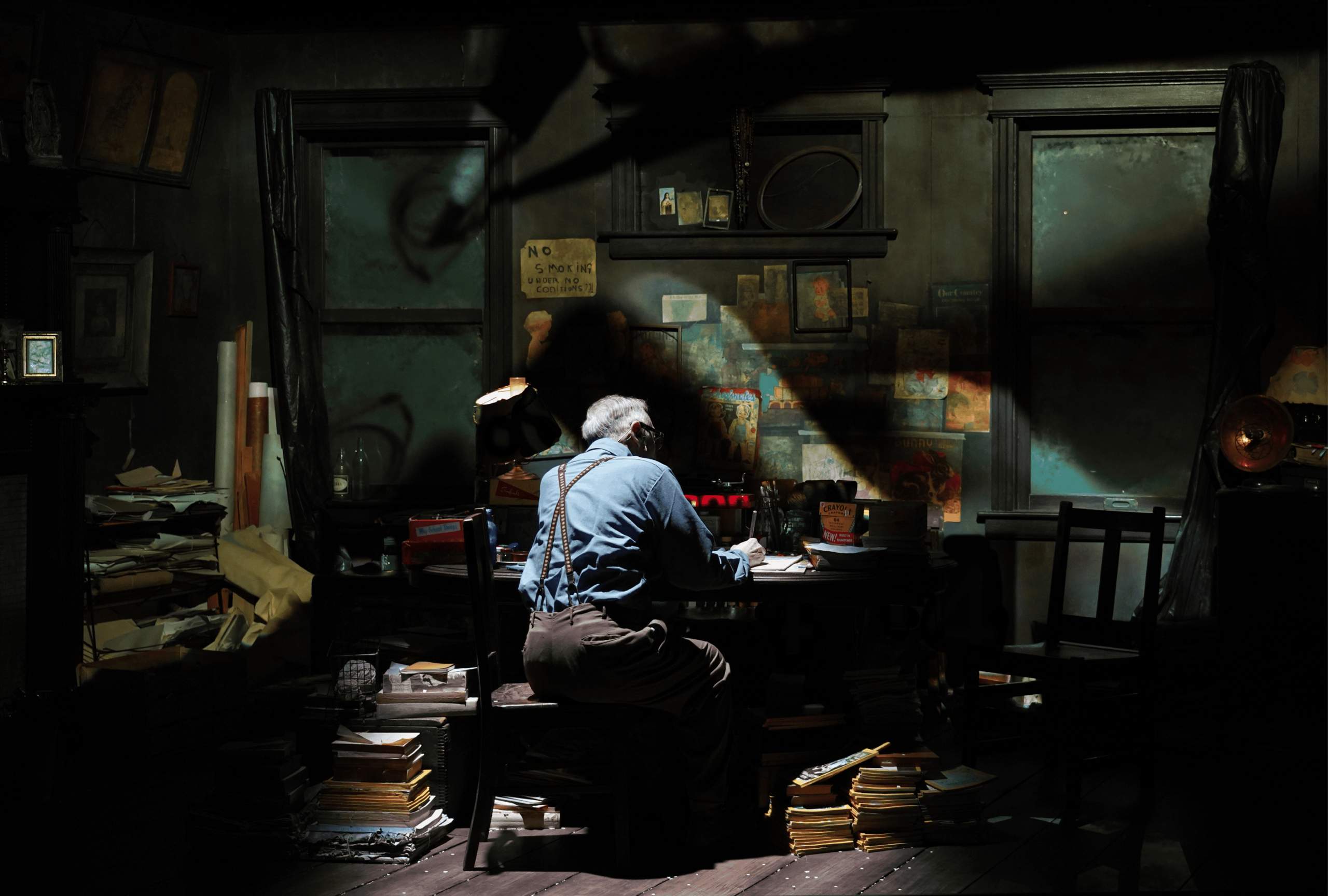
Henry Darger was a janitor and dishwasher by day, and in the confines of his home, a writer and artist by night. His landlord discovered his oeuvre after Darger, in his seventies, moved out of his apartment in Chicago’s Lincoln Park to a nursing home. He left behind him a 5,000-page autobiography, a six-volume journal of daily weather reports, a 15,000-page novel, and hundreds of drawings, paintings, and collages. It’s believed Darger never showed this work to anyone. Darger’s most well-known and ambitious work is a vast illustrated tale titled The Story of the Vivian Girls, in What is Known as the Realms of the Unreal, of the Glandeco-Angelinian War Storm, Caused by the Child Slave Rebellion. In this moral epic, a band of heroic young girls, battle the evil Glandelinians for their practice of child enslavement. Despite the haunting unsettling nature of the story, Darger’s work is filled with bright expressive drawings of lush vegitation. His depictions of flowers resemble a William Morris print, while his blonde-haired Vivian girls look like the ideal of a children’s book character. Except that Darger’s virtuous female creatures feature miniature phalluses. It is most likely that Darger’s obsessions with children, and the potential of their enslavement and safety, came from his own tortured childhood. After the death of his father, Darger was sent to a home for unfit children. There, he was beaten by nuns and forced to witness the abuse of other children. After escaping the home, he spent most of his life on his own, except for a singular friend William “Willie” Schloede.
In Bughouse– playing at The Vineyard Theatre until April 5th– famed downtown director and choreographer Martha Clarke takes on Henry Darger’s story. In a script written by playwright Beth Henley and based on Darger’s writings, the audience witnesses a singular evening of Darger’s garbled, isolated, fantastical world. Played by John Kelly– celebrated performance artist and close collaborator of Clarke’s– Darger stalks the stage set up to be his overstuffed apartment: books piled on each other, ephemera stuffed in boxes, a record player, tchotchkes– including a few catholic figurines– line the mantlepiece. It is cramped and dusty. Kelly swirls within the self-created world, plunged deeply into the mind of an enigmatic tortured soul. Darger was the ultimate outsider artist. His creative pursuits were kept entirely to himself. In this 70-minute, mostly one person show, Clarke seems ask what it would be like to observe and witness someone entirely fit on never being seen.
I spoke with John and Beth over Zoom earlier this month about their experience working on Bughouse: the origins of the project, the machinations of the process, John and Martha’s shorthand, and the compelling nature of Darger’s freaky tale.
This interview has been edited for both length and clarity
Eve Bromberg: John, I know your background is in dance.
John Kelley: Yeah, my background is initially visual art, and then dance, and not theater. I’ve been making my own work for 3540 years. Occasionally I do other people’s work, but my work tends not to be text based. I went kind of kicking and screaming into verbal acting. And, you know, the closest thing that I’ve done to verbal work is probably John Cage. I’ve done a lot of John Cage’s work. That kind of shifts in text. But for Bughouse, I had to learn the script verbatim, because Henry’s language is very specific, and you know, sometimes incredibly beautiful. The way he places words can be very illogical. That takes extra attention and memorizing. Martha and I speak the same body language. That’s really why we work well together.
EB: And where did you grow up? And where was your early training?
JK: I grew up in Jersey City, and I escaped as soon as I could. When I was 17, I got a scholarship at American Ballet Theater school. Oh, amazing. But I started too late. So I trained at ABT, I did Harkness, and I danced with Charles Wideman. I danced in some small modern dance companies, I did small roles on stage at ABT and Stuttgart, right near Lincoln Center. It was kind of the halcyon days of dance in the 70s, and it was a great moment, but I quit, because I wasn’t going to become a prince, which is what I wanted. So, I went to art school at Parsons.
EB: And what medium did you study there?
JK: Fashion illustration, because I saw these beautiful Antonio Lopez drawings. I realized I didn’t like the fashion world, but I used the classes as fine art training. I studied painting with Larry Rivers. I became an excellent draftsman. The mirror of the dance studio became the mirror of self portraiture through Egon Schiele’s work. Schiele’s work led me into the next stage of my work, eventually painting myself and performing in clubs in the early 80s in the East Village. So it kind of was, in retrospect, a very organic and logical progression, in a way, about the body, about changing the way one shows up physically.
EB: Because you discussed mirrors… do you have any particularly strong feelings about Jerome Robbins’s Afternoon of a Fawn?
JK: You know, I’ve never seen the full ballet. I’ve only seen bits of it, isn’t that odd? Yeah, but I love the idea of the mirror and maintaining a relationship to it throughout a performance. When you think about it, in performance, especially if it’s presentational, the face is always the mirror for the audience. audience. So that’s, that’s intentional.
EB: When did you first meet Martha [Clarke]? What was your first project with her?
JK: I met Martha in the late 1980s through a mutual friend, a novelist. I had just performed my Pass the Blutwurst, Bitte at Dance Theater Workshop again, and Martha had done Vienna: Lusthaus. We shared a common fascination with Egon Schiele. When we met Martha was working on a new piece, this was in 1989, and you know I’ve worked with her about four or five times over the years.
EB: When and how did Bughouse come about?
JK: That might be a Beth question. I know Martha’s been working on this piece for nine years, and she was working with Beth before I came in.
Beth Henley: I think it was last, around last March, that I got Martha started talking to me about working on this. She has been working on this for a matter of years, so she had an immense amount of material and perspective. Previously, Martha worked with Michael Bonesteel, who is an academic who wrote one of the great books on Henry Darger. I got introduced to Darger through her, and just started looking at his work and reading things from his novel The Story of the Vivian Girls in What is Known as the Realms of the Unreal and his autobiography. We went through two workshops, one in September, and then John joined us for the second workshop in November. Martha already had a real vision. She was already working with animation and images that she wanted, and also working with sound, with sound designer Arthur Solari, and animator Ruth Lingford. So, she was kind of ahead of the game.
EB: John, you were saying you had first encountered Henry through an outsider art gallery,
JK: A board member of mine in the 90s, Phyllis Kind who had galleries in Chicago and New York and really specialized in outsider art. In fact, last night, I was talking to Michael Bonesteel, and he totally knew Phyllis from way back. I was aware of Darger’s work very early, but I was totally unaware of his writing, which is a huge part of his reality.
EB: I assume that all the materials came from Henry’s illustrations and writings? Nothing was added in terms?
JK: In terms of the imagery, as far as I know, the animations are called from Henry’s drawings of the Vivian Girls and the Giggle creatures and all that. In terms of the words, I think you should ask to Beth about that.
EB: Beth, can you talk about where the words came from?
BH: The words, I would say it 99% are Henry’s. I made up for the very beginning of the play, when he’s talking to the nuns. Maybe I made up some of what the nuns were saying. But it was important to me to use his words, but his writing is not at all linear, and so it was difficult. Sometimes, I mean there’s suddenly a moment where he writes Oh, I forgot. I meant to tell you… So, the words are from his autobiography and from The Realms, and even from one of some of his weather reports. He wrote pages and pages of daily diaries about the weather. So a little from that, and his autobiography, even when it turns into a story about a tornado sweetie pie.
EB: Beth, could you speak to what you were attempting to do dramaturgically in the creation of this script? Was there a particular theme, for instance, that caught your attention that you were expanding upon?
BH: Martha didn’t want to go with a linear story about him. We were looking and wanting to look at what was in his mind. An exploration of a creative mind and what his mind and body go through in one night in his apartment when he’s older and haunted by memories and images that inspired and obsessed him. It is a very expressionistic approach, if that makes sense.
EB: John, when you were brought on this project, how was it explained to you? And actually, maybe you could both speak to this, why was Martha drawn to this character?
JK: Yes, well, Martha likes weirdos and outsiders and gorgeous, poetic, astonishing, unique explosions of creativity, you know. I think Martha thinks he’s a great artist. She considers him to be a great artist. And also how he arrived there, through a lot of pain and abuse, confusion, and abandonment. He concocted his own way of prevailing in the midst of such horror. I also think initially, Martha was drawn in visually– the Vivian girls and the world they inhabit, all that, I imagine Martha was completely beguiled.
EB: And what were you up to when this project was pitched to you?
JK: I had a month long residency at the Isabella Stewart Garden Museum in Boston, and I got a kind of a phone message from Martha saying, explaining that she was doing a project with Beth Henley but they weren’t sure it was going to work with the actor attached. She asked if I’d consider stepping in.
BH: Martha told me to come to this workshop and that we’d create the script and that there’d be an actor there. I’d never worked with Martha or in this way, so I appeared at the workshop in September having no idea, really, about Martha Clarke’s work. I came to explore Martha’s work and I loved it. But, the actor we were working with at the time, he was a wonderful actor, but he was a bit rigid. Martha brought some of Darger’s autobiographical material to the workshop for the actor, and he responded by asking very typical questions for an actor– Who am I saying this to? Why am I saying this? What’s our environment?— but these are not typical questions for Martha. They just didn’t have much of an artistic connection. He didn’t have a facility to create and live in not knowing or with the potential for the piece to change the very next day. So, at the end of the workshop, we didn’t have anything. There was nothing written. But then, Martha came across a photo of John in her phone, and I don’t know if it was real magic or associative mysticism, but she thought of him for the part. The way she communicates with John is a type of shorthand. She knew he’d be able to fit into her process because they’d worked together before.
EB: John, you said, you kind of, you went kicking and screaming into verbal acting. What was the first speaking role, or speaking acting role you had?
JK: My work is based on oblique narratives, that’s what I’ve been doing for 3035 years. Occasionally, there might be one word or a few words placed here, but it is really entirely non verbal. The last thing I wanted to do was speak. The first thing performance people do is begin with words. It was the last thing I wanted to do, but then I began doing more autobiographical works. One work was based on 30 years of journal writing. And then I wound up in a production of James Joyce’s The Dead that went to Broadway. I do a fair amount of chamber opera singing, so that allows me to approach texts in a musical way. And then I’ve worked with Robert Woodruff up at ART a few times on shows like Marlowe’s Did Queen of Carthage, and Orpheus X by Rinde Eckert. Those productions demanded that I speak. And again through my work on John Cage, I’ve developed a command over my capacity to speak. But, generally, I do approach it musically. So it’s been kind of a checkered arrival, but I feel like I did have enough experience in these previous productions that I could pull this off.
EB: I can imagine your shorthand with Martha puts an emphasis on movement. Do you feel like the physical direction of this production was collaborative?
JK: It’s been an entirely collaborative process. It’s more about arriving at a physical effect or an emotional effect. The words will be there, but it’s really more about the body showing up in space. That is the shorthand and a vocabulary that we totally jive with. And so in a way, it’s like working toward the end initially, and then figuring out how you get there. And probably the antithesis of what actors want to know, as Beth mentioned: the where, why, how, when, if, etc. So it’s like working from the outside in and the inside out at the same time.
EB: How did you get in to this character without concrete answers?
JK: Physicality became important. He has a limp. I have very erect posture generally, and I had to get rid of that. And a voice I had to figure out. I thought about a Chicago accent and what his voice sounds like. You know, in his room, hours spent. Hours spent in his room. What? What does one wind up doing? You wind up meandering around, bumping into things, moving from this thing to that thing. Then I’d think about what it means to not be witnessed and be by yourself in a solitary zone. How can you make an interior world manifest?
EB: Beth, once rehearsal started, what kind of presence did you have in that rehearsal room?
BH: Very quiet, primarily, you know. I was trying to cut down the piece I had because there were a lot of words. But the cuts had to make sense to Martha and John and myself. And some of it didn’t. A lot of the process was watching them work together. It is a difficult job, you know a one man show. It was a task every time to run the show. Martha had never worked with projections before this, right?
JK: Yeah, I’ve been using projections in my work for years. It’s a whole different language. And the way Martha ideally works is when she needs to see everything in front of her, included completed costumes. When it’s all in front of her, that’s when she goes to work. But until that point, she almost works like a filmmaker. Until she gets to the point where everything is in front of her, she can’t really do what she loves to do. When I worked with her in ‘89 on Miracolo d’Amore at The Public Theater, we had the set on stage for a month. A month of tech on stage. That’s where Martha does her tinkering and poetic wielding.
EB: How long did you have access to the Bughouse set? It’s so specific.
JK: Two or three weeks?
EB: To me the animated components were so pivotal to the production. I saw two different kinds. There were Darger’s illustrations and then photographs. And then photographs were occasionally animated. And in the presence of those photos, it seemed to me almost an introduction to a whole other person, which broke the world of Darger as totally alone. Could you speak to that design choice?
JK: I think you might be talking about William “Willie” Schloeder, Darger’s only friend. Willie’s presence is a leitmotif in the piece because he was the only person Henry really interacted with. The archival footage is meant to provide context to Darger’s world of depression-era WPA Chicago. But in terms of bodies, from what I can remember, I think Willie may have been the only other body in that footage, aside from the animations of the Vivian girls.
BH: In order to capture the voice of the Vivian Girls, we had a child actress come in, and we had another actor do the voice of Willie. So those were the two different voices we added. But then sometimes Henry’s character does the narration that’s sort of in his mind.
EB: Clearly there is a great darkness in this show and in the life of Henry Darger. There is perhaps a world in which Henry’s relationship to the Vivian girls bordered on erotic. Did you have conversations about that potential?
BH: I am compelled by his darkness, like the dark violet pictures he makes, just because that really emphasizes to me a clear struggle in his soul. He was abused as that home for the feeble minded children. He was choked. He saw other children being tormented, and I think his anger
and hatred of that sort of violence is what he portrays. That’s probably the truth of his soul. Nobody was buying his paintings. He was an audience of one who was obsessed with telling these stories about saving the slave girls from the Grand Orleanians. I’m just intrigued by the depth and complexity of it. I certainly don’t think he was in any way sexually involved with children at all. I think that’s a misreading, a complete misreading.
JK: It’s funny because there’s one book that I read, in preparation for this role, that discusses how in the early 20th century that gay men were conditioned to think that they may have been a woman in a man’s body. It’s kind of ridiculous, but in one way it makes, I guess, some kind of sense in terms of men’s incapacity to show any emotion or nuance of emotion. I mean, men are very, you know, shackled to this, these ridiculous ideas of masculinity. So maybe the Vivigan girls, these naked female creatures with little penises, maybe it’s an empowerment gesture. I agree with Beth that the work is entirely devoid of sexuality or desire, it’s more about empowerment and struggle and desperately needing to process and make sense of turmoil: turmoil, horror, rape, and abuse. When you experience something like that, where do you put that? Having been bullied in Jersey City as a kid, I could very easily relate to a lot of Darger’s experiences of alienation. Also having lived through the AIDS epidemic and as a survivor myself, all of that has kind of fueled my capacity to give Darger utter compassion and a bit of a soul. As much soul as I could.
EB: Is there much documentation of his attempt to sell his work while live?
JK: I don’t think so. He was just making his work, it wasn’t even in his reality to consider that.
BH: He told no one about his art. In his autobiography, he mentions his painting, far as I know, once. In his fantasies with the Vivian Girls, there’s thought that he could be great. But then in the actual dialogue, and it’s in the play as well, the Vivian Girls talk about how he’s a wonderful man, and how he’s done a great job describing all these specific details of the wars, and maybe it’ll be a big book. But then one of the girls responds by asking, Yes, but what is his name? Even the characters he created can’t remember his name. I think he talked to his friend Willie about his work, but it was very private,
JK: So many artists spend their lives toiling away and never make it, and yet, they continue to create. It comes with the turf of being an artist. There’s no assurance of what is going to be. But even he didn’t seem to have the capacity to even know how to go about showing his work or sharing it, yeah. He was stuck in his room with his work, yeah, and in his world that he created. By day, he was a janitor and a dishwasher. He didn’t go to school past sixth or seventh grade, if that, so that there wasn’t any sense of what an art world or book publisher was. He did the binding of his own books and saved them. There was a great meticulousness to his work. He didn’t just leave things in piles
Tickets for Bughouse can be purchased here.
Photo by Caroll Rosegg
Leave a Reply