

Actua One is a six-minute film by French filmmaker Philippe Garrel that documents the uprisings of May ’68, a student protest and then general strike in Paris, France. The scenes of this “revolutionary newsreel” display moments of confrontation and collectivity, cutting between elevated vantage points—looking down onto protesting crowds, for example—and close-up conflicts with riot police. Actua One was considered a “lost film,” with Garrel said to have lost the negatives after its initial screening in 1968. By the end of June 1968, the uprisings had concluded also. President of France Charles de Gaulle called an election amidst waning protests and was definitively re-elected, signaling a reestablishment of the political status quo over revolutionary possibility.
Despite its failure, May ’68 persists as a significant historical reference for social movements. And Actua One was not, in fact, lost: it was found at the French Archives in 2014, restored, and screened. I found a version on a Russian online video platform.
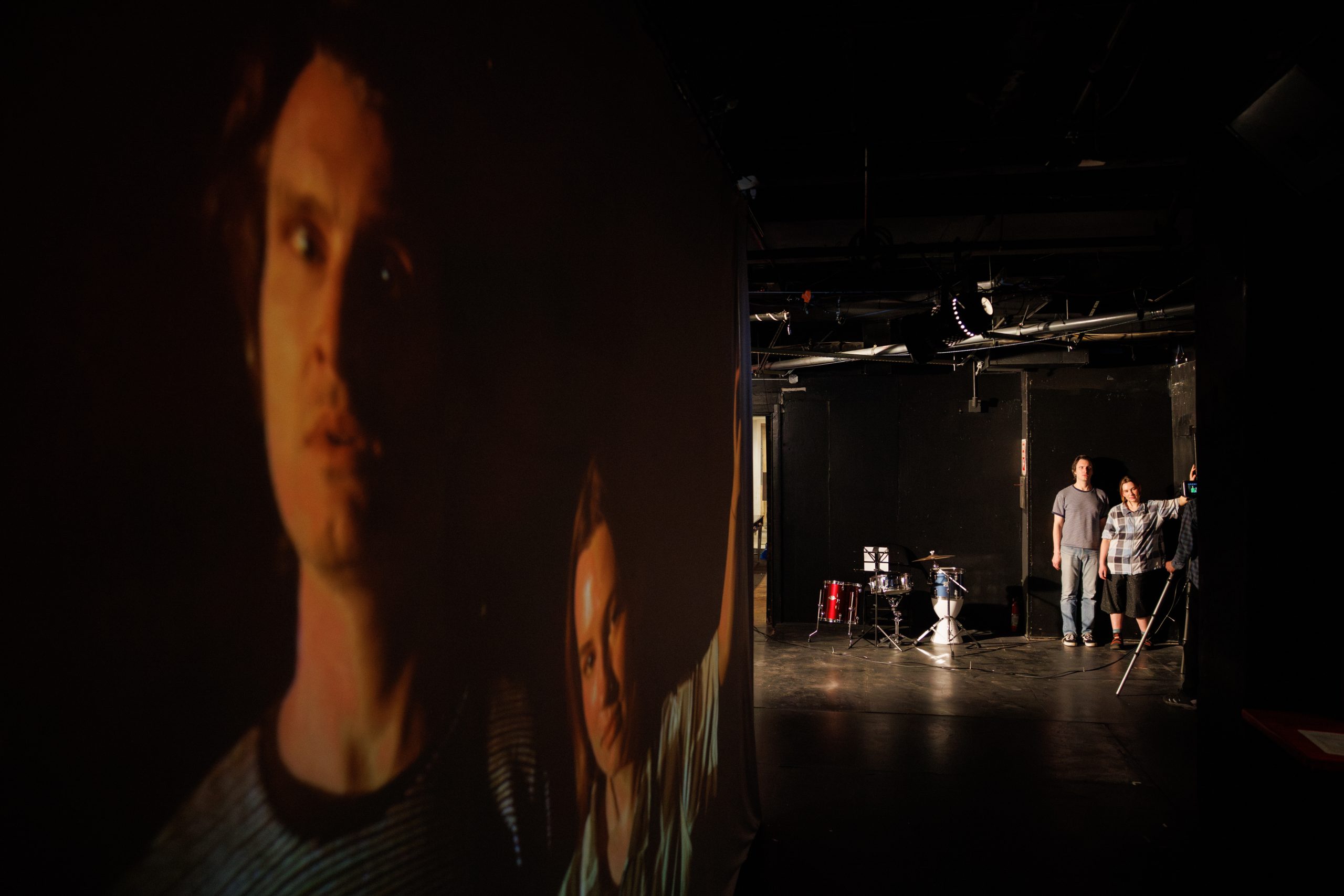
The title of Garrel’s film is also the title of Object Collection’s hour-long performance at The Collapsable Hole, which ran from March 12-22, 2026. Written by Kara Feely and Travis Just, the founders of Brooklyn-based performance group Object Collection, Actua 1 is a riveting, relentless rush of found text and original sound, composed by Just, that evinces questions about mediation and memory not dissimilar to those of its namesake. The performance stages a real-time mediation of live action, with a camera filming the dialogue and movement of Actua 1’s five performers (Yuki Kawahisa, Daniel Allen Nelson, Pimprenelle Noël, Nicolas Noreña, and Timothy Scott), which are then projected onto a movie screen onstage. The immediacy of the performance event is already reconstructed through its documentation, distorting the “facts” of its occurrence into its re-presentation. As the program notes describe, Actua 1 “constructs an event that did happen and did not” — like a lost documentary, like the debated legacies of political movements, the performance emphasizes the impossibility of conveying a singular narrative or a consensus truth. Instead, it thinks through how we measure change, not aiming to determine whether progress happened but uncovering how we might track its movement.
The movie screen is the anchor of the performance, large enough to obscure audience sightlines and to create a feeling of proximity with the performers. The effect here is visual and aural overwhelm, displacing into sensory experience any straightforward narrative that some audience members might expect to encounter. Actua 1 does not feature a clear plot or stable presentations of character; although this performance was my introduction to Object Collection’s work, my research suggests that this lack of standard story, and an embrace instead of layered text, sound, task-based movement, and, yes, objects, is typical of their performance style.
The screen, then, introduces the camera as another performer, mobile and able to initiate its own tasks beyond merely documenting them. Rather than a purveyor of objective reality, the camera is a technology for shifting perspective. In one scene, for example, the camera shows Noreña performing as French revolutionary leader Jean-Paul Marat as he is depicted in Jacques-Louis David’s painting The Death of Marat (1793), creating a representation of a representation of political violence and its mythologizing. Peering beyond the image and into the theater, audiences can see Kawahisa as Marat’s assassin, slinking into the frame before the camera captures the fatal stab. We, the audience, are encouraged to be unruly, to peek behind corners and anticipate action. The experience is also demanding, with Actua 1 asking us to be expertly perceptive and agile as we encounter live performance, film stills, paragraphs of text, bright colors, flashing lights, and the sounds of piano keys, violin strings, and drums.
Actua 1 invites us into a sort-of intertextual game, layering reference onto reference throughout each scene. The rigor involved in following the dense citations and their fast-paced delivery is exciting, and it brings together multiple histories of political dissent through stylistic choices that hold the audience firmly in the present. Actua 1 rewards a spectator who is deeply curious but can sit comfortably with unknowing, who can pull context-less insight from interviews with Alain Badiou, scholarly writing on Sergei Eisenstein’s films, snippets of Tom Hayden’s 1968 testimony before the House Committee on Un-American Activities, and images from The Organizer, a 1963 Italian film about a textile workers’ strike. The saturation of complex source material sometimes finds humorous, surreal resolution. In one moment, performers engaged in a “mental agility test” seize, tremble and, after the camera pans away, turn into house plants. Later, Noël and Scott recite a Washington Post interview about UFOs and US national security, whispering into a megaphone as Kawahisa and Noreña place pairs of sunglasses over their faces.
What do these threads of distrust and dissent built towards? The program notes describe the actors “spouting slogans for a missing revolution” that, for the show’s duration, goes unfound. In Actua 1, it is uncertainty and futility that we find; indeed, many of the tasks performed throughout the work are pointless (the “mental agility test,” for example, demands bizarre actions that are impossible to measure). In this open failure, we also find ae, radical strategy of seeing and listening, and of being present while deeply entangled with the past. Actua 1 reminds us that we’ve been here before, that we have histories of resistance that are there for us to remember. This is a tactic that resists the promise of a spectacular tomorrow, as we navigate what our present demands now.
In a 2018 interview with Rev Left Radio, writer Mitchell Abidor offers a critique of some students involved in May ’68 as “playacting,” merely “reliving” moments from revolutionary histories rather than being attentive to the moment before them. Actua 1 disassembles such a critique: everything is reenactment and reflection. A lack of authenticity or “truth,” a “playacting” of intention, is a method of examining how radical affects live on — on screens, in bodies, in messy national archives and pirated films.

Leave a Reply