
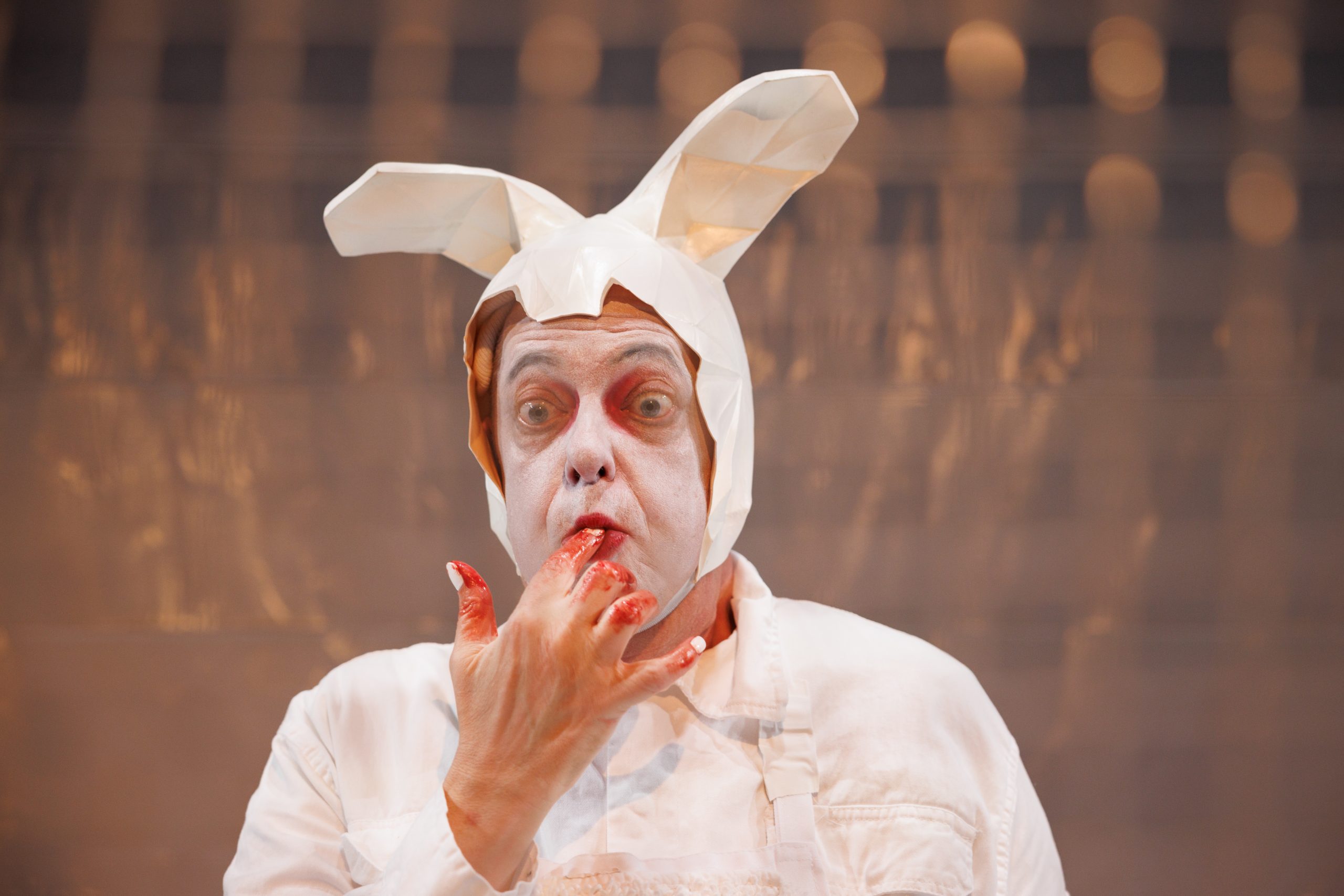
The production design of Spider Rabbit at La MaMa could easily be used for a children’s birthday party. I mean this as a compliment. Immediately after being blinded by a row of white plastic streamers, I was greeted by an inflatable rabbit and sparkly spider, with their titular name spelled out above in cardboard letters hung from a string. When I do meet the actual eponymous being, played by the all-encompassing Tony Torn, he basically just looks like a rabbit (I was charmed by Torn’s bathmat apron tummy, designed by the actor, an endearing touch). More specifically, a rabbit that just put on his mother’s powder and lipstick for the first time. But, Spideryness comes from within, we’ll soon find out. Torn is a pervasive performer not only in his storied, varied work, but because of his seemingly inherent ability to jump from and between emotional states without ever losing sight of his character. Torn does not turn anything on or off for the sake of the performance. He simply traverses, using the text as his guide. And a sullied one at that.
Spider Rabbit originated in 1971, as part of a short play collection by Michael McClure titled Gargoyle Cartoons. All eleven plays tell the plights and delights of strange creatures. Spider Rabbit’s trials are of a hostage situation. Carrying a PeeWee-esque coyness at the jump, Torn presents as a children’s entertainer, backed up by lively sound effects resembling those often found in overstimulating, kid-oriented Youtube vlogs. Spider Rabbit wants to say hi and show us what’s in his duffel bag, though he finds it necessary to repeat said goals over and over again. Very quickly, we come to understand this creature to be a dissociative schizophrenic of sorts, easily distracted by life’s simple pleasures (the feel of a wig, using a spoon to scratch his back, his own flatulence which went on just a bit longer than anyone would really like), and haunted by a recurring knock, random blurts of light, and the feedback of his own mic. Just when we think he’s in control, he seems to lose it completely, over and over again. Even whilst rifling through his precious duffle bag (a copy of Melania, his signed copy of Mein Kampf, a scholarship to the Ancient Mystic Order of Roscrucius, a religious tradition concerned with transcendental consciousness and reincarnation), he’s just as surprised as we are at what he uncovers. After pulling out hand grenade after grenade that he doesn’t remember packing, Torn, matter of factly states that “there are three hand grenades on the table” with a sigh of resignation that allows us, most clearly, to see the performer at work. It was my favorite line reading of the evening.
Watching Torn tear through his duffel bag, I couldn’t stop thinking about how much my students would love this performance. I teach K-5 part time at two South Brooklyn public schools, where the youths have adopted a sort of dadaist pop culture, rooted in the reappropriation of random sports memes, political scandals, rap lyrics (SIX SEVENNNN) and the ironic worship of AI slop. One such form, known as Italian Brainrot, consists of AI-generated characters that are composites of animals, objects, or figures, for instance Ballerina Cappucina, or Bombardiro Crocodilo. Spider Rabbit fits in pretty well amongst this cast of characters under these requirements. Perhaps his place is as the elder brainrot.
Like the countless animated short form videos across social media platforms, Rabbit engages in violence. He lies, steals, seduces, sabotages, and punishes, using both physical and verbal violence. Unlike the Brainrots, though, Spider Rabbit is the only one who goes as far as to kill.
Near the play’s climax, Rabbit reveals that what appeared as a mannequin head affixed with a wig was actually a young soldier trapped underneath the table. Torn cuts open his head with a swift motion, and confetti blood sprays out as Torn savors on his gelatinous brain (it honestly looked delicious). Spider Rabbit seems to blame this young, spindly soldier for the nondescript war hovering around the play, and the death as a means to hold him accountable for the larger crimes and fallacies created by even larger powers at be. What brought this on? Is this because the soldier was in closest vicinity, or does Spider Rabbit simply hold all traces of complicity to the same level of blame?
After this carnage, Spider Rabbit is greeted by a Vision (poetess supreme and Torn’s wife, Lee Ann Brown), who accosts him for his recklessness, before forgiving him, quickly. “Within yourself you are generous, Spider Rabbit.” This is easy to believe. This is a being who is trying to reach us. We all hate war, right? And yet, that very hatred creates a violent urge within Spider Rabbit that, through the performance, is often turned on the audience through thinly veiled threats, like when Rabbit saws off a carrot and gives it to an audience member. Or when another viewer is subjected to watching Torn mime stuffing said viewers body into a bag easily accessible in his own bag. Still, this urge towards sadism was easy to understand. It is much easier and more fulfilling to imagine an antagonist dead and gone than to imagine said figure with a changed mind and heart.
I write this bedbound post wisdom teeth removal, loopy and swollen. I’ve learned beat poetry is a great form to consume prior to a temporarily debilitating medical procedure. I will also say that what’s really weighing on me is how much a performance art considered “experimental” has failed to really come up with new experiments since McClure’s time. If I were to show my students this piece, they would guess that Torn is a Twitch streamer and that someone like Hasan Piker wrote the text. It seems like as long as our sociopolitical system spins the way it has and does, our “experiments” will remain in a contained loop, unable to break out into new conclusions. But to imagine this piece, in particular, through the eyes of a child–perhaps this is the dramaturgy of it all–gives way to a tender, simple message: it is very easy to believe in something that makes one feel all powerful. I do restorative justice work with my students and, when accused of bullying or some form of harassment, they admit that they don’t fully understand why they do it, but continue anyways because it feels great. And it does, especially at an age where the consequences of said actions are not as severe or tangible. To relinquish that, though, is to truly understand oneself: Torn loses his ears following his apology streak to the Vision and the universe at large.
In submitting to humility, in acknowledging his smallness and the actions borne as a means of claiming something that is unavailable, he seems to understand something new about himself. But this happens in a flash, just as the lights dim. There is no opportunity for an audience to see this change in action. Again, this is a valid dramaturgical impulse, but keeps the loop that this piece’s discipline lives in closed off and cyclical. This all to say that I think this piece could and should be adapted for Theatre for Young Audiences. “You must learn gentleness, Spider Rabbit”, the Vision urges him. We must, for our own sakes and that of young people learning for the first time that they may be trapped.
Photo by Maria Baranova.
Leave a Reply